Oldest buildings in NYC: 13 still standing, oldest first
The oldest buildings in NYC start with the Wyckoff House in Brooklyn, built around 1652. In Manhattan, the oldest is Fraunces Tavern (1719, much rebuilt) and the oldest house is the Morris–Jumel Mansion (1765). Here are 13 still standing, oldest first, and whether you can go in.
The first three are the oldest in the city. After them come the old landmarks of Lower Manhattan, Central Park and Fifth Avenue, in the order they went up, ending in 1913. A few more colonial farmhouses survive in Brooklyn, Queens and Staten Island. Each place with a page of its own links to its full story.
Oldest buildings in NYC, in order
Wyckoff House
Why it matters. It's the oldest building in New York City, and in New York State: a Dutch farmhouse in East Flatbush, Brooklyn, older than the city's English name.
What the record shows. Tree rings in its timbers date it to about 1652, though Wikipedia's own article estimates before 1641. Wouter van Twiller, the director of New Netherland, bought the land from the Lenape around 1636, and Pieter Claesen Wyckoff's family moved in around 1652. When New York began naming landmarks, on October 14, 1965, this house got number 0001. It became a National Historic Landmark in 1967.
Visiting. Yes, as a museum in a park of an acre and a half, run by the Wyckoff House & Association. Its website gives no regular hours, so check before you go.
Fraunces Tavern
Why it matters. George Washington said goodbye to his officers in its Long Room on December 4, 1783, nine days after the last British troops left New York.
What the record shows. Stephen DeLancey built it as a house in 1719. Samuel Fraunces bought it in 1762 and made it a tavern, the Queen's Head. The Sons of the Revolution bought it in 1904 and rebuilt it by 1907, so thoroughly that the critic Ada Louise Huxtable wrote in 1965 that it was built "virtually from scratch". A 2021 study found more of the original than that, Dutch brick included. On January 24, 1975, a bomb next door, claimed by the FALN, killed four people.
Visiting. Yes. The museum upstairs, with the Long Room, is open every day from noon to 5 p.m., and there's a bar and restaurant downstairs.
Morris–Jumel Mansion
Why it matters. The oldest house in Manhattan stands on a hill in Washington Heights, where George Washington planned a battle and Aaron Burr got married.
What the record shows. Roger Morris, a British officer, built it in 1765 as a home for himself and his wife, Mary Philipse Morris, and called it Mount Morris. Washington moved in on the night of September 14, 1776, planned the Battle of Harlem Heights here, and left about five weeks later as the British advanced. Eliza Jumel married Aaron Burr in its parlor on July 3, 1833. She filed for divorce the next year.
Visiting. Not inside, for now: the mansion is temporarily closed and its $10 self-guided tours are on hold. The grounds are open from 10 a.m. to 5 p.m., and a $25 guided walk runs on Saturdays.
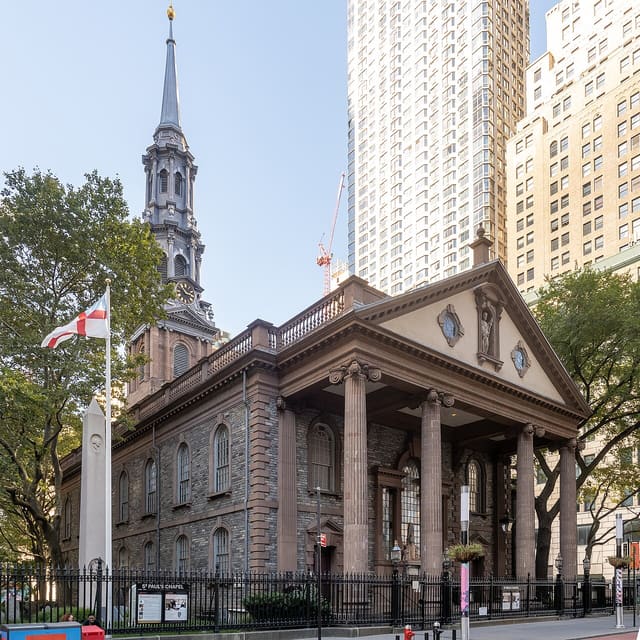
Photo: ajay_suresh, CC BY 2.0, via Wikimedia Commons St. Paul's Chapel
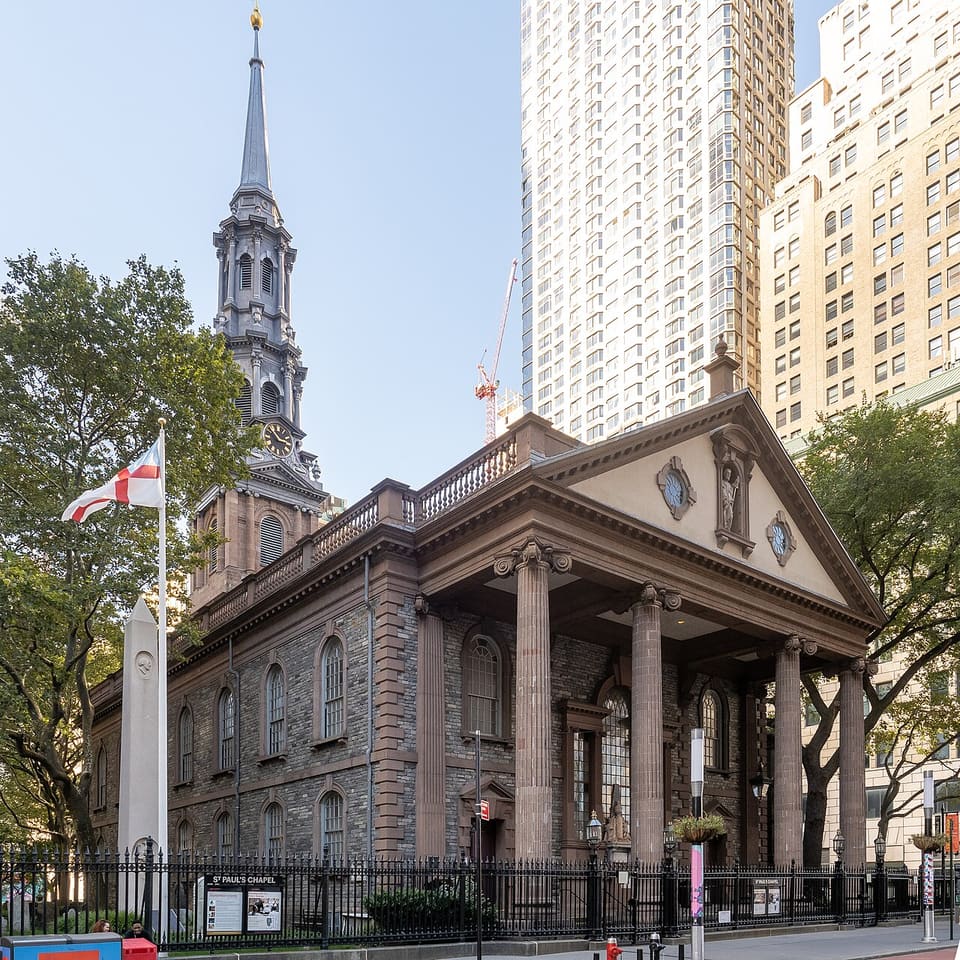
Why it matters. Manhattan's oldest surviving church, where George Washington prayed on the day he became president, and two centuries later a refuge for the people working at Ground Zero.
What the record shows. It was finished in 1766 as a chapel-of-ease for Trinity Church, on land granted by Queen Anne, and it came through the Great Fire of 1776 that destroyed Trinity. Washington worshipped here on Inauguration Day, April 30, 1789. On September 11, 2001, it lost no windows, largely because a sycamore tree took the falling debris; then volunteers served recovery workers here around the clock for nine months. The 1790 wooden statue of Saint Paul moved indoors in 2016.
Visiting. Yes, every day from 8:30 a.m. to 6 p.m.; the churchyard is open from 8:30 a.m. to 4 p.m. There's a security check at the door.
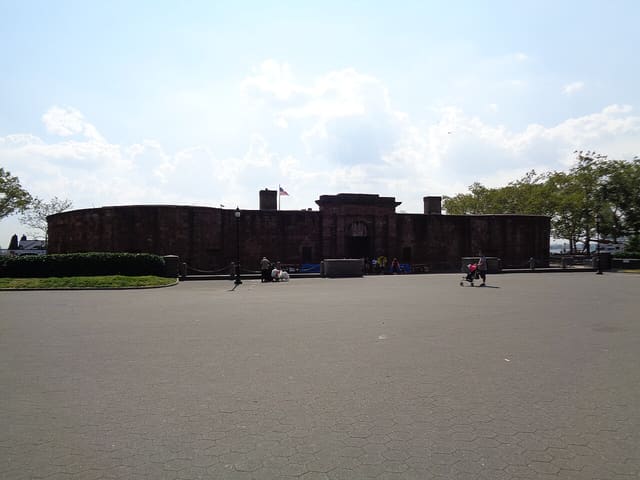
Photo: Tdorante10, CC BY-SA 4.0, via Wikimedia Commons Castle Clinton in the Battery
Why it matters. This round sandstone fort has been a fort, a concert hall and America's first immigration station, and it's where you buy tickets for the Statue of Liberty ferry.
What the record shows. It went up from 1808 to 1811 on a small artificial island off Lower Manhattan, in red New Jersey sandstone, with 28 heavy cannon, and it never fired a shot in the War of 1812. It reopened in 1824 as Castle Garden, where 6,000 people honored Lafayette, Samuel Morse showed off his telegraph, and Jenny Lind sang her first American concerts in 1850. From 1855, decades before Ellis Island, it was America's first immigration station: more than 7.5 million people came through by 1890.
Visiting. Free, every day from 7:45 a.m. to 5 p.m. (closed Thanksgiving and Christmas). The ferry tickets are sold here, with airport-style security before you board.
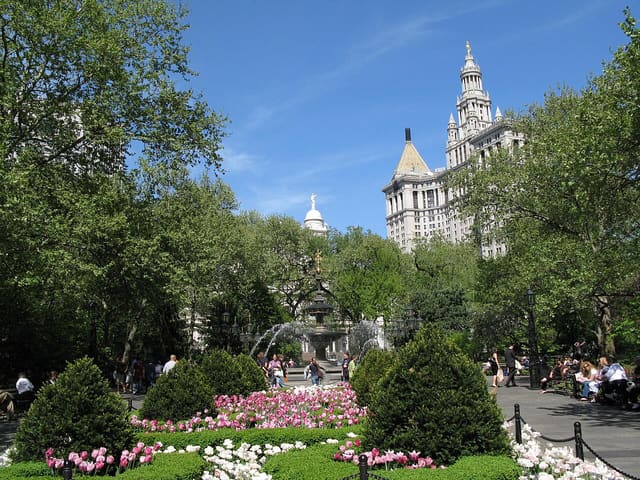
Photo: Momos, CC BY-SA 3.0, via Wikimedia Commons City Hall Park
Why it matters. City Hall, finished in 1812, still runs New York, and the park around it is the old commons, where the Declaration of Independence was read on July 9, 1776, with more than 150 British ships in the harbor.
What the record shows. New Yorkers protested the Stamp Act on the commons in 1765 and celebrated its repeal in March 1766, when the Sons of Liberty raised a Liberty pole outside the soldiers' barracks. British soldiers kept chopping it down, and it was replaced five times; a 1921 replica stands between City Hall and Broadway. When slavery was abolished in New York on July 4, 1827, people celebrated here for two days.
Visiting. The park is open to everyone. City Hall itself opens on tours booked ahead, 20 people at most: Wednesdays at noon and Thursdays at 10 a.m.
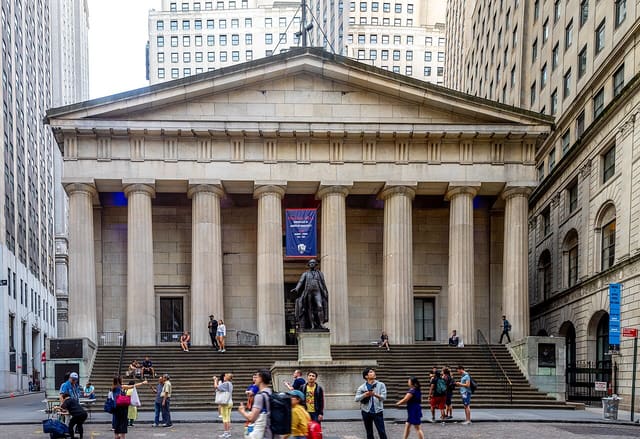
Photo: Ajay Suresh from New York, NY, USA, CC BY 2.0, via Wikimedia Commons Federal Hall
Why it matters. On April 30, 1789, George Washington took the oath as the first president here, on the balcony of the building that stood on this spot.
What the record shows. Pierre Charles L'Enfant rebuilt the old City Hall as Federal Hall in 1788 and 1789, with four Doric columns and a balcony over the street. The First Congress met inside from March 1789, proposed the Bill of Rights there, and adopted the plan for a capital on the Potomac. That building came down in 1812. The marble one you see was finished in 1842 as the New York Custom House.
Visiting. Free. The National Park Service runs it, but its open days differ from page to page, so call 212-825-6990 before you go. The statue of Washington on the steps is there whenever you pass.
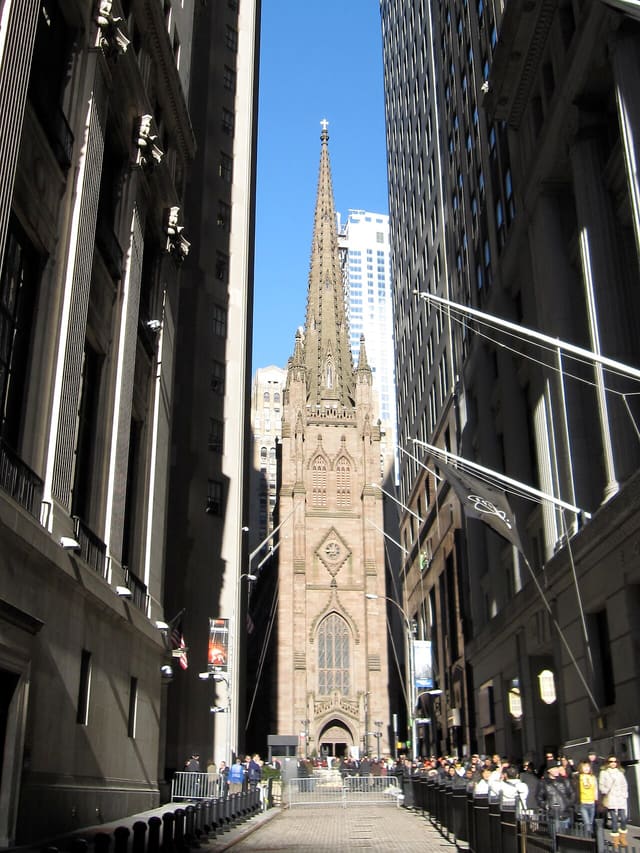
Photo: Gryffindor (Public domain), via Wikimedia Commons Trinity Church
Why it matters. Alexander Hamilton is buried in its churchyard, and when it was finished its spire made it the tallest building in the country.
What the record shows. King William III chartered the parish in 1697, for a yearly rent of 60 bushels of wheat, and Captain William Kidd lent the tackle from his ship to hoist the stones of its first church. Queen Anne raised its land to 215 acres of Manhattan in 1705, and King's College, now Columbia, was founded on its grounds in 1754. The church you see was finished in 1846 and was the tallest building in the United States until 1869.
Visiting. Yes, every day from 8:30 a.m. to 4 p.m., after a security check. The churchyard, with the graves of Alexander and Eliza Hamilton and Angelica Schuyler Church, is open until 6 p.m.
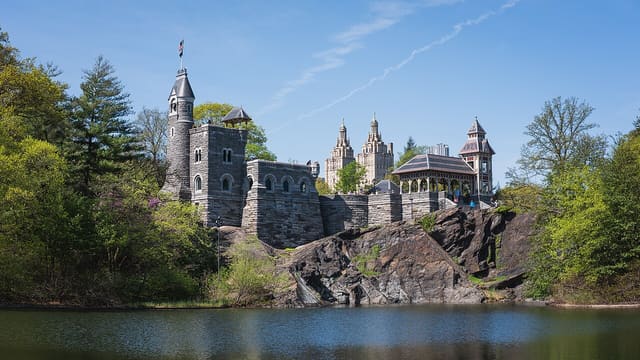
Photo: Christian David, CC BY-SA 4.0, via Wikimedia Commons Belvedere Castle
Why it matters. Central Park's castle was built for the view, which is what belvedere means in Italian, and from 1919 it was the park's official weather station.
What the record shows. Calvert Vaux and Jacob Wrey Mould designed it in 1867, in Manhattan schist quarried in the park, and it was finished in 1872 as an open-air lookout with no doors or windows. A second, western tower was cut in 1870 to save money. The U.S. Weather Bureau moved in in 1919; after its instruments were automated in the 1960s the castle closed and fell apart, until the Central Park Conservancy reopened it in 1983.
Visiting. Yes, every day from 10 a.m. to 5 p.m. (closed Thanksgiving, Christmas and New Year's Day). The park itself is open from 6 a.m. to 1 a.m.
Stop 7 of Central Park Walking Tour: The Pond to Belvedere Castle
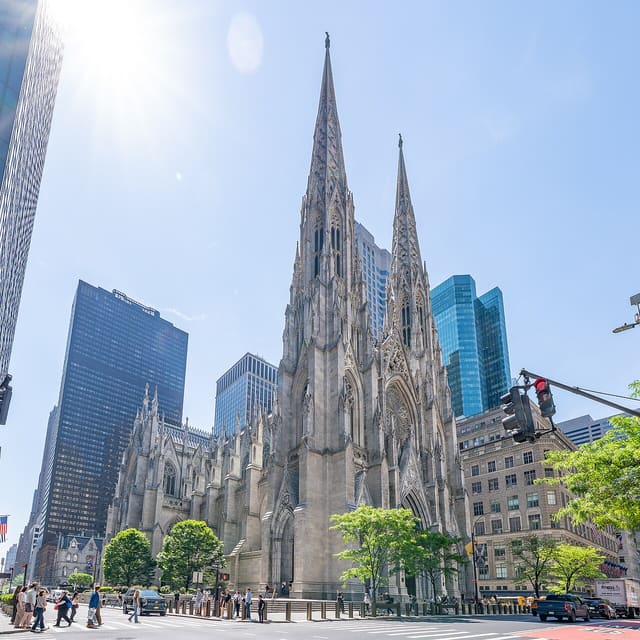
Photo: Ajay Suresh, CC BY 4.0, via Wikimedia Commons St. Patrick's Cathedral
Why it matters. New York's Catholic cathedral faces Rockefeller Center across Fifth Avenue, its spires about 330 feet high, and it took 52 years to go from cornerstone to consecration.
What the record shows. Archbishop John Hughes chose the site as early as 1850 and laid the cornerstone in August 1858 before 100,000 people. James Renwick Jr. drew on the unfinished cathedral in Cologne. Work stopped during the Civil War, and 103 citizens pledged $1,000 each to finish it, two of them not Catholic. The doors opened in 1879, before the spires were added, and it was consecrated on October 5, 1910, once the debt was paid.
Visiting. Yes, and it's free to go in. It opens early and stays open into the evening; check the cathedral's site for Masses and events that close parts of it.
Stop 6 of Rockefeller Center Christmas Walk: The Tree, the Windows and Fifth Avenue
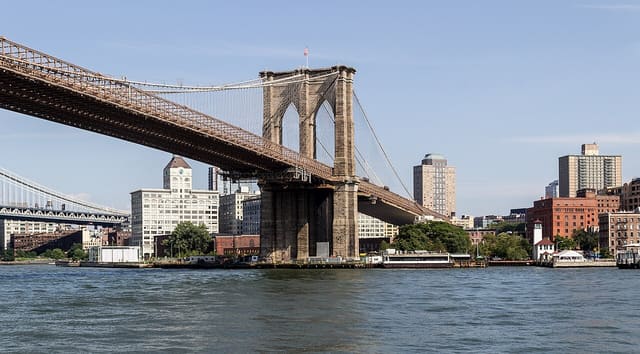
Photo: Dietmar Rabich, CC BY-SA 4.0, via Wikimedia Commons Brooklyn Bridge
Why it matters. When it opened on May 24, 1883, it was the longest suspension bridge in the world and the first fixed crossing of the East River.
What the record shows. John Roebling, who designed it, was injured at the site in 1869 and died of tetanus. His son Washington took over, got caisson disease and was left bedridden, so his wife, Emily Warren Roebling, carried his instructions to the engineers and ran the daily work for more than ten years. In 1882 she argued officials out of removing him, and she was the first to cross by carriage, holding a rooster.
Visiting. Yes, free, and the walkway is open at all times. From Manhattan, most people start on Centre Street, across from City Hall.
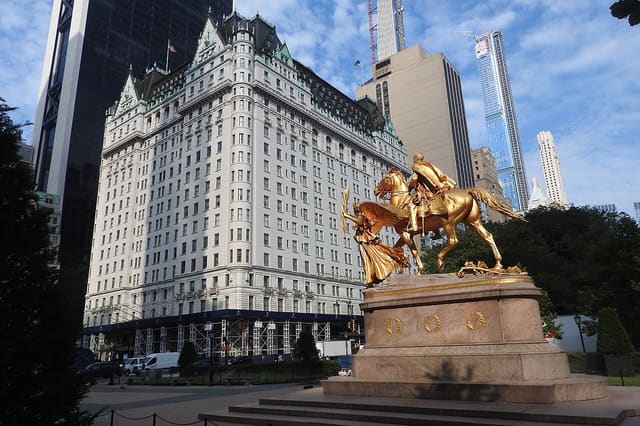
Photo: Jim.henderson, CC BY-SA 4.0, via Wikimedia Commons The Plaza Hotel
Why it matters. It's the hotel Kevin McCallister checks into in Home Alone 2, a French château in white brick at the corner of Central Park.
What the record shows. Henry Janeway Hardenbergh designed it, with a mansard roof and rounded corner turrets, and it opened on October 1, 1907, replacing an earlier Plaza on the same spot. At its peak it had more than 800 rooms; since a 2008 renovation it has 282 hotel rooms and 181 condominiums, whose entrance is at One Central Park South. The Pulitzer Fountain, topped by a bronze goddess, stands beside it in Grand Army Plaza.
Visiting. Without a room, yes: the Palm Court serves afternoon tea and evening drinks, booked on OpenTable, from 8:30 a.m. to midnight. Breakfast there is for hotel guests.
Stop 9 of Rockefeller Center Christmas Walk: The Tree, the Windows and Fifth Avenue
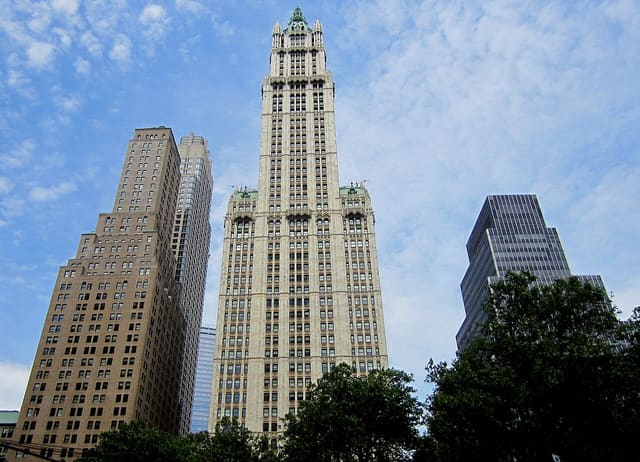
Photo: Martin Furtschegger, CC BY 3.0, via Wikimedia Commons Woolworth Building
Why it matters. The Cathedral of Commerce, paid for by five-and-dime stores, was the tallest building in the world for 16 years.
What the record shows. Frank W. Woolworth built it as his company's headquarters. Early plans called for 12 to 16 stories; in January 1911 the height was set at 792 feet. It opened on April 24, 1913, and stayed the world's tallest until 40 Wall Street and the Chrysler Building passed it at the end of the 1920s. In 1916 the Reverend S. Parkes Cadman gave it its nickname. It has its own ZIP code, 10279, and its top 30 floors became homes after a 2012 sale.
Visiting. Only on a tour: there's no public access, but 90-minute lobby tours ($45) run on weekends and one night a week.
The map
The numbers are the list's. Colored pins have a page of their own with the full story; open the map to zoom into the streets.
Walk them with Dot
7 of the 13 places on this list are stops on our Brooklyn Bridge and Lower Manhattan Walking Tour (9 stops, 1 h 24 min). Dot, the green dot on your map, takes you from one to the next and plays each story when you get there. Stop 1, Brooklyn Bridge, is free: hear it before you go.
1 of the 13 places on this list is a stop on our Central Park Walking Tour: The Pond to Belvedere Castle (8 stops, 1 h 18 min). Stop 1, The Pond and Gapstow Bridge, is free: hear it before you go.
2 of the 13 places on this list are stops on our Rockefeller Center Christmas Walk: The Tree, the Windows and Fifth Avenue (9 stops, 1 h 7 min). Stop 1, Bryant Park, is free: hear it before you go.
Oldest buildings in NYC: questions people ask
What is the oldest house in New York?
The Wyckoff House at 5816 Clarendon Road in East Flatbush, Brooklyn, a Dutch farmhouse whose timbers date it to about 1652. It's the oldest building in the city and the state, and in 1965 it became New York City landmark number 0001.
What is the oldest building in Manhattan?
Fraunces Tavern, at 54 Pearl Street, built as a house in 1719. It was rebuilt so heavily between 1904 and 1907 that critics have called it a reconstruction, though a 2021 study found original Dutch brick. The oldest church is St. Paul's Chapel, from 1766.
What is the oldest surviving house in Manhattan?
The Morris–Jumel Mansion, built in 1765 at what is now 65 Jumel Terrace in Washington Heights. The Dyckman Farmhouse in Inwood, from about 1784, is the last farmhouse left in Manhattan.
Do any Gilded Age mansions still exist in NYC?
Yes, on and off Fifth Avenue. Andrew Carnegie's (1902, 2 East 91st Street) is the Cooper Hewitt museum, Henry Clay Frick's (1912 to 1914, 1 East 70th Street) holds the Frick Collection, and James B. Duke's (1912, 1 East 78th Street) belongs to NYU's Institute of Fine Arts.
Can you see the oldest buildings in NYC on your own?
Yes. Most are free to walk past or into. Our Brooklyn Bridge and Lower Manhattan walk stops at eight of them in about 2.4 miles and 84 minutes, and its first stop is free.
Where these facts come from
The record for each place is what our fact-check matched to a source in its story (the place's page lists them), or a page we read on the day below. Hours and prices change: check the official site before you go.
- Wikipedia: List of the oldest buildings in New York
- Wikipedia: Wyckoff House
- Wyckoff House Museum
- Wikipedia: Fraunces Tavern
- Fraunces Tavern Museum
- Wikipedia: Morris–Jumel Mansion
- Morris-Jumel Mansion: visit
- Wikipedia: St. Paul's Chapel
- Trinity Church Wall Street: St. Paul's Chapel
- Wikipedia: Castle Clinton
- National Park Service: Castle Clinton, plan your visit
- Wikipedia: City Hall Park
- NYC Public Design Commission: City Hall tours
- Wikipedia: Federal Hall
- National Park Service: Federal Hall, basic information
- Wikipedia: Trinity Church
- Trinity Church Wall Street: Trinity Church
- Wikipedia: Belvedere Castle
- Central Park Conservancy: Belvedere Castle
- Wikipedia: St. Patrick's Cathedral
- Wikipedia: Brooklyn Bridge
- Wikipedia: Emily Warren Roebling
- NYC DOT: Brooklyn Bridge
- Wikipedia: Plaza Hotel
- The Plaza: the Palm Court
- Wikipedia: Woolworth Building
- Downtown Alliance: Woolworth Building lobby tours (2026-07-13)
- Wikipedia: Dyckman House
Checked November 2026. More in town: New York City.