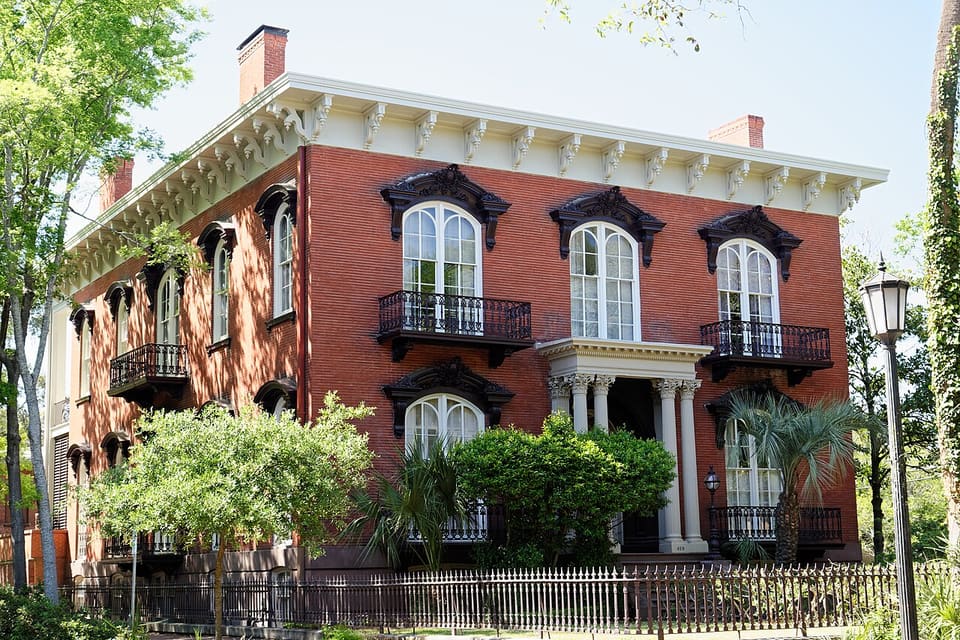
Historic sites in Savannah: the 12 to see, square by square
The historic sites in Savannah to see first are Mercer House, of Midnight in the Garden of Good and Evil; Chippewa Square, where Forrest Gump sat on his bench; and Johnson Square, the city's first, laid out in 1733. Here are 12, most a few blocks apart.
The best-known come first. All of them are in the Historic District, and most sit on or just off Bull Street, so you can walk the whole list in an afternoon. Each one has a page of its own with the full story; here is what happened there and what it costs to go in.
Historic sites in Savannah, in order
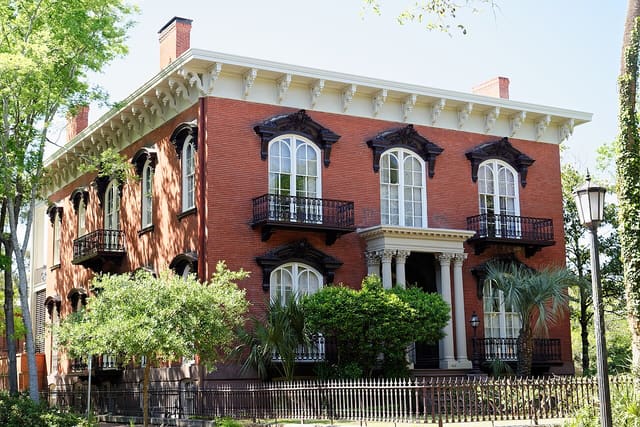
Photo: Bubba73, CC BY-SA 3.0, via Wikimedia Commons Mercer House
Why it matters. It's the house in Midnight in the Garden of Good and Evil, John Berendt's 1994 book that spent 216 weeks on the New York Times bestseller list, and it faces Monterey Square.
What the record shows. Building began in 1860 for General Hugh Mercer, great-grandfather of the songwriter Johnny Mercer. The Civil War stopped it, and a cotton merchant, John Randolph Wilder, finished it around 1868. In 1969 the antiques dealer Jim Williams bought it for about $55,000 and spent two years restoring it. In 1981 he shot and killed Danny Hansford inside. He was tried four times; the fourth trial, moved away from Savannah's jury pool, ended in acquittal.
Visiting. Yes, on 35-minute guided tours from 10:30 a.m. (noon on Sunday), $14.95 for adults, first come, first served. Tickets and the way in are behind the house, at 430 Whitaker Street.
Stop 7 of Haunted Savannah Walking Tour
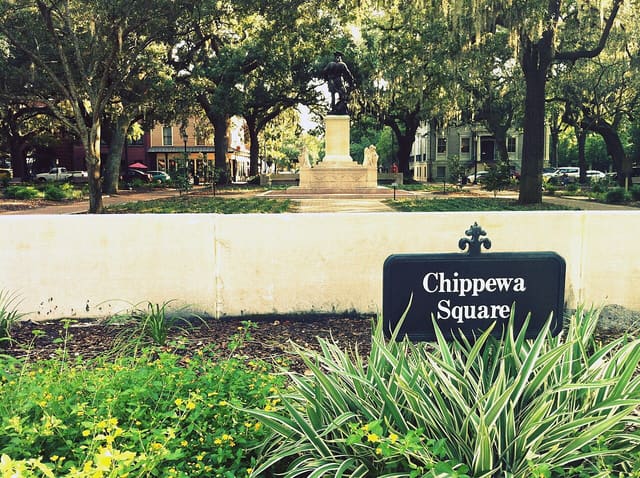
Photo: Alecconnell, CC BY-SA 3.0, via Wikimedia Commons Chippewa Square
Why it matters. Forrest Gump sat on his bench and told his life story on the north side of this square in the 1994 film. It's also where Savannah put up the statue of the man who founded it.
What the record shows. The square was laid out in 1815 and named for American soldiers killed at the Battle of Chippawa in the War of 1812. The Oglethorpe Monument, by the sculptor Daniel Chester French and the architect Henry Bacon, was unveiled in 1910; to make room, the city moved two busts of Confederate officers to Forsyth Park. Oglethorpe faces south, toward Spanish Florida, with his sword drawn. The bench was a fiberglass prop.
Visiting. Free; it's a public square on Bull Street. The bench isn't here: one of the props is in the Savannah History Museum, beside the visitor center.
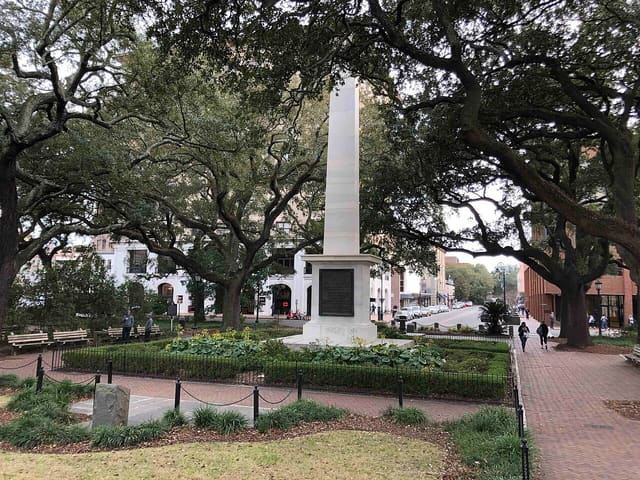
Photo: Tjbliss, CC BY 4.0, via Wikimedia Commons Johnson Square
Why it matters. This is where Savannah began: the first square the colonists laid out, still the largest of the 22, with a Revolutionary War general buried under its obelisk.
What the record shows. Oglethorpe's plan repeated one unit, the ward: a square in the middle, four blocks of houses and four blocks for public buildings. Savannah laid out 24 of them in all. The Marquis de Lafayette laid the obelisk's cornerstone in 1825, and for years it honored both Nathanael Greene and Casimir Pulaski. Greene's name was carved on it in 1886, and in 1901 he and his son were reburied beneath it. On November 8, 1860, the first flag of independence raised in the South flew here.
Visiting. Free; it's a public square on Bull Street, a short walk south of City Hall.
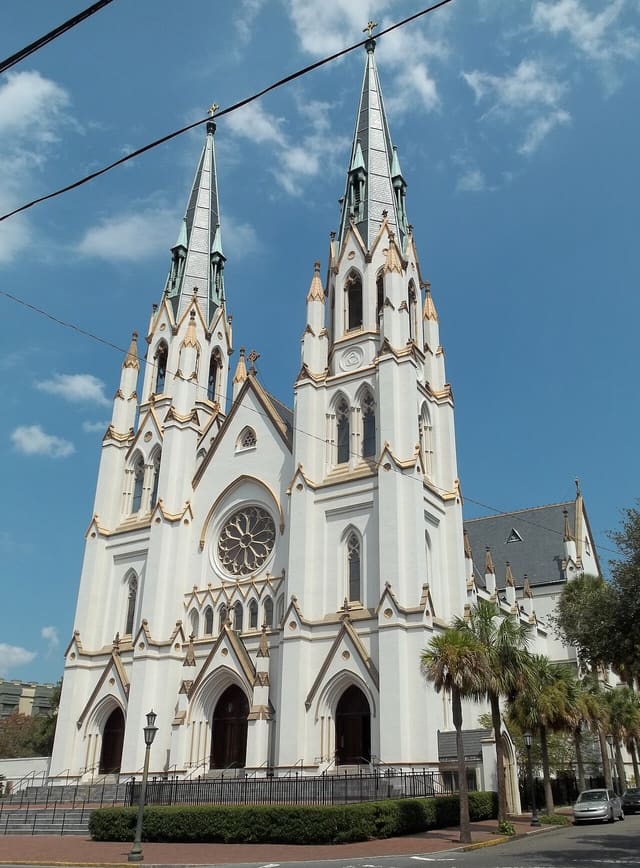
Photo: Ebyabe, CC BY-SA 3.0, via Wikimedia Commons Cathedral of St. John the Baptist
Why it matters. Its two spires climb about 214 feet over Lafayette Square, in a colony whose 1732 charter barred Catholics from living there at all.
What the record shows. Pope Pius IX created the Diocese of Savannah in July 1850, with St. John's as its cathedral. The present church's cornerstone was laid in 1873, and it was dedicated in 1876 as the Cathedral of Our Lady of Perpetual Help; the name went back to St. John the Baptist in 1883, because the Vatican had never approved the new one. A fire destroyed the inside on February 6, 1898. In January 2020 Pope Francis made it a basilica.
Visiting. Yes, and it's free, with a $3 donation suggested: Monday to Saturday from 9 to 11:30 a.m. and 1 to 4:30 p.m., Sunday from 1 to 4:30 p.m. It closes to visitors during Masses, weddings and funerals.
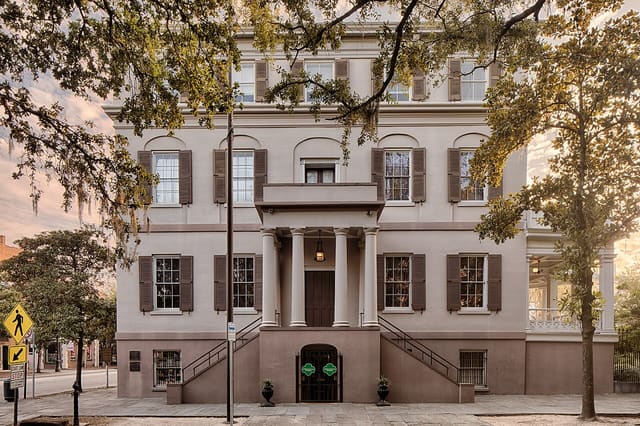
Photo: KWhiteJGLB, CC BY-SA 4.0, via Wikimedia Commons Juliette Gordon Low Birthplace
Why it matters. Juliette Gordon Low, Daisy to her family, was born here in 1860. Fifty-two years later she started the club that became the Girl Scouts of the USA.
What the record shows. The house was built in 1820 for James Moore Wayne, then the mayor and later a Supreme Court justice, who sold it in 1831 to his niece Sarah Gordon and her husband. Juliette's parents added a third story in 1886, the year she married William Mackay Low and moved to Britain. In 1912 she gathered girls from her cousin Nina Pape's school to tell them about a new club. The Girl Scouts bought the run-down house in 1953 and opened it as a museum on October 19, 1956.
Visiting. Yes, every day from 10 a.m. to 5 p.m.; guided tours are $15 for adults. Allow about an hour.
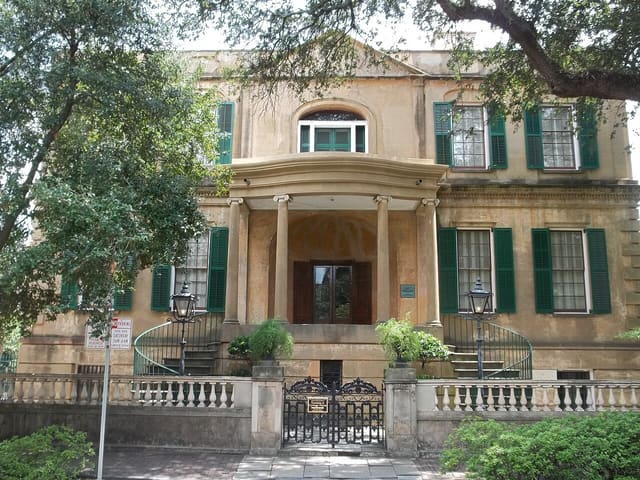
Photo: Ebyabe, CC BY-SA 3.0, via Wikimedia Commons Owens-Thomas House
Why it matters. Behind a Regency mansion on Oglethorpe Square are some of the oldest and best-preserved urban slave quarters in the South, with a blue ceiling that is the reason many people come.
What the record shows. The English architect William Jay designed it, and it was built from 1816 to 1819 for Richard Richardson, who sold it after the Panic of 1819, a yellow fever epidemic, a great fire, and the deaths of his wife Frances and two of their children. In 1825 Lafayette spoke to Savannah from its cast-iron veranda. A 1990s renovation uncovered the slave quarters; their haint blue ceiling is the largest known swath of the paint in North America.
Visiting. Yes, on guided tours that leave every 15 minutes from 10 a.m. (the last at 4), closed Mondays, 12 people at most. The Telfair's $30 adult ticket covers this house and its two other museums for seven days. There's no elevator.
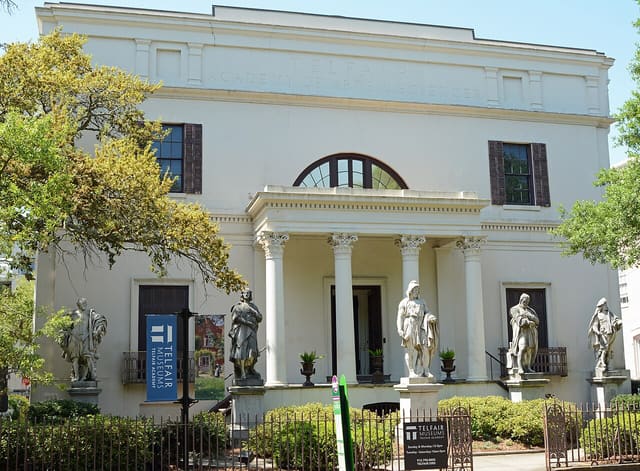
Photo: Bubba73 (Jud McCranie), CC BY-SA 4.0, via Wikimedia Commons Telfair Academy
Why it matters. It's the oldest public art museum in the South, in a house on Telfair Square that one woman gave away.
What the record shows. William Jay designed the house around 1818 for Alexander Telfair, son of Edward Telfair, one of Georgia's first governors, on the site of the colonial royal governors' residence. Mary Telfair left the house and its collections to the Georgia Historical Society in 1875. The architect Detlef Lienau remodeled and enlarged it, the painter Carl Ludwig Brandt was elected its first director in 1883, and it opened, free, in 1886. Statues of Rembrandt, Rubens, Phidias, Raphael and Michelangelo stand out front.
Visiting. Yes. The $30 adult ticket covers the Telfair Academy, the modern Jepson Center and the Owens-Thomas House for seven days, as often as you like. The Academy is open Tuesday to Sunday, 10 a.m. to 5 p.m.
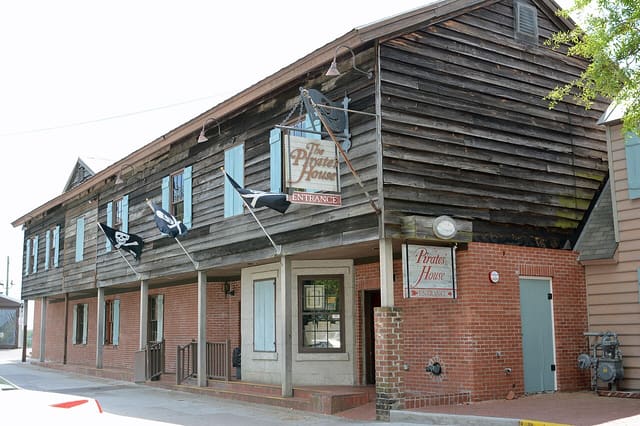
Photo: Bubba73 (Jud McCranie), CC BY-SA 4.0, via Wikimedia Commons The Pirates' House
Why it matters. In Savannah lore, Captain Flint of Treasure Island spent his last days here, and the ghost walks start at its door.
What the record shows. This was the edge of the Trustees' Garden, the ten acres Oglethorpe set aside in 1733 for an experimental garden modeled on the Chelsea garden in London, with mulberry trees for silk. The silk and wine failed, though peaches and cotton did well, and by the late 1730s the garden was out of use. The restaurant says an inn for sailors opened here around 1753; sources disagree on whether its Herb House dates from 1734 or 1853. A secret chamber found under the building during remodeling has no known purpose.
Visiting. Yes, as a restaurant, open every day from 11 a.m. It has been one since 1953.
Stop 1 of Haunted Savannah Walking Tour
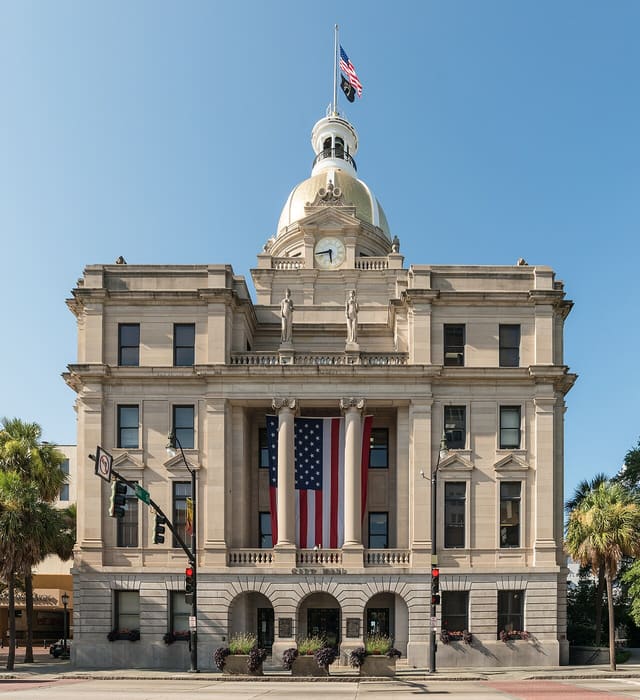
Photo: DXR, CC BY-SA 4.0, via Wikimedia Commons Savannah City Hall
Why it matters. Its gold dome stands at the top of Bull Street, where the city's grid meets the river bluff, and it was the first building Savannah ever built only to run the city.
What the record shows. It stands where the City Exchange stood from 1799 until it was torn down in 1904. Hyman Witcover designed it; the cornerstone went down on August 11, 1904, and it opened on January 2, 1906, at a cost of more than $250,000. Mayor Herman Myers said it stood for the Savannah of "indomitable energy". Four chariot statues were planned for the corners of the roof, but the money ran out. The dome has been covered in gold leaf since 1987.
Visiting. It's a working city hall. Look at it from Bay Street, or from River Street below the bluff, looking up.
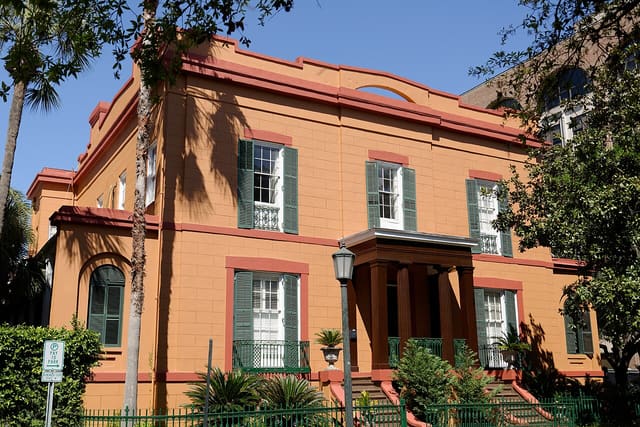
Photo: Jud McCranie, CC BY-SA 4.0, via Wikimedia Commons Sorrel-Weed House
Why it matters. At about 10,000 square feet it's among the largest houses in Savannah, and the feather that drifts across the sky at the start of Forrest Gump was filmed from its roof.
What the record shows. Charles Cluskey, who also designed the old Governor's Mansion in Milledgeville, designed it for the shipping merchant Francis Sorrel. Henry Weed agreed to buy it in 1859, and his family kept it until 1914. Ghost tours tell of Molly, an enslaved woman, but no record tied to the Sorrel family mentions her, and archaeologists who dug the dip in the carriage-house floor called her grave found a trash pit. The records do name others: Sorrel sold Minda, Louisa and a ten-month-old girl, Virginia.
Visiting. Yes, on tours: a history tour ($14) and a nightly ghost tour of an hour and a quarter ($35, ages 10 and up). Meet in the courtyard on the Bull Street side.
Stop 6 of Haunted Savannah Walking Tour
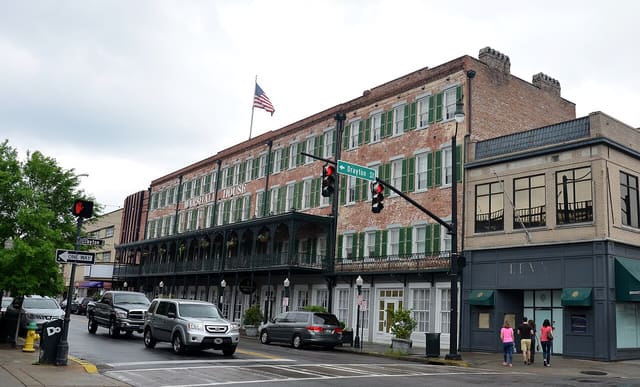
Photo: Roman Eugeniusz, CC BY-SA 3.0, via Wikimedia Commons The Marshall House
Why it matters. Savannah's hotel of 1851 was a Union Army hospital at the end of the Civil War, which is what brings the ghost walks to its door.
What the record shows. Mary Magdalene Marshall, a Savannah property owner who lived to 93, opened it in the early 1850s. In 1857 the proprietor Ralph Meldrim added an iron veranda 12 feet high and 120 feet long. The Union Army used it as a hospital from 1864 through 1865. It closed in 1957, and its upper three floors stood empty above working shops until a restoration in 1999. The veranda and gas lamps are copies, and an 1830 portrait of Mary Marshall from Jim Williams's estate hangs in the lobby.
Visiting. It's a working hotel on Broughton Street. The veranda is best seen from the other side of the street.
Stop 2 of Haunted Savannah Walking Tour
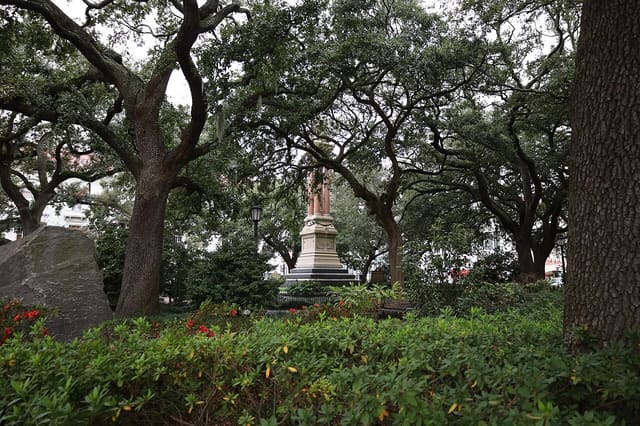
Photo: Antony-22, CC BY-SA 4.0, via Wikimedia Commons Wright Square
Why it matters. Tomochichi, the Yamacraw chief who gave Oglethorpe the land Savannah stands on, is buried in the middle of this square.
What the record shows. It was one of the first four squares, laid out in 1733. Tomochichi led a town of about 200 Creek and Yamasee people on Yamacraw Bluff, and with Mary Musgrove interpreting he gave the English settlers land to build on. He died in 1739 and was buried here with military honors. In 1883 his marker was taken away for the William Washington Gordon Monument. Nellie Gordon and the Colonial Dames put up a granite monument to him in 1899; the quarry billed her a dollar or 50 cents, payable on Judgment Day.
Visiting. Free; it's a public square on Bull Street. Tomochichi's granite stone is in the southeast corner.
Stop 3 of Haunted Savannah Walking Tour
The map
The numbers are the list's. Colored pins have a page of their own with the full story; open the map to zoom into the streets.
Walk them with Dot
7 of the 12 places on this list are stops on our Savannah Walking Tour: City Hall to Forsyth Park (8 stops, 1 h 20 min). Dot, the green dot on your map, takes you from one to the next and plays each story when you get there. Stop 1, Savannah City Hall, is free: hear it before you go.
5 of the 12 places on this list are stops on our Haunted Savannah Walking Tour (7 stops, 1 h 1 min). Stop 1, The Pirates' House, is free: hear it before you go.
Historic sites in Savannah: questions people ask
Is downtown Savannah the same as the Historic District?
Mostly. The Savannah Historic District, a National Historic Landmark since 1966, runs from the river south to Gwinnett Street and from East Broad Street to Martin Luther King Jr. Boulevard, about a square mile. Most people mean it when they say downtown. Forsyth Park is only partly inside it.
How many squares does Savannah have?
Twenty-two. Oglethorpe laid out the first four, Johnson and Wright among them, in 1733, and 24 were laid out in all. Ellis Square was reclaimed as a square in 2010.
What is the prettiest street in historic Savannah?
Visit Savannah calls Jones Street the prettiest street in Savannah. It crosses Bull Street between Madison and Monterey squares, so it's on the way to Mercer House.
Does the Forrest Gump bench still exist?
The bench was a fiberglass prop made for the 1994 film. One is in the Savannah History Museum and the other went back to Paramount. Chippewa Square, where it stood for filming, is free to visit.
Which scenes from Forrest Gump were filmed in Savannah?
The bench scenes, on the north side of Chippewa Square, and the opening shot of the feather drifting across the sky, which was filmed from the roof of the Sorrel-Weed House.
Can you see Savannah's historic sites on your own?
Yes. The squares are free and public, and the museums sell tickets at the door. Our walk from City Hall to Forsyth Park links seven of the places on this list in about 80 minutes, and its first stop is free.
Where these facts come from
The record for each place is what our fact-check matched to a source in its story (the place's page lists them), or a page we read on the day below. Hours and prices change: check the official site before you go.
- Wikipedia: Mercer House
- Wikipedia: Midnight in the Garden of Good and Evil
- Mercer Williams House Museum: visit
- Wikipedia: Chippewa Square
- Wikipedia: Johnson Square
- Wikipedia: Cathedral Basilica of St. John the Baptist
- Cathedral Basilica of St. John the Baptist: visit
- Wikipedia: 10 East Oglethorpe Avenue
- Juliette Gordon Low Birthplace: hours and admission
- Wikipedia: Owens–Thomas House
- Telfair Museums: Owens-Thomas House & Slave Quarters
- Telfair Museums: hours and admission
- Wikipedia: Telfair Academy
- Wikipedia: Pirates' House
- Wikipedia: Trustees' Garden
- The Pirates' House
- Wikipedia: Savannah City Hall
- Wikipedia: Sorrel–Weed House
- Sorrel Weed House: tours
- Wikipedia: The Marshall House
- Wikipedia: Wright Square
- Wikipedia: Tomochichi
- Wikipedia: Savannah Historic District
- Wikipedia: Squares of Savannah
- Historic Savannah Foundation: the National Historic Landmark District
- Visit Savannah: Jones Street, the prettiest street in Savannah
- Wikipedia: Jones Street
Checked November 2026. More in town: Savannah.