The whole storyStop 7 of Central Park Walking Tour: The Pond to Belvedere Castle
The Castle That Got a Day Job
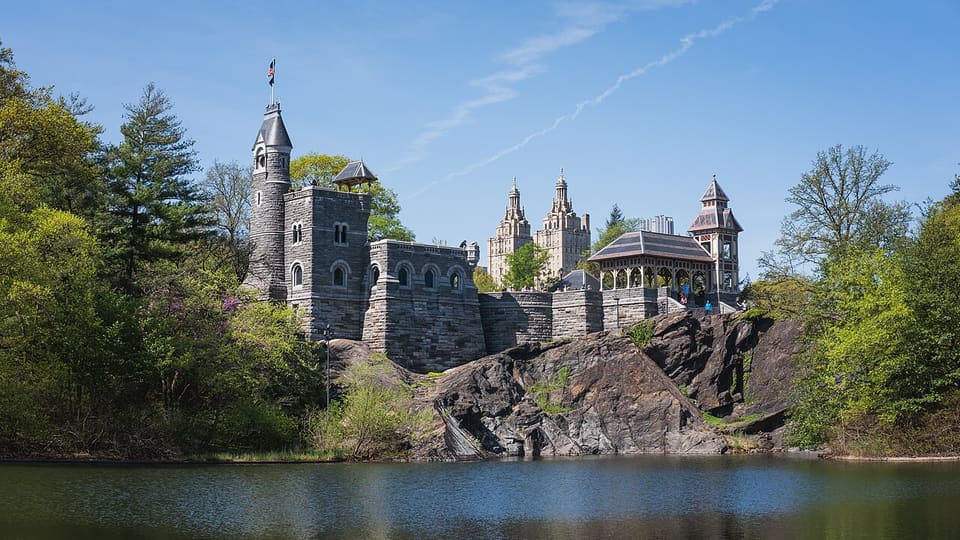
You're standing at the top of Vista Rock, the park's second-highest natural point, and the little gray castle in front of you is Belvedere Castle. Look at how its stone seems to rise straight out of the rock. It almost does: it's built of Manhattan schist, the same ancient bedrock under your feet, quarried right here in the park. Now find the top of the tower. Up there, beside the flag and the weather vane, is a small spinning instrument for measuring wind. Hold onto that. It's the twist in this story.
When Calvert Vaux, the architect who co-designed Central Park with Frederick Law Olmsted, drew this building with Jacob Wrey Mould in 1867, it wasn't meant to do anything at all. It was a folly, the Victorian word for a building put up purely for the pleasure of looking at it, and looking out from it. The name says as much: belvedere is Italian for "beautiful view." It was completed in 1872 as an open-air lookout. No doors. No windows. Rain and wind blew straight through.
It was supposed to be grander. The first plans called for two turreted stone towers, a larger one facing east and a smaller one on the west side. Then, in November 1870, under Tammany Hall's leadership, the plans were revised to cut costs. Mould designed an open painted-wood pavilion instead, and the western tower was never built. So the castle you see is, in a sense, half a castle.
In 1919, the United States Weather Bureau moved in. A building with nothing to close suddenly needed doors and windows, because instruments and the people reading them don't do well in the rain. The folly became Central Park's official weather station, and it still holds that title. The automated station sits just south of the castle now, and the wind equipment is still on the tower above you.
But the job didn't protect the building. In the 1960s the weather equipment was automated and the staff moved their offices to Rockefeller Center. The castle was closed to the public, and with nobody inside it was vandalized, neglected and left to deteriorate. The Central Park Conservancy launched a restoration and reopened it on May 1, 1983. A second renovation followed, and it reopened in 2019.
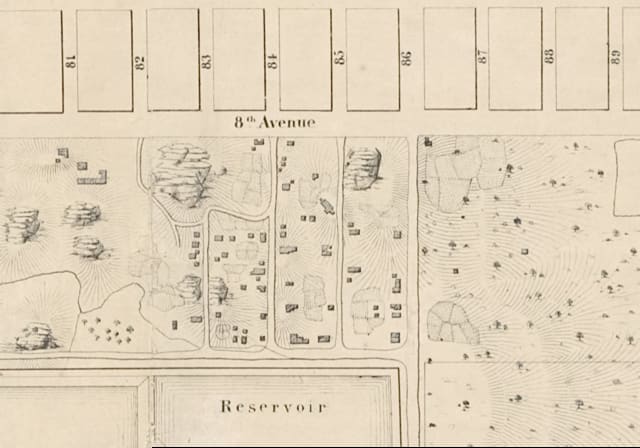
Now look east, toward Turtle Pond and the Great Lawn. When Vaux built this lookout, that side faced a rectangular receiving reservoir, part of the Croton Aqueduct system. In the 1930s it was filled in with city building rubble, beginning with spoil from construction of the Eighth Avenue subway line. Where the water was, there is now lawn and pond, and the castle still has its post above them.
When you're ready, walk southwest, turn sharp right onto West Drive, then bear left onto West 85th Street, about ten minutes. You're heading to Seneca Village, the community that was here before the park.
Hear it where it happened. It plays at stop 7 of Central Park Walking Tour: The Pond to Belvedere Castle (3 min), narrated as you walk. Unlock the tour for the audio, or try stop 1 free first.