The whole storyStop 9 of Brooklyn Bridge and Lower Manhattan Walking Tour
The Fort That Fired at Nobody
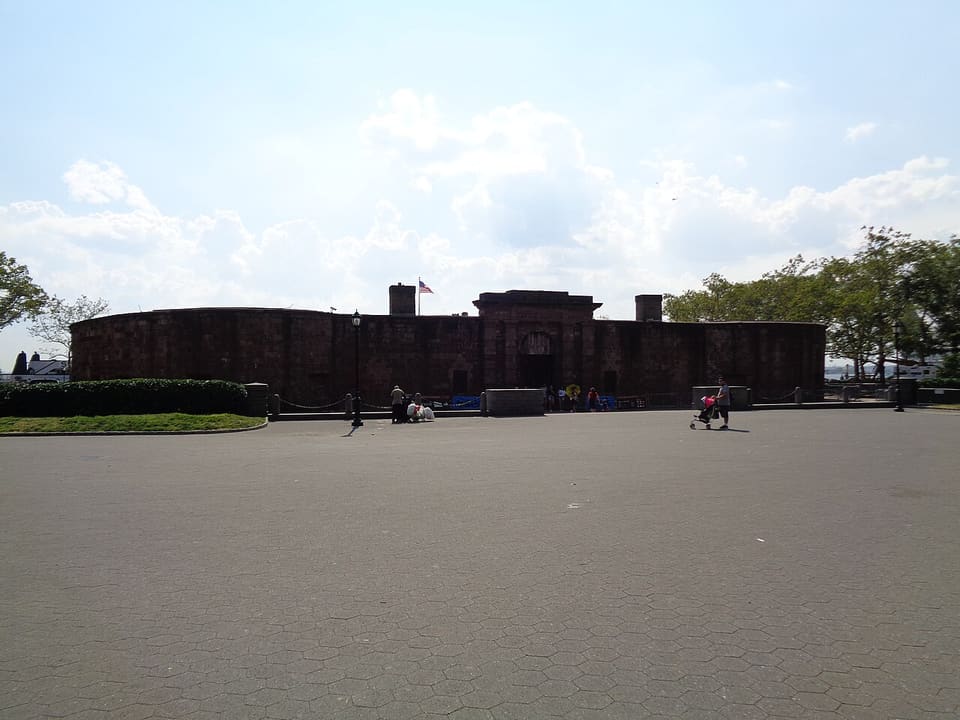
You're standing in the Battery, at the very bottom of Manhattan, in front of a low, round fort. Look at the walls. That's red sandstone, quarried in New Jersey and stacked into a near-perfect circle, with one short straight side. It has had more lives than almost any building in this city, and it never once did the job it was built for.
This was Lenape ground first. They called this rocky tip of the island Kapsee, a rocky ledge, and the Dutch borrowed the word. Two centuries later, with war against Britain looming, the young United States built this fort from 1808 to 1811. Back then it didn't sit in a park. It sat on a little artificial island just offshore, with 28 heavy cannon and a wooden bridge to the mainland. They named it for DeWitt Clinton, the city's mayor. Then the War of 1812 came and went, and the fort never fired a shot. Within a few years the most active thing on that bridge was the fishermen.
So the city found it a better use. In 1824 the fort reopened as Castle Garden, a beer garden, exhibition hall and theater. Six thousand people packed in to honor Lafayette. Samuel Morse demonstrated his telegraph here. In 1850 the Swedish soprano Jenny Lind gave her first American concerts inside these walls, and the dancer Lola Montez performed something billed as her "tarantula dance." Not bad for a building designed to sink warships.
Then, in 1855, the music stopped and the ships started. Castle Garden became America's first immigration station, decades before Ellis Island. Picture the arrival. Newcomers had already passed a medical inspection on Staten Island, where the sick were held in quarantine. The rest came by steamship to a dock on the fort's far side, deliberately facing away from the park, so no one could slip into Manhattan before being processed. A wooden fence taller than two people ringed the fort. Inside, in the round hall where audiences had once cheered Jenny Lind, families waited on wooden benches while clerks wrote down their names and asked them where they were headed.
Between 1855 and 1890, more than 7.5 million people came through this one circle of sandstone. A huge share of the country's family stories begin right where you're standing.
In 1892 the work moved out to Ellis Island, and the fort became the city's first aquarium. In the 1940s Robert Moses, the city's parks commissioner, wanted to tear it down for a tunnel project. Preservationists fought him, and won.
And here's the payoff. The fort that once received the immigrants is now where you buy tickets for the ferry out to Ellis Island, the place that replaced it. The island fort is long since surrounded by landfill, but it's still the front door to the harbor.
That's the end of the walk. You've gone from the bridge to the money to the first capital, and finished at the harbor where millions of New Yorkers first set foot. Take a minute at the water's edge before you go.
Hear it where it happened. It plays at stop 9 of Brooklyn Bridge and Lower Manhattan Walking Tour (3 min), narrated as you walk. Unlock the tour for the audio, or try stop 1 free first.