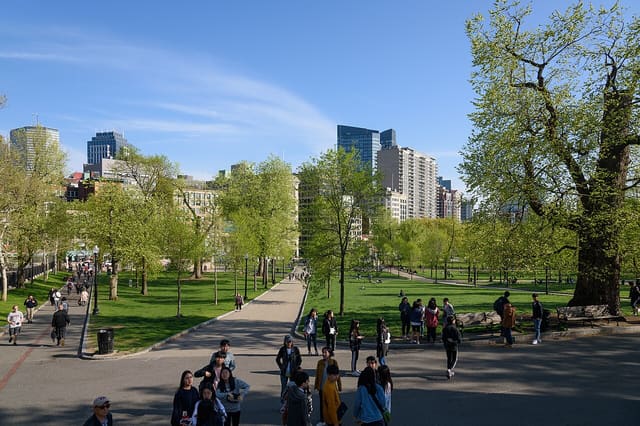
Freedom Trail Walking Tour
Ten stops from Boston Common to Copp's Hill, past the Old North Church steeple where two lanterns hung on the night of April 18, 1775.
At an average 3 mph, a mile takes 20 minutes, 3 miles take an hour and 5 miles take 1 hour 40 minutes. A 2 mph stroll takes 30 minutes a mile; a brisk 4 mph takes 15. Add 30 minutes for every 1,000 feet you climb, and the time you spend at each stop. Put your own walk in below.
| Distance | Stroll, 2 mph | Average, 3 mph | Brisk, 4 mph |
|---|---|---|---|
| ½ mile | 15 min | 10 min | 8 min |
| 1 mile | 30 min | 20 min | 15 min |
| 1.5 miles | 45 min | 30 min | 23 min |
| 2 miles | 1 h | 40 min | 30 min |
| 3 miles | 1 h 30 min | 1 h | 45 min |
| 4 miles | 2 h | 1 h 20 min | 1 h |
| 5 miles | 2 h 30 min | 1 h 40 min | 1 h 15 min |
| 6 miles | 3 h | 2 h | 1 h 30 min |
| 10 miles | 5 h | 3 h 20 min | 2 h 30 min |
| 15 miles | 7 h 30 min | 5 h | 3 h 45 min |
| 20 miles | 10 h | 6 h 40 min | 5 h |
| 1 km | 19 min | 12 min | 9 min |
| 5 km (3.1 miles) | 1 h 33 min | 1 h 2 min | 47 min |
| 10 km (6.2 miles) | 3 h 6 min | 2 h 4 min | 1 h 33 min |
| Half marathon (13.1 miles) | 6 h 33 min | 4 h 22 min | 3 h 17 min |
| Marathon (26.2 miles) | 13 h 7 min | 8 h 44 min | 6 h 33 min |
Flat ground, no stops, rounded to the minute.
It adds up three things, the same way you would on the back of a map:
3 miles at 3 mph is one hour. The paces run from a 2 mph stroll to a brisk 4 mph; pick the one that sounds like you on a normal day, not your best.
Naismith's rule adds an hour for every 2,000 feet of climb, about an hour per 600 meters. Enter the total uphill along the way, not just the height of the top.
A photo takes a minute; a museum takes an afternoon. Five minutes is a fair guess for a quick look.
It leaves out descents, rough ground, heat, crowds and long rests, so treat the answer as a plan, not a promise.
Healthy adults under 60 average about 3 mph, roughly 19 to 20 minutes a mile. Speeds ease off after 60, and past 80 the average is a little over 2 mph, about 28 minutes a mile.
| Age | Men | Women |
|---|---|---|
| 20–29 | 3.0 mph · 20 min a mile | 3.0 mph · 20 min a mile |
| 30–39 | 3.2 mph · 19 min a mile | 3.0 mph · 20 min a mile |
| 40–49 | 3.2 mph · 19 min a mile | 3.1 mph · 19 min a mile |
| 50–59 | 3.2 mph · 19 min a mile | 2.9 mph · 20 min a mile |
| 60–69 | 3.0 mph · 20 min a mile | 2.8 mph · 22 min a mile |
| 70–79 | 2.8 mph · 21 min a mile | 2.5 mph · 24 min a mile |
| 80–99 | 2.2 mph · 28 min a mile | 2.1 mph · 29 min a mile |
Normal walking pace measured over short, flat courses (3 to 30 meters): 41 studies and 23,111 healthy adults, pooled by Bohannon and Andrews (2011). A real walk has corners, curbs and crossings, so read these as your speed on open ground.
William Naismith, a Scottish climber, worked out his rule in 1892. Going down, Eric Langmuir's correction takes off 10 minutes per 300 meters on gentle slopes (5 to 12 degrees) and adds 10 on steep ones.
A group walks at its slowest walker's speed. Langmuir's guidance for a party is 4 km/h (about 2.5 mph) plus an hour per 450 meters of climb, set by the slowest member's fitness.
US crosswalk signals are timed for people walking 3.5 feet a second, about 2.4 mph; the manual says to consider slower where slower walkers cross often. Waiting for the light is time the calculator can't see.
Naismith's rule assumes reasonably fit walkers on typical ground in normal conditions, with no long breaks for rest or sightseeing. Heat, rough paths and small legs all need room.
The CDC counts walking at 2.5 mph or faster as brisk, moderate-intensity activity. You can talk but not sing; if you can only manage a few words between breaths, it's vigorous.
Count the stops, not just the miles. Our 29 self-guided walks run 0.6 to 4.2 miles with 4 to 10 stops; the middle one is 1.9 miles. We time them at an easy 2.5 mph, the pace of a group that stops to look, plus the story at each stop, about 3 minutes. One of them, Freedom Trail Walking Tour, is 2.0 miles: about 48 min of walking, and its 10 stories add about 29 min, so 1 h 17 min in all.
The first stop of every walk plays free, no sign-up. Dot, the walking green dot, shows you the way.
Ten stops from Boston Common to Copp's Hill, past the Old North Church steeple where two lanterns hung on the night of April 18, 1775.
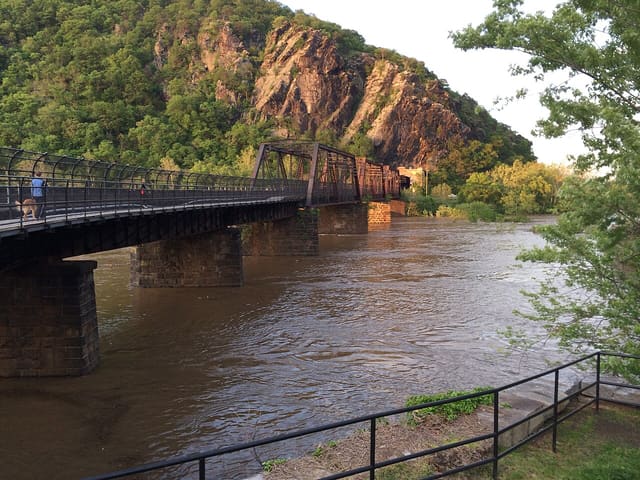
Six stops from the armory grounds and John Brown's Fort, the 1848 firehouse, up to Jefferson Rock and Storer College.
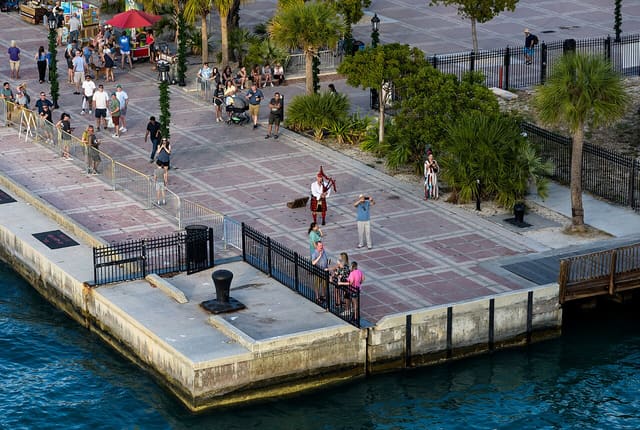
Eight stops from Mallory Square to the Southernmost Point buoy, dedicated in 1983, by way of Truman's Little White House.
See all our tours, walks and drives.
About 20 minutes at an average 3 mph. A brisk 4 mph takes 15 minutes and a 2 mph stroll takes 30.
An hour at 3 mph, 45 minutes at 4 mph and an hour and a half at 2 mph, on flat ground with no stops. Add 30 minutes for every 1,000 feet of climb.
1 hour 40 minutes at 3 mph, 1 hour 15 minutes at 4 mph and 2 hours 30 minutes at 2 mph, before any breaks.
About 3 mph (1.3 to 1.4 meters a second) for healthy adults under 60, from a 2011 review of 41 studies and 23,111 people. It slows with age, to a little over 2 mph after 80.
About 3 miles at an average pace, 2 miles at a stroll and 4 miles at a brisk pace, on flat ground without stops.
With Naismith's rule: add an hour for every 2,000 feet of climb, which is 30 minutes per 1,000 feet or about an hour per 600 meters. Put your total climb in the calculator and it does this for you.
Yes. The CDC counts walking at 2.5 mph or faster as brisk, moderate-intensity exercise. A simple check: you can talk, but not sing.
It depends on the stops more than the miles. Our 29 self-guided walks run 0.6 to 4.2 miles with 4 to 10 stops, and we time them at an easy 2.5 mph plus about 3 minutes of story at each stop.
Checked November 2026. Our walks' lengths, stops and times are read live from the tours on this site.