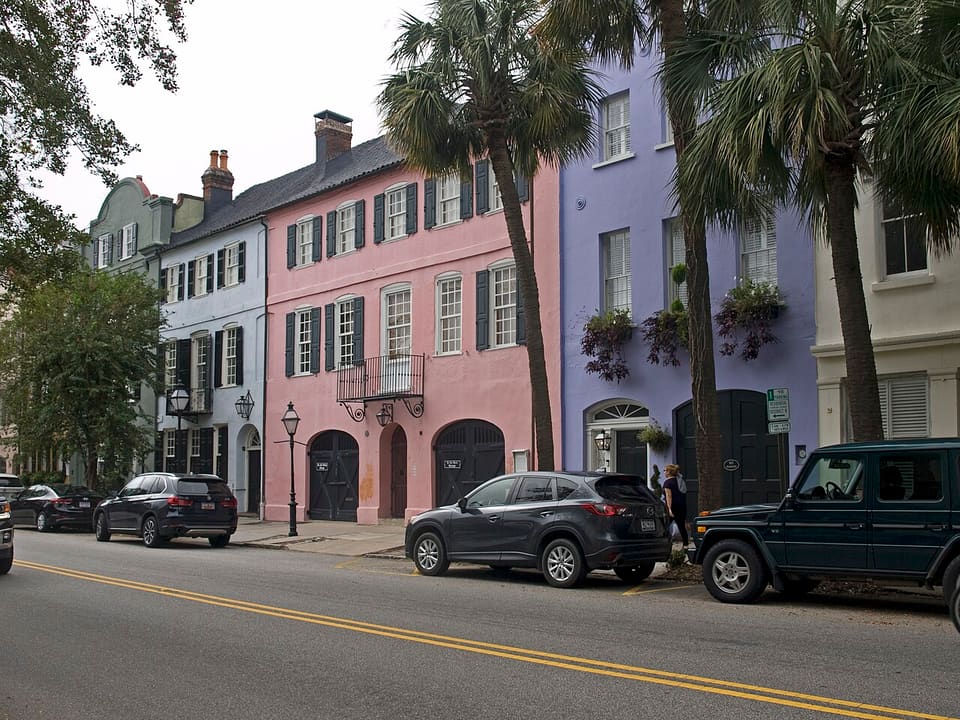
Historic sites in Charleston: 15 worth the walk
The historic sites in Charleston to see first are Rainbow Row, thirteen pastel houses on East Bay Street; the Battery, facing Fort Sumter, where the Civil War began; and the Four Corners of Law, with St. Michael's Church. Here are 15, all within a mile of each other.
The best-known come first. All of them stand on the old peninsula, and all but two have a page of their own with the full story. Fort Sumter itself is a boat ride away; the questions at the end say how to get there.
Historic sites in Charleston, in order
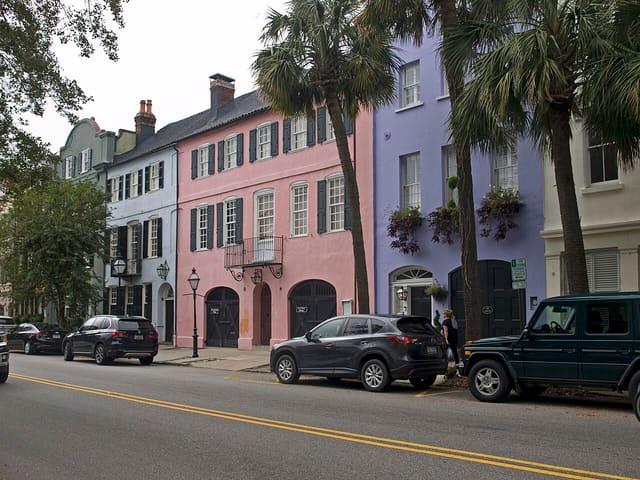
Photo: Ymblanter, CC BY-SA 4.0, via Wikimedia Commons Rainbow Row
Why it matters. The row everyone photographs first: thirteen houses in Caribbean pastels facing the harbor, painted that way less than a century ago.
What the record shows. The houses once fronted straight onto the Cooper River; the land in front was filled in later. In 1791 John Blake took over a neighbor's wall that sat eight inches over the line, in return for building a gutter between the houses. In the 1920s Susan Pringle Frost bought six of the run-down buildings but couldn't afford to fix them. In 1931 Dorothy Haskell Porcher Legge began restoring 99 to 101 and painted it pink; by 1945 most of the row was restored.
Visiting. From the street. They're lived in, so look from the sidewalk; the whole row fits in one view from across East Bay Street.
Stop 5 of Charleston Walking Tour: Rainbow Row to the Battery
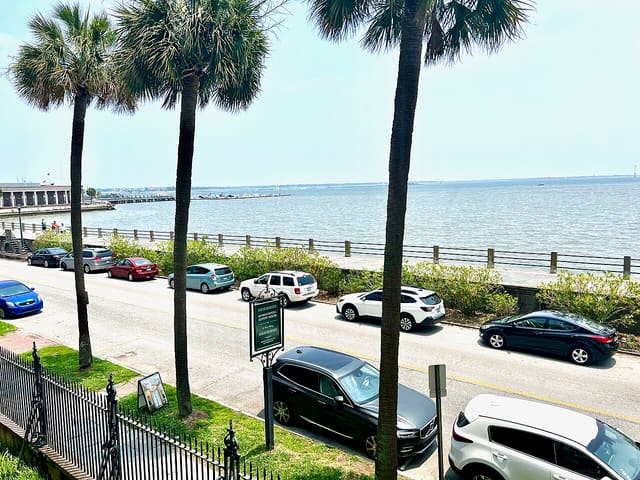
Photo: Eagledj, CC BY-SA 4.0, via Wikimedia Commons The Battery
Why it matters. Fort Sumter is in plain sight from this seawall, where the harbor watched the Civil War begin in April 1861.
What the record shows. The name comes from an artillery battery the British built here, and the promenade dates to 1838. On December 26, 1860, Major Robert Anderson moved his garrison, five officers, 64 artillerymen and nine musicians by the Park Service's count, from Fort Moultrie to Fort Sumter. In January 1861 cadets from The Citadel fired on the Star of the West. Confederate guns opened on the fort on April 12, 1861; Anderson surrendered the next day, took the flag with him, and raised it there again on April 14, 1865.
Visiting. Free, and always there: it's a public seawall walk, ending in White Point Garden, a 5.7-acre city park.
Stop 8 of Charleston Walking Tour: Rainbow Row to the Battery
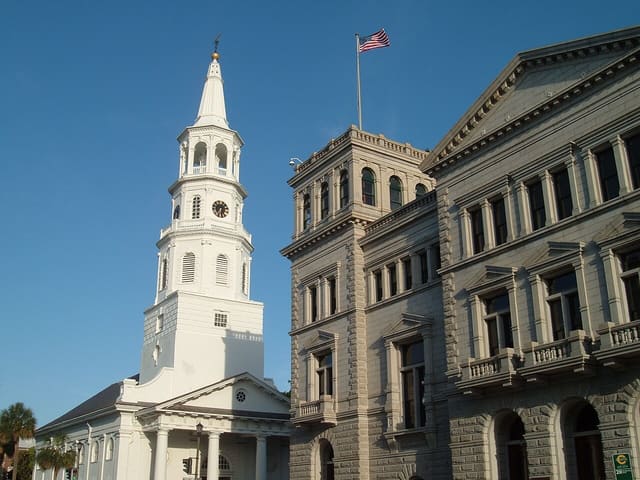
Photo: Brian Zinnel, CC BY-SA 4.0, via Wikimedia Commons Four Corners of Law
Why it matters. Robert Ripley, of Believe It or Not!, named this crossing the Four Corners of Law: City Hall, the county courthouse, the federal courthouse and, on the southeast corner, St. Michael's, the oldest church building in Charleston.
What the record shows. The South Carolina Assembly ordered the church built, and Samuel Cardy built it between 1751 and 1761 where St. Philip's first wooden church had stood. Its two-story portico was the first of its size in colonial America. The bells were cast in London in 1764 and recast in 1866. George Washington worshipped in pew 43 in 1791, and in 1865 Union shells exposed the chancel window that had been bricked up since 1788.
Visiting. Yes: St. Michael's and its churchyard are open Monday to Thursday, 9 a.m. to 4 p.m., closed Friday and Saturday, and they close without notice for funerals and weddings.
Stop 3 of Charleston Walking Tour: Rainbow Row to the Battery
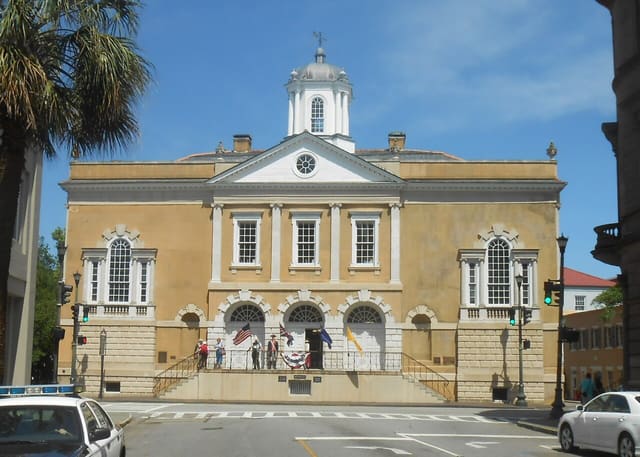
Photo: ProfReader, CC BY-SA 3.0, via Wikimedia Commons The Old Exchange and Provost Dungeon
Why it matters. Charleston's colonial custom house held the city's confiscated tea in 1774, and the British turned its basement into a prison.
What the record shows. The colonial government finished it in 1771. When the British took the city in 1780 they used it as a barracks and the basement as a military prison; a 2012 study counted at least 120 people held there, some of them British soldiers. In 1965 the Half-Moon Battery, a wall of the 1698 fortifications, was found beneath it. Enslaved people were sold at auction in front of it from colonial days until after the mid-1800s. The cupola, its third, went up in 1981.
Visiting. Yes, Monday to Saturday 9 a.m. to 5 p.m. and Sunday from 11; $16 for adults, at the door. A 25-minute guided tour of the dungeon runs every half hour.
Stop 2 of Haunted Charleston Walking Tour
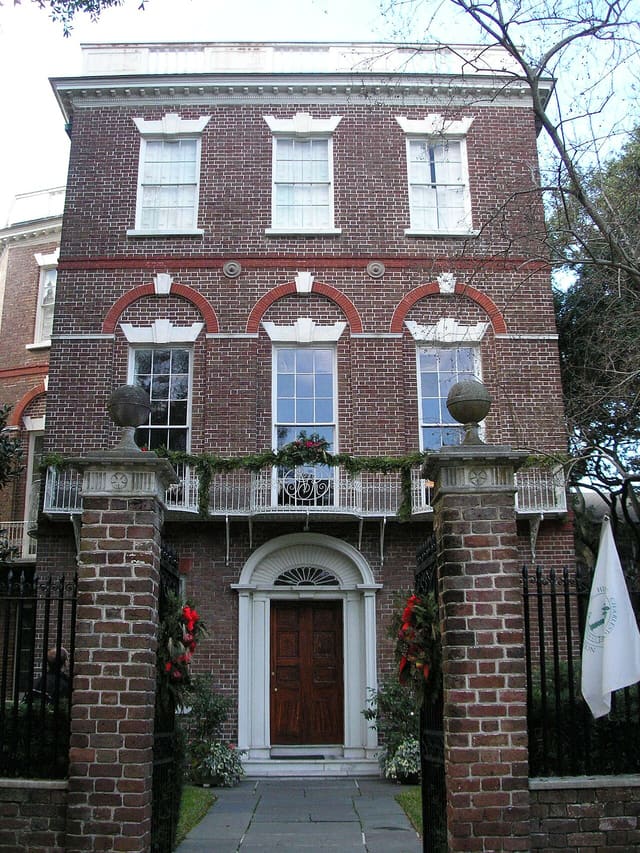
Photo: Dima Sergiyenko; Please attribute this image as the work of "DiscoverWithDima.", CC BY-SA 4.0, via Wikimedia Commons Nathaniel Russell House
Why it matters. A merchant's town house of 1808, kept as it was, that shows where Charleston's money came from, the slave trade included.
What the record shows. Nathaniel Russell came from Bristol, Rhode Island, in 1765, and his business included buying and selling captive Africans. He began the house in 1803 and finished it in 1808, at 70; his initials, N and R, are worked into the iron of the second-floor balcony. In 1955 the owners proposed to subdivide it, and Historic Charleston Foundation raised $65,000 to buy it. The foundation's board voted to sell it in December 2023, then voted in January 2024 to keep it.
Visiting. Yes, Tuesday to Sunday 10 a.m. to 4 p.m. and Monday 1 to 4, on a guided tour on the hour or a 45-minute audio tour; $16 for adults, or $24 with the Aiken-Rhett House.
Stop 6 of Charleston Walking Tour: Rainbow Row to the Battery
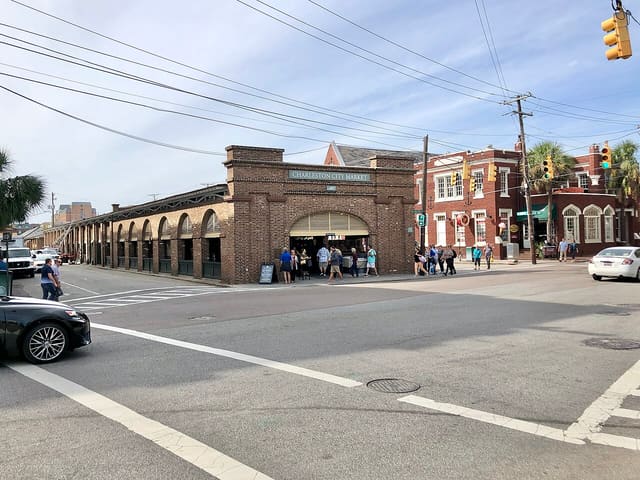
Photo: Warren LeMay from Covington, KY, United States (CC0), via Wikimedia Commons Charleston City Market
Why it matters. Four blocks of open sheds, about 1,240 feet from Meeting Street to East Bay, that have to stay a market forever, by the terms of the gift.
What the record shows. In 1788 Charles Cotesworth Pinckney and other landowners gave the city a strip of reclaimed marsh on condition that it remain a market in perpetuity. The first sheds went up around 1790. Vultures that cleaned up the meat scraps were protected by law. Edward B. White's Market Hall, with rams' heads and oxen skulls under its roof, was finished in 1841 after a fire. Whatever you hear, enslaved people were never auctioned here; that happened at places like the Old Slave Mart.
Visiting. Yes, and it's free to walk: the day market opens at 9:30 every day and closes around 5:30, and the night market runs Friday and Saturday, 6:30 to 10:30 p.m.
Stop 1 of Charleston Walking Tour: Rainbow Row to the Battery
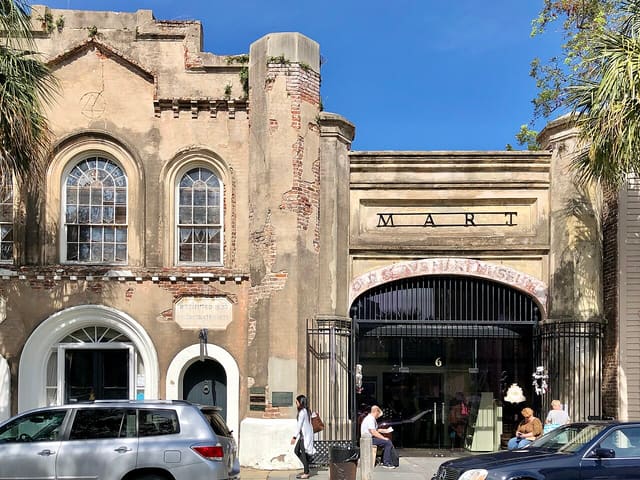
Photo: Warren LeMay from Covington, KY, United States (CC0), via Wikimedia Commons Old Slave Mart
Why it matters. It is believed to be the last surviving slave auction building in South Carolina.
What the record shows. When Charleston banned public slave auctions in 1856, the sales moved indoors: that year Councilman Thomas Ryan and James Marsh opened Ryan's Mart on this block, with a four-story barracoon, a jail where people were held before sale. The auction master Z. B. Oakes bought it in 1859 and built this gallery; the auction table inside was about three feet high and ten feet long. When the Union Army occupied the city in February 1865, the people still held here were freed.
Visiting. Yes, as a museum the city runs: Monday to Saturday 9 a.m. to 5 p.m., closed Sundays; $8 for adults.
Stop 2 of Charleston Walking Tour: Rainbow Row to the Battery
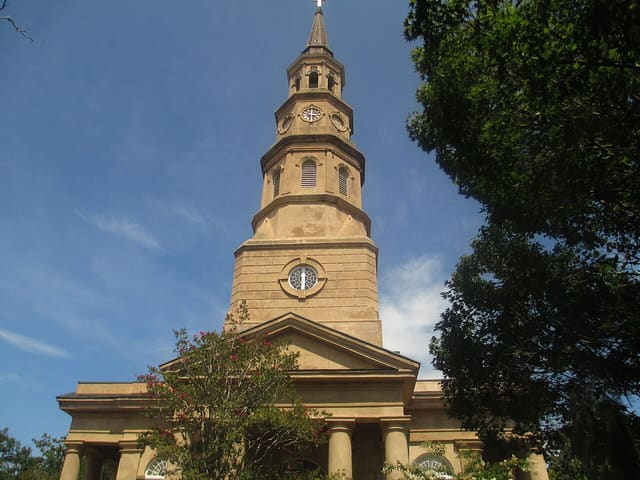
Photo: Billy Hathorn, CC BY-SA 3.0, via Wikimedia Commons St. Philip's Church
Why it matters. South Carolina's oldest congregation, under a steeple that once helped steer ships into the harbor.
What the record shows. Its first wooden church stood where St. Michael's is now, and a hurricane damaged it in 1710. The second, on Church Street, was finished in 1723 and burned in 1835. The present church went up in 1835 and 1836, and its spire was finished in 1850. From 1893 to 1915 the tower held the rear light of a range whose front light stood on Fort Sumter. Edward Rutledge, Charles Pinckney and John C. Calhoun are buried in its churchyard.
Visiting. Yes: the church is open Monday to Thursday 10 a.m. to 4 p.m. and Friday until 1, with a booklet to guide yourself. The churchyard keeps office hours and opens for Sunday worship.
Stop 4 of Haunted Charleston Walking Tour
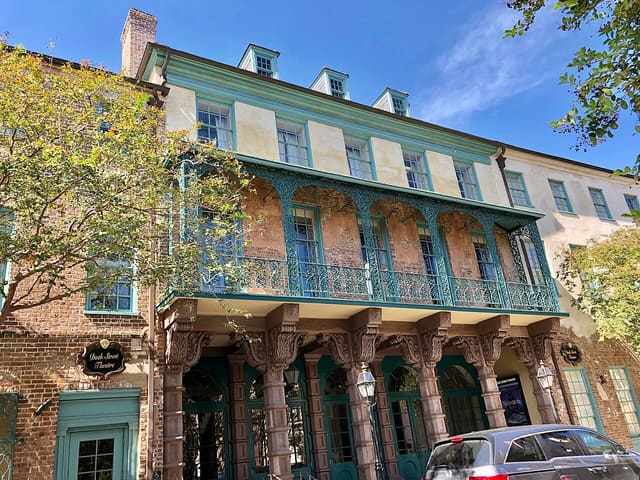
Photo: Warren LeMay from Covington, KY, United States (CC0), via Wikimedia Commons Dock Street Theatre
Why it matters. The first building in the colonies built just for plays opened on this corner in 1736, and Flora, the first opera performed in America, was staged here.
What the record shows. The playhouse opened on February 12, 1736, with a comedy, The Recruiting Officer, and the Great Fire of 1740 most likely destroyed it. The Planter's Hotel went up on the site in 1809, with its iron balcony added in 1835; Robert Smalls waited tables in its dining room before the Civil War, and Planter's Punch is said to have started there. The theater you see was built inside the hotel's shell by the WPA and opened on November 26, 1937.
Visiting. Yes. The city owns it and opens it every day for visitors to look in; at night it's a working theater, home to Charleston Stage and a Spoleto Festival stage.
Stop 3 of Haunted Charleston Walking Tour
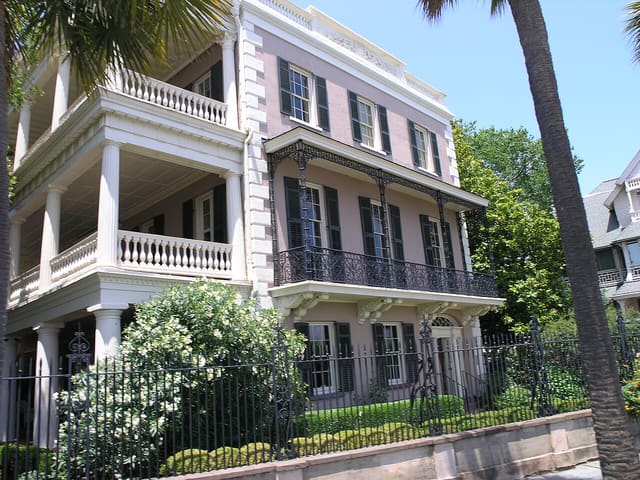
Photo: Daniel Mayer, CC BY-SA 3.0, via Wikimedia Commons Edmondston-Alston House
Why it matters. General P. G. T. Beauregard watched the bombardment of Fort Sumter from its piazza, facing the harbor, on April 12, 1861.
What the record shows. The merchant Charles Edmondston built it around 1825 on the edge of the harbor. In the 1830s it passed to Charles Alston, a rice planter, who gave it its grander look. Both free and enslaved people lived and worked on the property. Before dawn on April 12, 1861, Confederate guns opened fire on Fort Sumter, and the general who ordered it watched from this house.
Visiting. Yes, on 30-minute guided tours from Tuesday to Saturday, starting around 11 a.m.; closed Sundays and Mondays. Listings disagree on the last tour, so check before you go.
Stop 7 of Charleston Walking Tour: Rainbow Row to the Battery
Heyward-Washington House
Why it matters. George Washington stayed here for a week in May 1791, in the town house of a signer of the Declaration of Independence.
What the record shows. The house dates to 1772 and was the home of Thomas Heyward Jr., one of four South Carolinians to sign the Declaration. The British captured him when they took the city in 1780 and held him in St. Augustine until an exchange the next year. The city rented the house for Washington's stay. Heyward sold it in 1794 to John Grimké, father of the abolitionists Sarah and Angelina Grimké. The Charleston Museum bought it in 1929 and opened it in 1930 as the city's first historic house museum.
Visiting. Yes, as one of the Charleston Museum's houses; check its site for hours, which we couldn't read. The $40 Essential Charleston Passport covers it and two more downtown sites over five days.
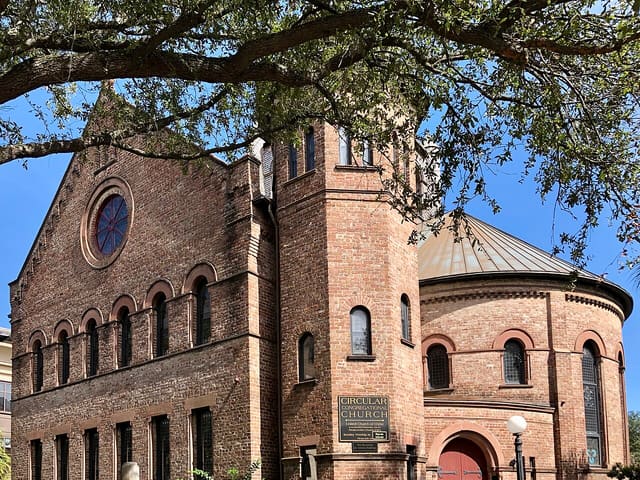
Photo: Warren LeMay from Covington, KY, United States (CC0), via Wikimedia Commons Circular Congregational Church
Why it matters. Its graveyard is the oldest known burial ground in Charleston, and Meeting Street is named for the meeting house that stood here.
What the record shows. The city's dissenting settlers founded the congregation around 1681 and built a meeting house on this spot; a hurricane destroyed its earliest records in 1713. In 1804 Martha Laurens Ramsay proposed a round church, and Robert Mills, later the architect of the Washington Monument, drew it. A 182-foot steeple came in 1838, after people mocked it for having none. Fire destroyed the church on December 11, 1861, and in 1867 its Black members left to found Plymouth Congregational Church.
Visiting. Visitors are welcome in the grounds and the graveyard, where the oldest inscribed stone is from 1729. The church lists no visiting hours, only Sunday worship at 11 a.m.
Stop 5 of Haunted Charleston Walking Tour
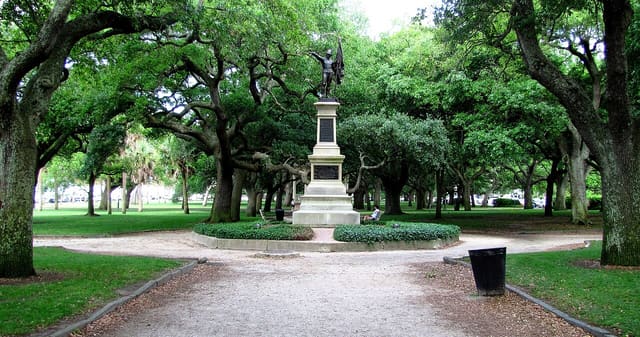
Photo: Brian Stansberry (photographer), CC BY 3.0, via Wikimedia Commons White Point Garden
Why it matters. Stede Bonnet, the gentleman pirate, was hanged near here in 1718, and a stone in the park remembers him.
What the record shows. Bonnet owned more than 400 acres on Barbados and was a militia major when he turned pirate in 1717, knowing nothing about sailing. He had a sloop built, armed her with ten guns, named her the Revenge and paid his crew wages. Colonel William Rhett caught him on the Cape Fear River on September 27, 1718, and he was hanged near here on December 10. The 1943 marker says 29 of his crew were executed nearby; the evidence suggests 22.
Visiting. Free; it's a 5.7-acre city park where the Battery's seawall turns the corner. Bonnet's marker is at its northeast corner.
Stop 1 of Haunted Charleston Walking Tour
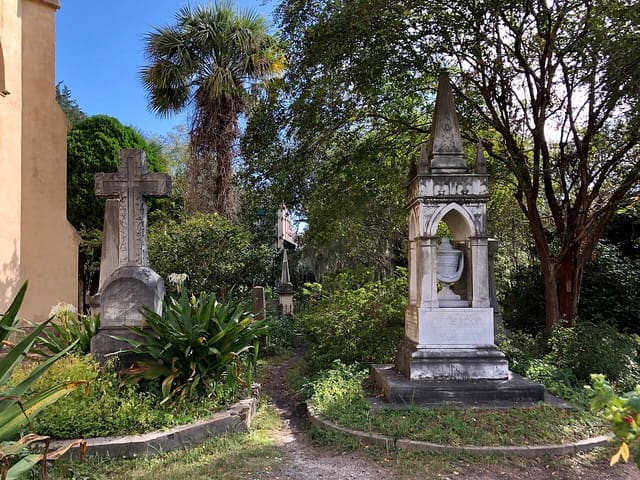
Photo: Warren LeMay from Covington, KY, United States (CC0), via Wikimedia Commons Unitarian Church Graveyard
Why it matters. The oldest Unitarian church in the South keeps a churchyard planted as a wild garden, where the paths wind between the graves.
What the record shows. Its brick walls went up from 1772 as an overflow meeting house for the Circular Church. The congregation split over theology in 1817, and the group that left made this building its own. In 1819 it hired Samuel Gilman, the Harvard graduate who wrote "Fair Harvard". His wife, Caroline Howard Gilman, laid out the churchyard in the 1830s after Mount Auburn Cemetery outside Boston. Hurricane Hugo felled about 30 of its trees in 1989; dogwood and silverbell grow in their place.
Visiting. Yes: the churchyard is open Monday to Saturday from 10 a.m. to 2 p.m., and you can walk through it from Archdale Street to King Street.
Stop 6 of Haunted Charleston Walking Tour
Old City Jail
Why it matters. Ghost tours call Lavinia Fisher America's first female serial killer, and this is the jail where they say she still waits.
What the record shows. The land was set aside in 1680 for the poor, the sick and the dispossessed. The jail opened in 1802, four stories under a two-story octagonal tower; the 1886 earthquake brought down the tower and the top floor. In the Civil War it held Black soldiers of the 54th Massachusetts captured at Fort Wagner. John and Lavinia Fisher, of a gang of highwaymen, were convicted in 1819 of highway robbery, then a capital crime, not murder. Lavinia died on February 18, 1820.
Visiting. Only on a ticketed 45-minute tour run by Bulldog Tours, for ages 10 and up. Since 2016 the building has also been an event venue.
The map
The numbers are the list's. Colored pins have a page of their own with the full story; open the map to zoom into the streets.
Walk them with Dot
7 of the 15 places on this list are stops on our Charleston Walking Tour: Rainbow Row to the Battery (8 stops, 1 h 20 min). Dot, the green dot on your map, takes you from one to the next and plays each story when you get there. Stop 1, Charleston City Market, is free: hear it before you go.
6 of the 15 places on this list are stops on our Haunted Charleston Walking Tour (7 stops, 1 h 8 min). Stop 1, White Point Garden, is free: hear it before you go.
Historic sites in Charleston: questions people ask
Is historic Charleston walkable?
Yes. The Charleston Historic District covers about 770 acres, a little over a square mile at the tip of the peninsula, and everything on this list sits within about a mile. In 1931 it became the first historic district in the country protected by a local law.
Why is Charleston called the Holy City?
For its church spires and, Charlestonians say, its old religious tolerance. Wikipedia adds that the nickname came along in the 20th century and may have started as a joke about the city's opinion of itself.
What does "Lowcountry" mean?
The coastal region of South Carolina, Charleston and the Sea Islands included. At first the word meant all of the state below the Fall Line.
How do you get to Fort Sumter?
Only on the Fort Sumter Tours boat, from Liberty Square downtown (340 Concord Street) or Patriots Point in Mount Pleasant. The fort is free; the boat is $43 for adults, and the trip takes about two and a quarter hours, an hour of it on the fort.
When was Charleston founded?
In 1670, as Charles Town, at Albemarle Point on the Ashley River. It moved to Oyster Point, the tip of today's peninsula, in 1680, and took the name Charleston in 1783.
Can you see Charleston's historic sites on your own?
Yes. The streets and parks are free, and the house museums sell tickets at the door. Our Rainbow Row to the Battery walk stops at eight of these places in about 2.4 miles and 80 minutes, and its first stop is free.
Where these facts come from
The record for each place is what our fact-check matched to a source in its story (the place's page lists them), or a page we read on the day below. Hours and prices change: check the official site before you go.
- Wikipedia: Rainbow Row
- Wikipedia: The Battery
- Wikipedia: Fort Sumter
- Wikipedia: Four Corners of Law
- Wikipedia: St. Michael's Church
- Wikipedia: Exchange and Provost
- Wikipedia: Nathaniel Russell House
- Historic Charleston Foundation: Nathaniel Russell House
- Wikipedia: City Market
- Wikipedia: Old Slave Mart
- Wikipedia: St. Philip's Church
- Wikipedia: Dock Street Theatre
- Edmondston-Alston House
- Wikipedia: Heyward-Washington House
- Wikipedia: Circular Congregational Church
- Wikipedia: White Point Garden
- Wikipedia: Stede Bonnet
- Wikipedia: Unitarian Church in Charleston
- Wikipedia: Old Charleston Jail
- Wikipedia: Lavinia Fisher
- Old Exchange and Provost Dungeon: plan a visit
- St. Michael's Church
- St. Philip's Church: our history
- Historic Charleston Foundation: house museums
- Charleston City Market
- Old Slave Mart Museum
- City of Charleston: Dock Street Theatre
- Circular Congregational Church: the graveyard
- Unitarian Church in Charleston
- Explore Charleston: Edmondston-Alston House
- Explore Charleston: the Essential Charleston Passport
- Explore Charleston: the Old City Jail tour
- National Park Service: Fort Sumter, plan your visit
- Fort Sumter Tours
- Wikipedia: Charleston Historic District
- Wikipedia: Lowcountry
- City of Charleston: history
Checked November 2026. More in town: Charleston.