Stories
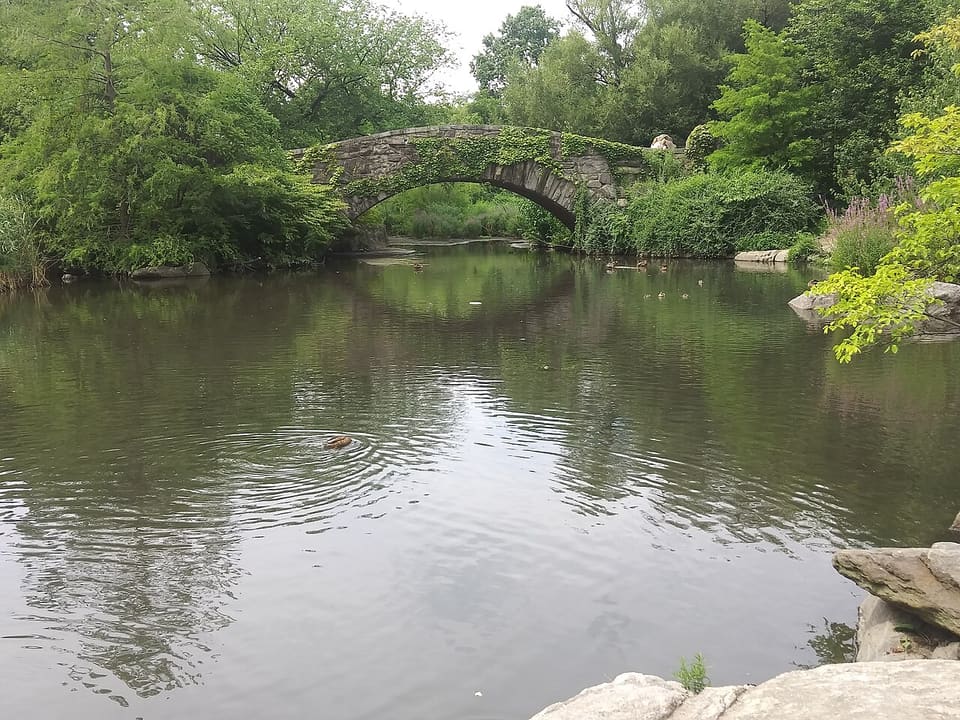
The Pond and Gapstow BridgePhoto: Jay Dobkin, CC BY-SA 4.0, via Wikimedia Commons
Walking tour · New York

Central Park Walking Tour: The Pond to Belvedere Castle

From the Pond to the castle and Seneca Village

1 h 18 min8 stops2.2 mi

Start the walk

Stop 1 is free, no sign-up. All 8 for $4.99, refunded within 7 days if it isn't for you.

See the 8 stops

The 8 stops

  1. 1Start hereFree

    The Pond and Gapstow Bridge

    The Rustic Bridge That Replaced Another

    Free sample · 2:41
    0:002:41

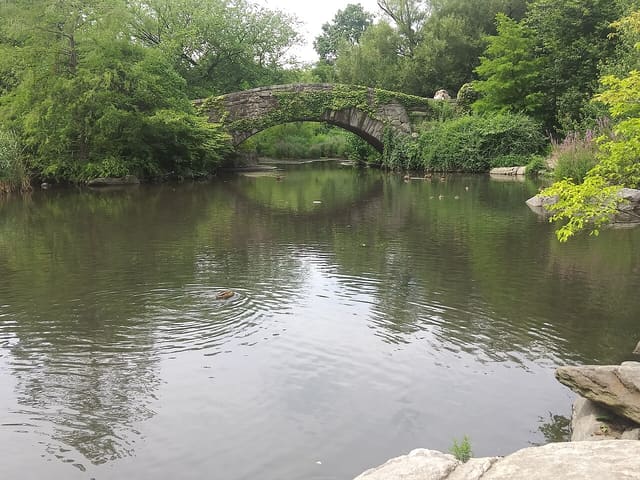
    You're standing at the Pond, in the southeast corner of Central Park, just a few steps in from the noise of Fifth Avenue and Central Park South. Find the small arched stone bridge crossing the water. That's Gapstow Bridge. Now let your eyes rise above it, to the towers of Midtown stacked behind the trees. That pairing, old stone against new glass, makes this one of the most photographed spots in New York.

    It looks like the bridge has always been here, and the Pond with it, as if the park simply fenced off a bit of countryside. That's the illusion, and it was built on purpose.

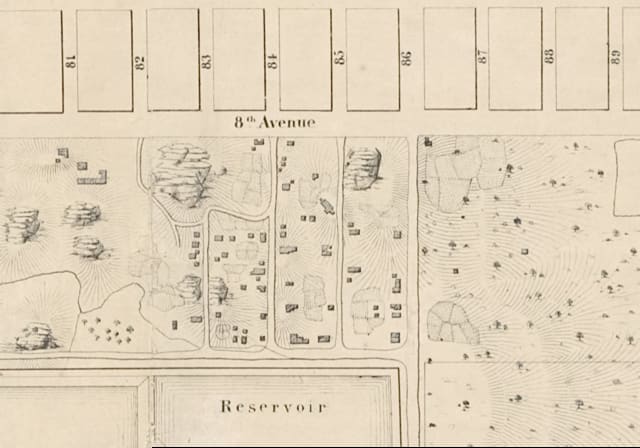
    In 1858, a landscape writer named Frederick Law Olmsted and an English-born architect named Calvert Vaux won the competition to design Central Park with a plan they called Greensward. The land they were handed was no meadow. Much of it was rocky ridge, swamp and scrub, and parts of it were homes. A few stops from now you'll hear about Seneca Village, the mostly African American community cleared to make way for this park.

    Olmsted and Vaux didn't preserve nature here. They manufactured it. Workers blasted rock with gunpowder and moved earth by hand and by cart, reshaping the ground into hills, hollows and shorelines. Even the water is not what it seems. The Pond and the park's other lakes look spring-fed, but they're topped up by the city's own water supply. A country pond, plumbed in.

    Now back to that bridge. The first Gapstow Bridge, from the 1870s, was nothing like this one. It was designed by Jacob Wrey Mould, Vaux's collaborator on much of the park's ornament, and it was a fanciful thing of wood and cast iron. Elegant, and not built to last. Within about twenty years it had deteriorated so badly the city took it down.

    Its replacement, the bridge in front of you, went up in 1896, made of rough-cut stone. And that's the quiet twist. The park's most rustic, most natural-looking crossing is the newer one. Somebody looked at a decaying showpiece and decided what this corner really needed was something that looked old.

    It worked. Generations have taken it for a remnant of the countryside. Hollywood did too: Home Alone 2 sent young Kevin wandering through this very scene.

    So look once more at the bridge and the towers behind it. Neither one grew here. Both were built by people, with real labor, on real land.

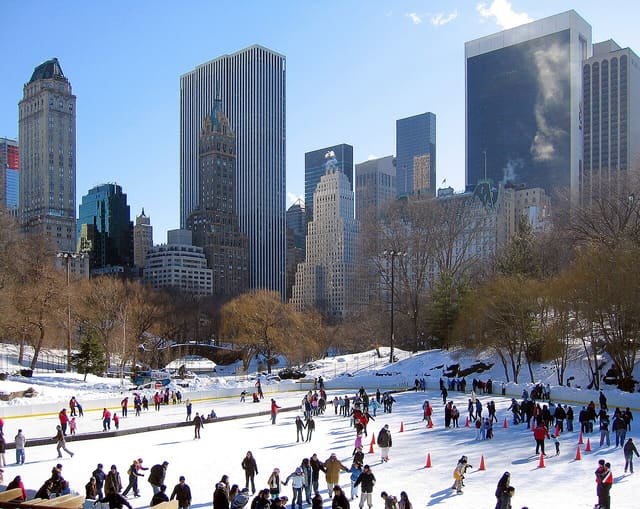
    When you're ready, walk north about three minutes to Wollman Rink, where a family's gift put New Yorkers on the ice.
The whole walk

8 stories across New York

1 h 18 min · 8 stops · 2.2 mi

Starts at The Pond and Gapstow Bridge and ends at Seneca Village.

  • Plays right here in your browser, or in the app
  • One purchase for your group, on up to 4 phones
  • Refunded within 7 days if it isn't for you

Plan your walk

    How long

    About 1 h 18 min for 2.2 mi with all 8 stories. Going inside the sites adds time.

    Start and finish

    Starts at The Pond and Gapstow Bridge and ends at Seneca Village.

    Add it to my calendar

    Know someone who'd love this walk? or see more gift ideas.

    Questions people ask

    What is the best path to walk through Central Park?

    For a first visit: from the Pond near 59th Street up the Mall and Literary Walk to Bethesda Terrace, across Bow Bridge, west to Strawberry Fields and north to Belvedere Castle. That's this tour: 2.2 miles, about 78 minutes with the stories.

    How long does it take to walk all of Central Park?

    The park is 2.5 miles long and half a mile wide, and the full loop road is about 6 miles, a two-hour walk. This route covers the southern half's best-known sights in about 78 minutes.

    Is there a free walking tour of Central Park?

    You can walk this route with any map for free. With Stories, the first stop's story plays free on your phone, and the rest unlock for one price.

    What are the stops on the Central Park walk?

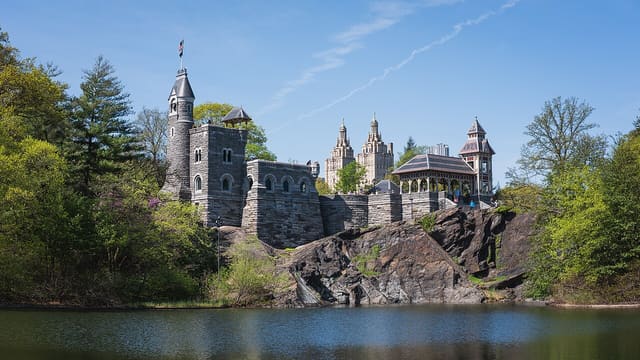
    The Pond and Gapstow Bridge, Wollman Rink, the Mall and Literary Walk, Bethesda Terrace and Fountain, Bow Bridge, Strawberry Fields, Belvedere Castle and the site of Seneca Village.

    Do I need the app?

    No. After you unlock, the tour plays right here in your browser: keep the screen on and tap each stop. The free Stories app adds GPS auto-play, so each story starts by itself when you arrive, with your phone in your pocket, and works offline.

    How many people can listen?

    One purchase covers your group on up to 4 phones. Share the link from your receipt, or everyone can sign in to the app with the same email.

    Does it work offline?

    In the app, yes: download the tour on Wi-Fi before you go. In the browser you need a signal, which is fine on most city streets; open the tour once before you leave.

    When can I start?

    Any time. It is self-guided, so there are no departure times and no group to keep up with. Pause for coffee and pick up where you left off.

    Can I give this tour as a gift?

    Yes. Tap "Give it as a gift", type their email and a note, and pick the day it arrives (Christmas morning works). They open it in their phone's browser; you get the receipt.

    Can I get a refund?

    Yes. If the tour did not work for you, email support@getstories.app within 7 days and we will refund it.

    Who made this tour?

    Stories writes each tour from public sources, checks every claim against them, and narrates it with a synthetic voice. The sources are listed at the end of this page; if you spot a mistake, tell us at support@getstories.app.

    About this tour and its sources

    You're standing at the edge of the Pond, at the southeast corner of Central Park. Look across the water to Gapstow Bridge, the small stone arch reflected below it, with the towers of Midtown rising just behind. It looks like the countryside wandered into the city and decided to stay.

    It didn't. Almost everything you'll see today was planned, dug, planted and built by hand. In 1858 two designers, Frederick Law Olmsted and Calvert Vaux, won the competition to design the park with a plan called Greensward. Workers reshaped the terrain with gunpowder blasting and hand and cart earth-moving. Nature, in other words, had a very good set of architects.

    That's the thread of this walk: how a park this natural-looking was made, and what was here before. Because this land wasn't empty. It held Seneca Village, a community of predominantly African American residents, many of whom owned property. By 1855 it had about 225 people, three churches and two schools. In 1857 they were forced out through eminent domain so the park could be built. That is where we'll finish.

    Let's begin right here, with the bridge in front of you.

    Written from public sources, every claim checked against them, narrated by a synthetic voice. Last checked October 2026.

    Share this walk