The whole storyStop 5 of Haunted Charleston Walking Tour
The Round Church That Isn't Round
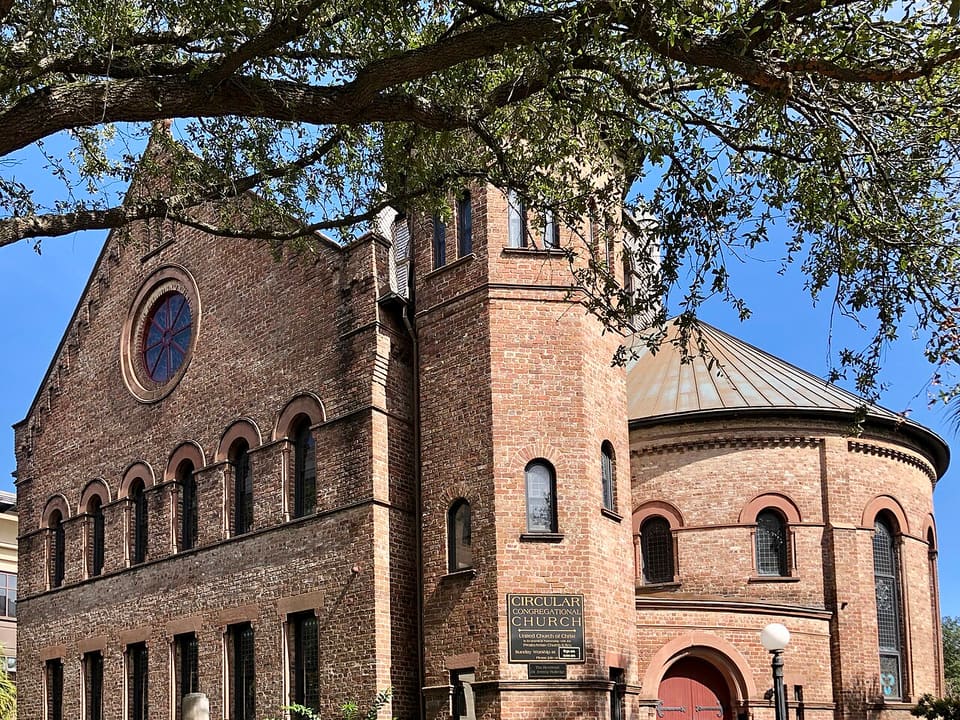
You're on Meeting Street now, standing in front of the building everyone in Charleston calls the Circular Church. Take a good look at its shape. It isn't a circle at all, but something more complex. Hold on to that, because the name is older than the building.
The street under your feet is named for this spot. Around 1681, Charleston's original settlers who dissented from the official church founded a congregation, and they put up a meeting house right here. They were English Congregationalists, Scots Presbyterians and French Huguenots, and the road leading to it became Meeting House Street, later shortened to Meeting Street. The church couldn't even settle on a label. Its own records say it let itself be called Presbyterian, Congregational or Independent, sometimes all three at once. As for the earliest records, a hurricane swept them out of the minister's house in 1713, so we'll never read them.
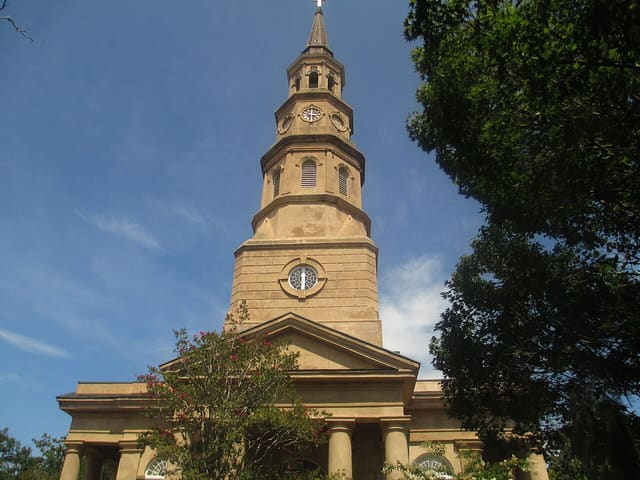
Here is the round part. In 1804 the congregation needed a bigger building, and a member named Martha Laurens Ramsay proposed a circular form. Robert Mills, the Charleston architect who also designed the Washington Monument, drew up the plans. He gave them a domed hall 88 feet across, with seven great doors and 26 windows, room for some 2,000 people. One visitor in 1818 called it the most extraordinary building in the United States. Charleston's verdict was a bit less reverent. People laughed that it had no steeple, and kept laughing for years, until 1838, when the congregation stopped the jokes by raising a New England-style steeple 182 feet over Meeting Street.
The pews of that church held two governors and the editor of the Charleston Courier. They also held many slaves and poor people whose names, as the church's own history puts it, were unknown to anyone beyond its walls. After the Civil War, in 1867, the Black members left to found their own congregation, Plymouth Congregational Church.
Then came December 11, 1861. A fire started near the Cooper River and swept all the way across the city overnight. Mills's round church was destroyed. When the congregation finally built again, they chose this Romanesque design, and they reused bricks from Old Circular to do it. So the round church is still here, in a way. It's just in the walls.
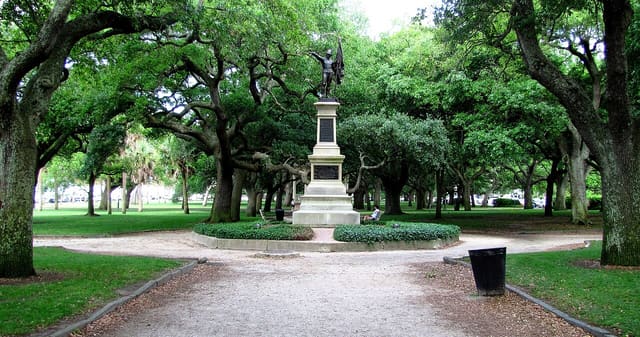
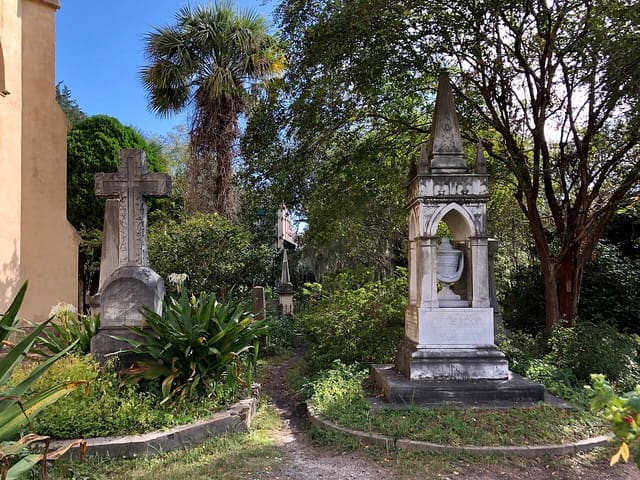
Walk to the side and you'll find the graveyard, the oldest known burial ground in the city, with monuments dating to 1695. Ghost tours tell plenty of stories about it, of grieving fathers, children and soldiers among the weathered stones and the oaks. Whatever you make of those tales, the graveyard has stood through the Civil War, fires, floods, earthquakes and hurricanes.
When you're ready, head southwest, then turn left onto Gateway Walk, about seven minutes. It leads to the Unitarian Church graveyard, founded by a congregation that split off from this one.
Hear it where it happened. It plays at stop 5 of Haunted Charleston Walking Tour (3 min), narrated as you walk. Unlock the tour for the audio, or try stop 1 free first.