The whole storyStop 3 of Charleston Walking Tour: Rainbow Row to the Battery
The Church the Government Ordered Built
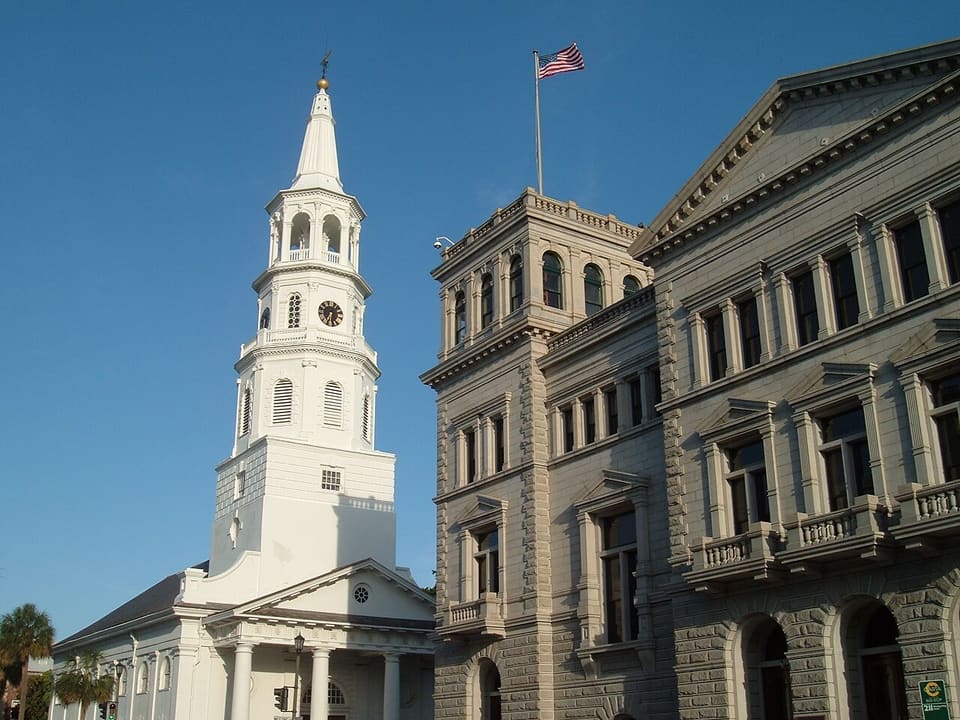
You're standing at the corner of Broad and Meeting, the crossing Charlestonians call the Four Corners of Law. Look at the white church on the corner, St. Michael's, and find the two-story portico with its row of plain Tuscan columns. When it went up, it was the first of its size in colonial America.
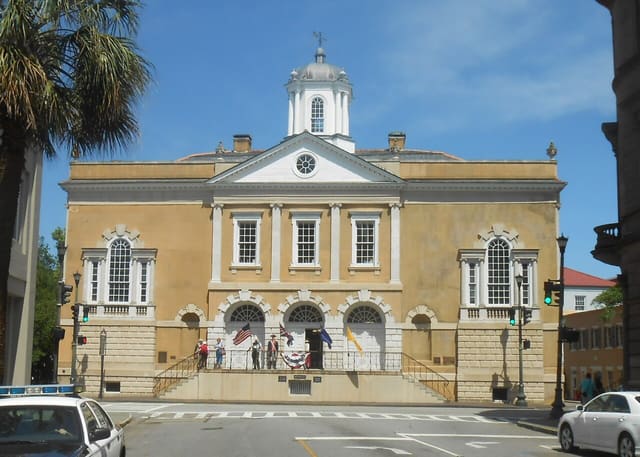
The nickname for this intersection came surprisingly late, and from an unlikely source. Robert Ripley, the man behind Ripley's Believe It or Not!, coined it. City Hall stands on one corner for city law, the county courthouse on another, and a federal post office and courthouse on a third. St. Michael's holds the fourth, for the law of the church.
That last corner made more literal sense here than you might expect. In colonial South Carolina, the Church of England was the official church, and St. Michael's was not founded by a pious congregation passing the plate. It was built by order of the South Carolina Assembly, the colony's legislature.
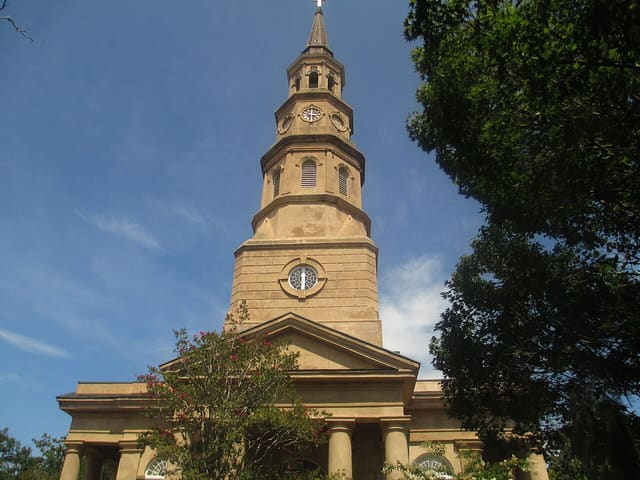
The spot had been holy ground for a long time. In 1681 the parish of St. Philip's put up a wooden church right here. A hurricane in 1710 damaged it, and St. Philip's built a new church a few blocks away on Church Street. In 1727 what was left of the old wooden church was demolished. Then, starting in 1751, a builder named Samuel Cardy raised the brick church you see now, stuccoed and painted white. Nobody knows who designed it, but it shows the influence of St Martin-in-the-Fields in London. It took about ten years, and it is the oldest surviving church building in Charleston.
George Washington worshipped in pew 43 during his 1791 visit to the city.
Now step inside in your mind, to the wall behind the altar. The church once had a window there. In 1788, to keep fire from leaping in from neighboring buildings, the opening was enclosed and the window was lost to sight. In 1865, Union shells struck the wall during the Civil War, and there was the old window's location, exposed by the war that began in this harbor. Today that spot holds a stained glass window of St. Michael defeating Satan, installed in 1893.
Listen for the tower clock striking the quarters. The bells up there were cast in London in 1764, and recast in 1866. Then, in 1870, one bell went back to London yet again, this time at Charleston's expense.
When you're ready, walk west for about seven minutes, roughly 440 meters, to the next stop.
Hear it where it happened. It plays at stop 3 of Charleston Walking Tour: Rainbow Row to the Battery (3 min), narrated as you walk. Unlock the tour for the audio, or try stop 1 free first.