Stories
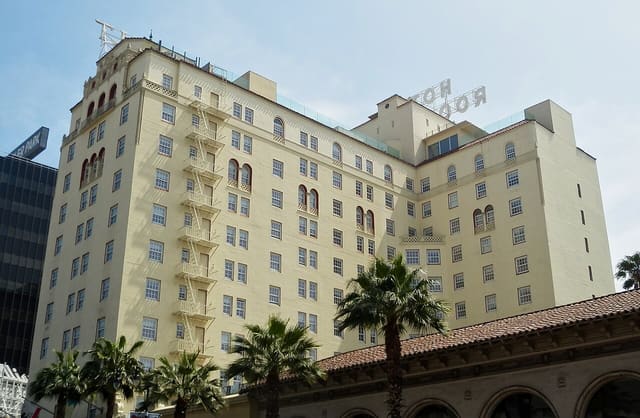
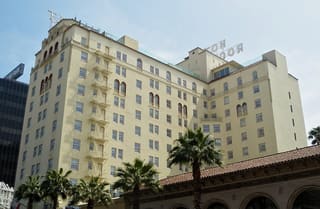
Hollywood Roosevelt HotelPhoto: Alexander Migl, CC BY-SA 4.0, via Wikimedia Commons
Walking tour · Los Angeles

Hollywood Walk of Fame Walking Tour: Chinese Theatre to Hollywood and Vine

Starts at Hollywood Roosevelt Hotel, 4 min from Hollywood/Highland station1 h 24 min10 stops2.2 mi

Start the walk

Self-guided audio, told stop by stop. All 10 for $4.99, for your whole group on up to 4 phones. 83 facts backed by 26 public sources. Refund within 7 days.

Not going yet? Email me this walk

The link and where it starts. One email, nothing else.

The Stories app plays each stop by itself as you arrive, phone in your pocket. Get the app

See the 10 stops

Before you go

Start
Hollywood Roosevelt Hotel.
Finish
The Pantages Theatre, 6233 Hollywood Boulevard, Los Angeles, CA 90028.
Distance and time
2.2 mi on foot. About 1 h 24 min with all 10 stories; the walking alone is about 52 min.
Getting there
Hollywood/Highland station is a 4-minute walk from stop 1. From the last stop, Hollywood/Vine station is 2 minutes away.
Parking
Ovation Parking, a 6-minute walk (paid underground garage).
Restrooms
No public restrooms are mapped within a block or two of the route.
Steps and access
No steps or cobblestones are mapped on the route.

Where no source is named, stations, parking, restrooms and steps are as OpenStreetMap maps them (read November 2026), with walking minutes at an easy pace. Hours and prices change: check the official sites on the day.

The 10 stops

  1. Photo: Alexander Migl, CC BY-SA 4.0, via Wikimedia Commons

    1Start hereFree

    Hollywood Roosevelt Hotel

    The Awards Night With No Suspense

    Free sample · 2:35
    0:002:35

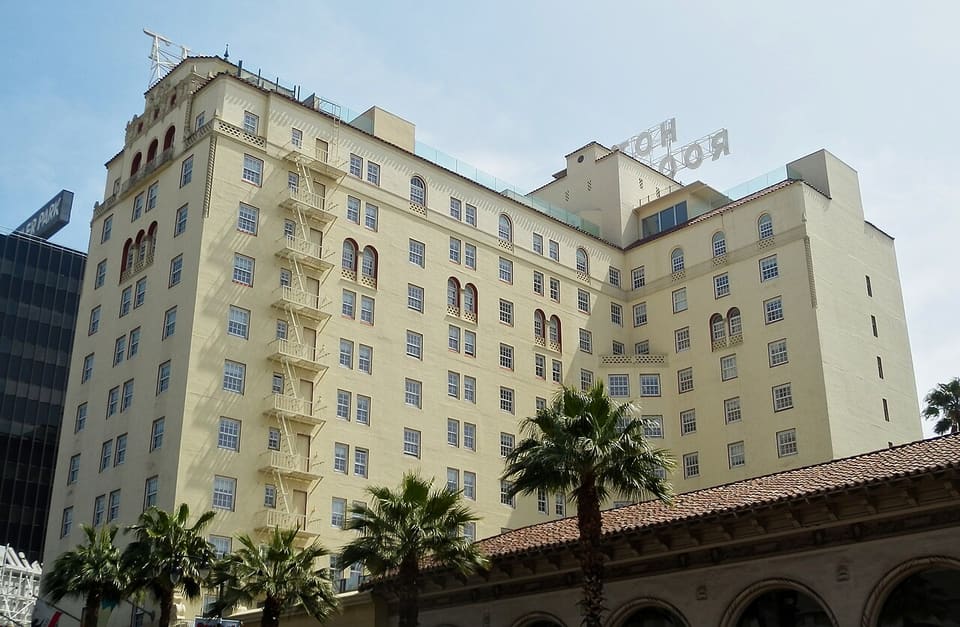
    Twelve stories up, the name Hollywood Roosevelt stands against the sky, so tip your head back toward the roofline. The hotel sits on Hollywood Boulevard, straight across the street from the Chinese Theatre, and you're right outside it. That building is where Hollywood first handed itself a prize.

    The Roosevelt opened on May 15, 1927, financed by a group that included the studio boss Louis B. Mayer, the theater showman Sid Grauman, and Hollywood's most famous married couple, Mary Pickford and Douglas Fairbanks. It was named for Theodore Roosevelt.

    Two years and one day after it opened, on May 16, 1929, the industry came calling. Inside the hotel's Blossom Ballroom, the Academy of Motion Picture Arts and Sciences held its first awards. The host was the Academy's president, that same Douglas Fairbanks, so in a sense he was throwing a party at his own hotel.

    It was nothing like the night you picture. It was a private ceremony open only to Academy members, with 270 people in attendance. And there was no suspense at all, because the winners had been announced three months earlier. Everyone in the room already knew who was going home with a statuette. Nobody even called it an Oscar yet. The nickname would be introduced four years later.

    Now jump ahead to 1986, when one of those statuettes turned up for sale. Lyle Wheeler was a five-time Academy Award winner, and he was facing heavy debt. He sold boxes of his possessions, including his five Oscars. The one he'd won for art direction on The Diary of Anne Frank was auctioned for $21,250 to a buyer named William Kaiser.

    Then Kaiser did something unusual. He gave it back. In 1989, he returned the award to Lyle Wheeler at a ceremony held right here at the Roosevelt, in the hotel where the Academy Awards were born. Sixty years after that first quiet banquet, one statuette came home.

    The hotel itself nearly lost its looks. It went into decline in the 1950s, and an owner around that time demolished its archways, covered up its painted ceilings, and painted the entire place seafoam green. In the 1980s, a renovation working from original blueprints and historic photos restored the Spanish Colonial architecture. And if you hear that Marilyn Monroe is part of the building's story, that one is true: she lived here for two years early in her career.

    When you're ready, walk north, turn left onto the Walk of Fame, then turn left onto Ovation Parking, about 330 meters and five minutes, to the next stop.

    The winners of the first Academy Awards were announced three months before the ceremony.

    Look for the hotel's name sign on the roofline; the twelve-story hotel facing the Chinese Theatre.
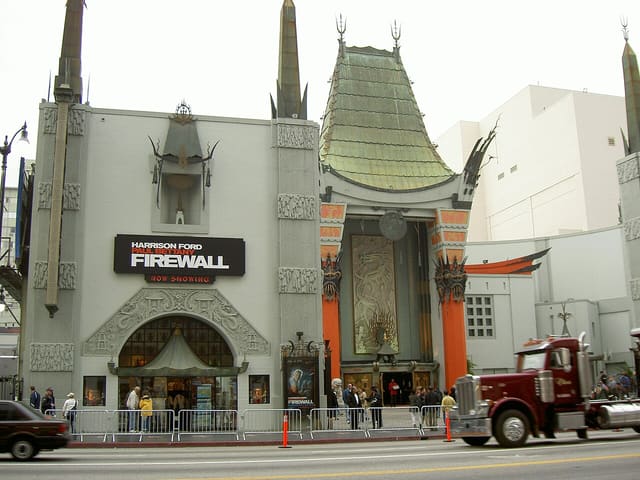
  2. Photo: Mr Bullitt, CC BY 2.5, via Wikimedia Commons

    25 min walk · 3 min story

    The Chinese Theatre

    Who Really Stepped in the Wet Cement?

    Sid Grauman said he accidentally stepped into the Chinese Theatre's wet concrete.

    Look for the concrete blocks with handprints and footprints in the forecourt; Klossner's 1927 handprint and autograph near the right-hand poster kiosk.

    Five million dollars bought an electronics company the right to put its name on this building in 2013, so officially it's the TCL Chinese Theatre. Everyone on Hollywood Boulevard still just calls it the Chinese, and you're right out front. Now drop your eyes to the open courtyard in front of the doors. Those grey concrete squares are covered in signatures, handprints and footprints, the movies' own guest book, running from the 1920s to now.Read the story

    The man behind all this was Sid Grauman, a theater showman who had already built the Million Dollar Theatre downtown and the Egyptian, just down this boulevard, which opened in 1922. The Egyptian was such a hit that Grauman wanted a second palace, even bigger. He leased the land where the actor Francis X. Bushman's mansion stood, and he brought in partners Mary Pickford and Douglas Fairbanks, the most famous couple in Hollywood. Early newspaper stories promised a 5 million dollar building with a tropical garden out front: imported flowers, trees, even fish in ponds. What actually got built cost about 2 million, and the garden became this courtyard of concrete.

    That building is a fantasy of China, not a copy of any real place. At the groundbreaking in January 1926, one of the stars turning the first spadeful of earth with a gold-plated shovel was Anna May Wong, a Chinese American actress. She later put the first rivet into the building's frame. In those same years, Hollywood mostly gave her stereotyped roles.

    The theater opened on May 18, 1927, with Cecil B. DeMille's The King of Kings. But the thing people still line up to see is out here on the pavement, and nobody can agree how it started.

    The theater's official version says the actress Norma Talmadge stepped into wet concrete by accident. Grauman himself, on the radio in 1937, said it was him. In his words: "pure accident. I walked right into it." Then, he said, he went straight to Mary Pickford, and she put her foot in too. A Hollywood historian tells yet another version, with stars stepping off the curb and leaving a trail of footprints to the doors. And Jean Klossner, the mason Grauman hired to mix an extra-hard concrete for this courtyard, said he signed his own work and he and Grauman came up with the idea together. Then, in 1949, Klossner changed his story and said Grauman had stepped in it.

    So the most famous accident in Hollywood has at least four authors. That may be the most Hollywood thing about it. What isn't in doubt is that Klossner became known as Mr. Footprint and ran the ceremonies for 30 years. Look near the right-hand poster case. His own handprint and autograph are still there, dated 1927. The man who poured the legend left his mark too.

    When you're ready, walk north on Ovation Parking, about four minutes, to the Dolby Theatre, where the Oscars are handed out now. The Chinese hosted them three times in the 1940s.

    The audio plays when you unlock the walk.

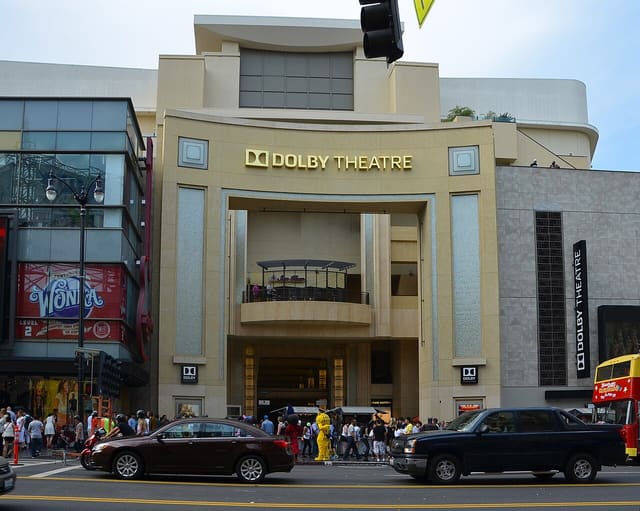
  3. Photo: File:Dolby_Theatre.jpg: Adam Fagen from Washington, DC, USA derivative work: Jullit31, CC BY-SA 2.0, via Wikimedia Commons

    34 min walk · 3 min story

    Dolby Theatre

    The Oscars Finally Get a Home

    Its Best Picture columns have spaces through 2071, but the Oscars will move in 2029.

    Look for the columns lining the hall with Best Picture winners' names; the blank spaces left on the columns; the grand stairway at the rear of the complex.

    The names of Best Picture winners are written on the columns of this long hall. It runs from the boulevard toward a grand stairway, inside the shopping complex at Hollywood and Highland that locals still call by that corner's name. Look all the way down it, past the columns on both sides, to the Dolby Theatre sitting at the very back. Keep looking. A lot of the spaces are blank.Read the story

    Those blanks are the story of this building. It was designed specifically with the Oscars in mind.

    From 1929 to 2001, the Academy of Motion Picture Arts and Sciences staged 73 ceremonies at nine different venues. Grauman's Chinese, right next door, had a turn. The show also landed in big halls like the Dorothy Chandler Pavilion downtown and the Shrine Auditorium, and those caused logistical headaches for a ceremony that had become a live television broadcast.

    So the Academy teamed up with a Canadian developer called TrizecHahn. Negotiations began in August 1997, and seven months later they agreed on a 20-year lease for a theater built around the show. The architect David Rockwell went to work, consulting extensively with the people who actually produce television in this town. What they built looks like a grand theater, but underneath it thinks like a TV studio. There's an underground cable bunker that crosses beneath the building to truck locations on the adjacent streets. There's a cockpit in the orchestra seats for the camera, sound and stage crews. The stage is one of the largest in the country, about 113 feet wide. The house, by comparison, is modest, around 3,300 seats.

    It opened in November 2001, and on March 24, 2002, the Oscars came home to Hollywood for the first time since 1960, when the ceremony was held at the Pantages. Before the ceremony, the building gets dressed like a film set: red drapery hiding the storefronts, sometimes a different sign out front, and the red carpet running right up that stairway.

    The name on the door has its own plot twist. It opened as the Kodak Theatre, after Eastman Kodak paid 75 million dollars for the naming rights. Then in early 2012 Kodak, the company that sold the world its film, filed for bankruptcy. For a while the movies' biggest stage was renamed the Hollywood and Highland Center, at its landlord's suggestion, until Dolby, the sound company, signed a 20-year naming deal.

    And here's the turn nobody planned for. It was announced that starting in 2029 the Oscars will move to the Peacock Theater downtown. The Dolby was built to give the show a permanent home. Those blank columns are set up through 2071. Who will fill them in is suddenly an open question.

    Head back out toward the boulevard: walk northwest on Ovation Parking, turn left onto the Walk of Fame, then left onto Alley 87830, about eight minutes. Across the street waits the El Capitan, where Disney rolls out its premieres.

    The audio plays when you unlock the walk.

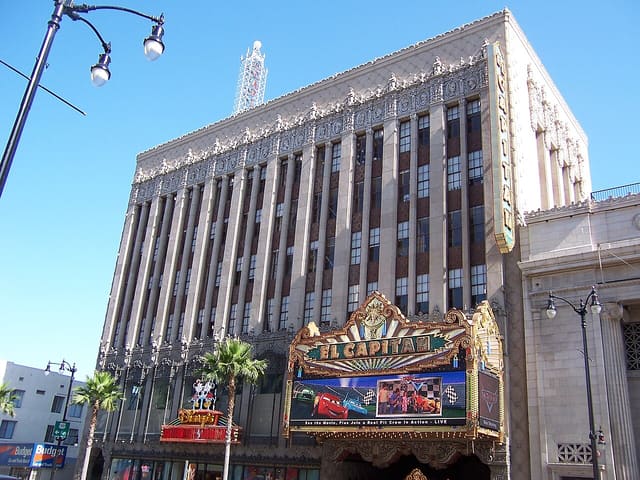
  4. Photo: Unknown author, CC BY-SA 2.5, via Wikimedia Commons

    48 min walk · 3 min story

    El Capitan Theatre

    The Theater That Saved Citizen Kane

    Citizen Kane had its world premiere at the El Capitan Theatre in 1941.

    Look for the Italian Baroque facade; the sign tower; the soda fountain next door.

    Carved swirls and flourishes cover the whole face of the El Capitan Theatre, the ornate building with the tall sign tower on Hollywood Boulevard. The Dolby is right across the street behind you, so keep your eyes on this side. That style is Italian Baroque, and what you're looking at is the original, saved and restored. Hold on to that word, saved, because this building has needed saving more than once.Read the story

    The El Capitan opened on May 3, 1926, and it wasn't built for movies at all. Charles Toberman, the developer people called the Father of Hollywood, wanted a real theater district here, and this was billed as Hollywood's First Home of Spoken Drama. Live plays. Over the next decade it staged more than 120 productions, with names like Clark Gable and Joan Fontaine.

    Then the Depression hit, the plays thinned out, and the El Capitan started showing films to survive. That's how it ended up with the most famous premiere it ever hosted.

    In 1941, Orson Welles, a young director, had a problem. His first feature, Citizen Kane, was a thinly veiled portrait of the newspaper baron William Randolph Hearst, and theater owners were afraid to touch it. Welles couldn't find anyone willing to take the risk. The El Capitan took it. Citizen Kane had its world premiere right here, a film now routinely called one of the greatest ever made, launched by a struggling playhouse that had little left to lose.

    Within a year Paramount bought the place, renamed it the Hollywood Paramount, and modernized it, hiding the old decor behind curtains and tearing out the box seats. For decades, that's what it was.

    Here's the turn. Late in the 1980s, Disney bought into the theater chain that ran it, and spent 14 million dollars uncovering what Paramount had covered up. The old ornament came back. So did the old name. The El Capitan reopened in 1991 with Disney's The Rocketeer, and it has been Disney's showcase ever since, where most of the studio's premieres happen. Toy Story premiered here in 1995. Disney even took over the Masonic hall next door to build a pop-up Toy Story attraction.

    And it nearly ended again. The 1994 Northridge earthquake damaged the frame, the sprinklers flooded the inside, and inspectors called it uninhabitable. The owner simply walked away and left it to the mortgage company. That lender, with Disney as a loyal tenant, paid to repair it all.

    One small absurdity to finish. Inside is a Wurlitzer organ built for a San Francisco movie palace in 1929. And next door, you can buy ice cream themed to whatever's playing. Citizen Kane never got a sundae.

    Walk east down the alley beside the theater, turn left, then left again back onto the Walk of Fame. It's about two minutes to the Hollywood Masonic Temple, where Masons met for decades.

    The audio plays when you unlock the walk.

  5. Photo: Los Angeles, CC BY-SA 3.0, via Wikimedia Commons

    52 min walk · 3 min story

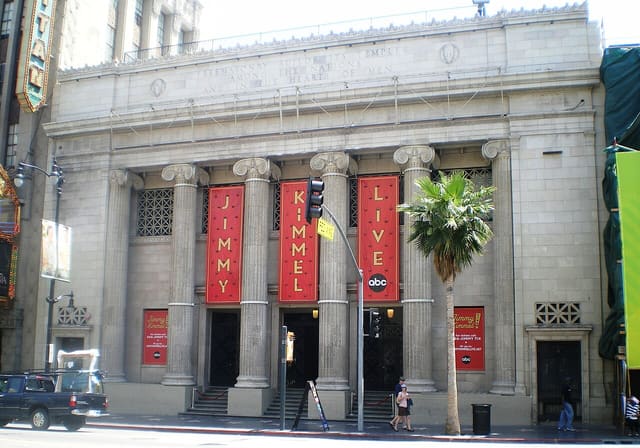
    Hollywood Masonic Temple

    The Temple That Couldn't Pay Its Bills

    The Masons sold their Hollywood temple because they couldn't afford required safety upgrades.

    Look for the six oversized Ionic columns; the eight stone steps to the wooden doors; the Masonic motto and medallions carved in the roof parapet.

    The Hollywood Masonic Temple sits on Hollywood Boulevard, right next door to the El Capitan, and it looks like a building that wandered in from ancient Greece and decided to stay. Face it and count the six oversized columns across the front. Then follow the eight stone steps up to the heavy wooden doors. Then look up at the top edge of the roof, where a Masonic motto is carved into the stone between two round medallions.Read the story

    The Masons built this place in 1921, and they built it to impress. The man behind it was Charles Toberman, the lodge master and a real estate developer who also had a hand in the Hollywood Bowl, the Roosevelt Hotel and the Chinese Theatre. Toberman more or less assembled Hollywood Boulevard, and this was his lodge. Inside there was a ballroom, a pipe organ, a billiard room and a ladies' parlor. One writer called it unsurpassed for beauty.

    And the members were Hollywood royalty. Douglas Fairbanks, Cecil B. DeMille, D.W. Griffith, Harold Lloyd, John Wayne, Oliver Hardy. When Griffith, the director, died in 1948, more than 300 people crowded in here for his memorial.

    But the money never stayed steady. During the Great Depression, many members lost their savings, and the Masons had to rent out the ground floor to a social club. That club installed an illegal slot machine. Inside a Masonic temple. They recovered after the war, but by the late 1970s membership was falling. In 1980 the lodge moved out to Van Nuys. And by 1982 the Masons couldn't afford the upgrades needed to meet new fire and earthquake codes. They sold.

    What came next was a decade of big dreams that didn't last. A singer named Rosita LaBello turned it into an opera company that staged only a few productions before failing. Then came a renovation into a cabaret, a jazz theater and a dance club, reopened in 1987 as Hollywood Live. That didn't last either.

    The turn came from next door. In 1995, Disney rented the building for a promotional funhouse tied to the Toy Story premiere at the El Capitan. Three years later, Disney simply bought it, from a bankrupt owner, for about 3.6 million dollars. They restored the old stone filigree, iron torchères and tiles, even the post boxes the Masonic officers once used. And since January 2003, the old lodge theater has been home to Jimmy Kimmel Live.

    One more thing. People say a tunnel once ran from here under the boulevard to the Chinese Theatre, so stars could dodge the crowds. Nobody has ever proved it existed. What is certain is underfoot. In 1969, Harold Lloyd, a longtime member of this lodge, got his star on the Walk of Fame. They put it directly in front of the temple.

    When you're ready, walk east along the Walk of Fame, about six minutes, to the Egyptian Theatre, where Hollywood threw one of its very first red-carpet premieres.

    The audio plays when you unlock the walk.

  6. Photo: Photo: Andreas Praefcke, CC BY 3.0, via Wikimedia Commons

    66 min walk · 3 min story

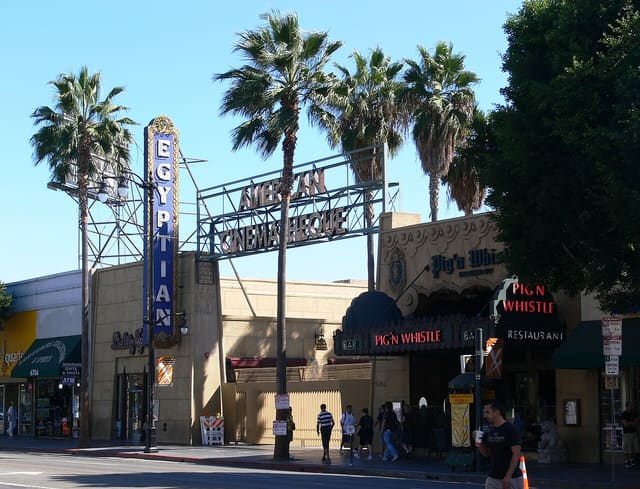
    The Egyptian Theatre

    The Night Hollywood Invented the Premiere

    The Egyptian hosted what is remembered as Hollywood's first movie premiere.

    Look for the long open forecourt; the four 20-foot columns at the entrance; Egyptian paintings and hieroglyphs on the walls.

    A long open courtyard runs back from the sidewalk on Hollywood Boulevard to the Egyptian Theatre, and you're right at the mouth of it. Look down its length to the four massive columns at the far end, each about 20 feet tall, and the painted walls covered in Egyptian figures and hieroglyphs. That courtyard is the whole reason for this stop. It was built for a crowd.Read the story

    The man who built it was Sid Grauman, a showman who had already run a movie palace downtown, and who you met back at the Chinese Theatre. He put up the Egyptian with a developer named Charles Toberman, the same man behind the El Capitan. It took 18 months and about 800,000 dollars, and it opened in 1922, when the whole country had a fever for all things ancient Egypt.

    Grauman's problem was simple. Movies opened quietly. You bought a ticket, you went in. Grauman wanted an event. So his opening film, Robin Hood, starring Douglas Fairbanks, the biggest swashbuckler in silent movies, didn't just open. It premiered. This is remembered as the first Hollywood movie premiere, and the theater's own history credits it with introducing the original red carpet.

    That's why the courtyard is shaped the way it is. It's about 150 feet deep, designed to host red-carpet ceremonies out in the Southern California sun. Back then it served as the theater's entrance hall. The front doors opened straight into the auditorium, so the long walk you're looking at was the lobby, open to the sky and to everyone watching.

    And it worked. Robin Hood ran for nearly five months. In its first three years, the Egyptian showed only four movies. Premieres of The Ten Commandments, The Thief of Bagdad and Charlie Chaplin's The Gold Rush followed. More than 40 theaters across North America copied the Egyptian look, from Brooklyn to Boise.

    Here's the dry footnote. Glance up at the roof edge if you can see it, and some of those panels look Spanish, not Egyptian. The theater was apparently planned in a Spanish style first, and the likely story, never confirmed, is that the roof pieces had already been bought and delivered. Nobody wanted to waste them.

    The Egyptian's reign was short. In 1927, Grauman opened the Chinese up the street, with its handprints in the cement, and the crowds moved on. The Egyptian slid into re-runs and decay and finally closed in 1992. The city sold it for one dollar to the American Cinematheque, on the condition that it be restored. Netflix bought it in 2020 and spent more than 70 million dollars restoring it again, and it reopened in 2023.

    So stand in that courtyard for a second. Every red carpet you've ever seen on television started with a walk like this one.

    When you're ready, walk north, then turn right onto the Walk of Fame. It's about three minutes to Musso & Frank Grill, where Hollywood's writers came to drink.

    The audio plays when you unlock the walk.

  7. Photo: peter boy12qq12, CC BY 3.0, via Wikimedia Commons

    73 min walk · 3 min story

    Musso & Frank Grill

    The Bar Where American Novels Drank

    A later owner named Mosso was no relation to the Musso in the restaurant's name.

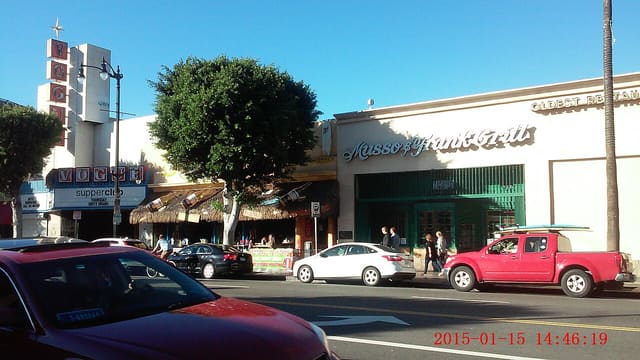
    Look for the neon sign; the glass brick windows; the flagstone wall.

    Neon spells out Musso & Frank Grill above the door, and the oldest restaurant in Hollywood is right in front of you on Hollywood Boulevard. Look over the glass brick windows, the flagstone wall and the recessed doorway under that sign. Each one was cited when this block went on the National Register of Historic Places. Inside, the waiters still wear red coats, as they have for decades.Read the story

    The name on that sign tells a small fib. Musso & Frank opened in 1919, but not as Musso & Frank. A French immigrant named Firmin Toulet, who went by Frank, started it as Frank's François Café. Only in 1923, when he took on a partner named Joseph Musso, did it get the name you see. Four years later both men sold out, to Joseph Carissimi and John Mosso. Mosso, with an O, was no relation to Musso, with a U. That's either a remarkable coincidence or the easiest sign change in Hollywood history. Mosso's descendants still own the place.

    Now the real story: how a steak house became a writers' bar.

    In 1919, the money and politics of Los Angeles sat downtown, and getting there from Hollywood was a genuine trek. So the people who ate here weren't bankers. They were the bohemians and intellectuals drifting out to this new movie town. By the 1930s, two neighbors sealed it. The Screen Writers Guild had its office across the street. And right next door was Stanley Rose's bookstore. Rose, a bookseller, loved hard-boiled fiction, and the writers of it hung around his back room. Then they wandered next door to the bar here and stayed for hours.

    James M. Cain. Raymond Chandler. Nathanael West, who put Musso & Frank into his Hollywood novel The Day of the Locust. John Fante. Dashiell Hammett. Dorothy Parker. William Faulkner and F. Scott Fitzgerald, both in town writing for the studios. The California historian Kevin Starr said the list of regulars resembles "the list of required reading for a sophomore survey of the mid-twentieth-century American novel."

    The bar drew politics too. The actor Will Geer, a Communist Party member, met here regularly with young radical writers and actors in the late 1930s and 1940s.

    Here's the turn. By the 1940s, the legend had become its own draw. Young writers like Charles Bukowski came to drink here on purpose, hoping some of Chandler and Faulkner might rub off. The bar that writers found by accident became the bar writers chose as a costume.

    The kitchen has its own Hollywood story. Mary Pickford and Douglas Fairbanks brought a recipe home from their honeymoon in Italy, and in 1927 Musso & Frank became the first restaurant in America to serve fettuccine Alfredo. And in 2019, on its hundredth birthday, it became the first restaurant to get a star on the Walk of Fame you're standing on.

    When you're ready, walk east along the Walk of Fame, about 17 minutes, to the Capitol Records Building, a tower that looks like a stack of records.

    The audio plays when you unlock the walk.

  8. Photo: Downtowngal, CC BY-SA 3.0, via Wikimedia Commons

    817 min walk · 3 min story

    Capitol Records Building

    The Record Stack Nobody Meant

    Capitol's president wanted a rectangular building, but the lender preferred it round.

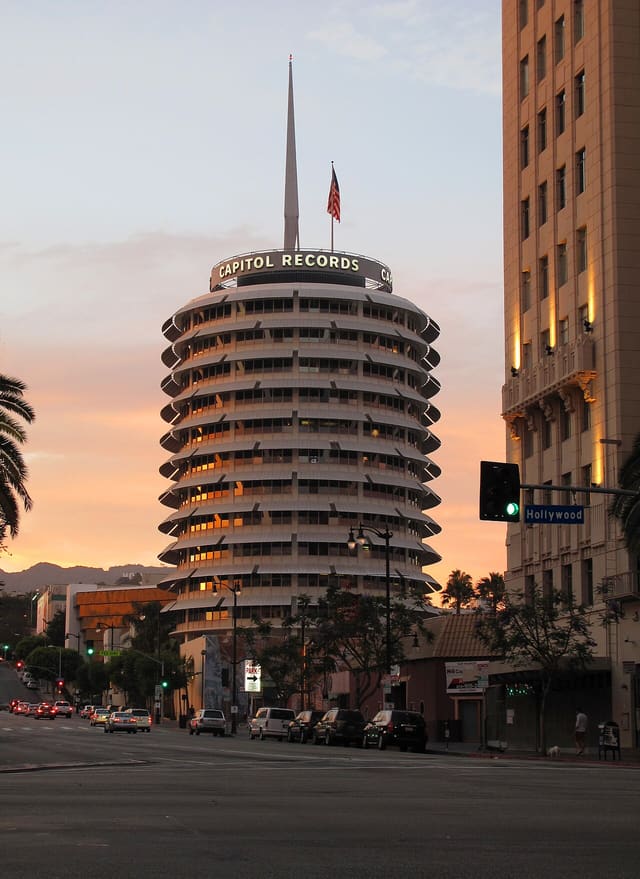
    Look for the round tower's curved awnings on each floor; the spike on top of the tower; the blinking light at the top.

    A pile of records on a turntable, with the spindle pointing at the sky, is what nearly everyone sees first when they look up from this spot. That round white tower rising just north of Hollywood and Vine is the Capitol Records Building. Tip your head back and take it all in, thirteen stories of wide curved awnings stacked one on another, with a tall spike rising from the top.Read the story

    That resemblance is the joke at the heart of this place, because nobody planned it. The man who drew this tower was Louis Naidorf, and he was 24 years old. He was a young architect at Welton Becket Associates, and the design grew out of drawings he'd made in graduate school. It is considered the world's first circular office building.

    Naidorf's firm kept the client's identity secret. So the stack of records, the spindle, was a coincidence. A record company got a building that looks like a record player, and the man who designed it was working without knowing who the client was.

    The client almost said no. Capitol Records had just been acquired by the British company EMI in 1955, and Capitol's president, Glen Wallichs, wanted to bring the label's West Coast operations under one roof. When he saw the round design, he insisted on a rectangle. Naidorf, sensibly, drew him both. Wallichs took the two designs to his lender. And the lender, of all people, felt the round one would attract attention, which would make it easier to lease. Wallichs conceded. The banker, not the artist, is why Hollywood has this skyline.

    The tower was finished in April 1956, and its height wasn't an accident either. The city capped buildings at 150 feet back then, and thirteen stories fit under it. Inside, the top floor doesn't call itself thirteen. It is the Executive Level, and on the elevator buttons it's simply E.

    That spike on top carries a light, and at night it blinks a word in Morse code: Hollywood. That was the idea of another Capitol president, Alan Livingston, who wanted to advertise Capitol's status as the first record label with a base on the West Coast. The person who switched it on was Leila Morse, the granddaughter of Samuel Morse himself.

    And the real treasure is underground. Below your feet are eight echo chambers engineered by the guitarist Les Paul, more than 20 feet down. The first album recorded in this tower was by Frank Sinatra, and the Neumann U 47 microphone he carried around with him is still there, often used for studio sessions. Nat King Cole sold so many records for Capitol that people call this place the House That Nat Built. Capitol even printed a graphic of this tower on albums, under the words "From the Sound Capitol of the World." Not bad for a building whose architect's client was kept secret from him.

    Walk east, then turn left onto the Walk of Fame, about 370 meters and six minutes, to Hollywood and Vine, the corner that became a legend and the place to learn how a name ends up in the sidewalk.

    The audio plays when you unlock the walk.

  9. Photo: Alen Ištoković, CC BY 3.0, via Wikimedia Commons

    96 min walk · 3 min story

    Hollywood and Vine

    The Corner That Was Mostly a Voice

    Before 1903, Hollywood and Vine was part of Daeida Beveridge’s lemon grove.

    Look for the round Apollo 11 Moon markers on the corner sidewalks; the 12-story Taft Building on the southeast corner; the Equitable Building on the northeast corner.

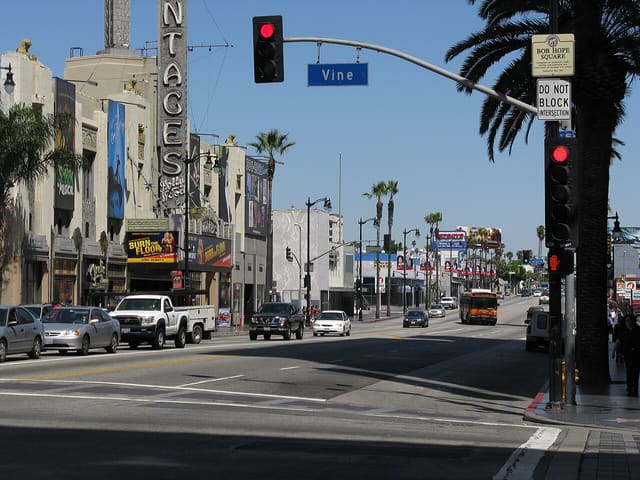
    Neil Armstrong, Buzz Aldrin and Michael Collins, the crew of Apollo 11, are waiting for you at Hollywood and Vine, the most famous street corner in a town built on fame. Look down at the sidewalk near the curb on any of the four corners. Their markers are the round ones, shaped like the Moon. The Walk of Fame centers on this crossing, and when the astronauts were added, someone decided only all four corners would do. Three men who flew to the Moon, honored on a sidewalk built for actors.Read the story

    Now turn to the southeast corner and the tall, pale twelve-story building. That's the Taft Building, and it holds the real story of this corner.

    A little over a century ago, there was nothing here but lemon trees. The land belonged to Daeida Beveridge, one of the founders of the town of Hollywood. In 1903 she let one corner of this dirt crossing be used for a church, the Hollywood Memorial Church. It didn't last long. In 1923 it came down, and the Taft Building went up in its place, the first high rise at Hollywood and Vine.

    What happened inside the Taft explains the legend. In Hollywood's golden age, every studio kept offices there. So did Charlie Chaplin. So did Will Rogers. So did the Academy of Motion Picture Arts and Sciences. Across the street, the Equitable Building on the northeast corner filled up with talent agents and advertising men. Through the 1920s, radio and movie businesses packed in so tightly that this became the second busiest intersection in Los Angeles.

    Then radio turned it into a myth. In the 1930s, station KFWB told listeners it was broadcasting live from Hollywood and Vine. Gossip columnists like Hedda Hopper and Jimmie Fidler kept dropping the name. Millions of people who would never see Los Angeles learned to picture this corner as the place where stars simply walked by.

    Here's the catch. The movies were mostly made somewhere else, on studio lots spread across the city. Hollywood and Vine was where the business had its offices, its lunches and its microphones. It was famous largely because it was famous.

    And when the money moved on in the 1960s, the corner fell hard. Offices and stores sat empty. For decades, tourists arrived expecting glamour and found boarded windows. The comeback started underground, with the subway station that opened here in 1999, and the new towers around you followed.

    The stars in the sidewalk came in 1960, right as the decline began. Getting one still works the way it long has: someone nominates an honoree to the Hollywood Chamber of Commerce, and a committee chooses who makes the cut. Fame by application, at the corner that radio made famous by repetition.

    When you're ready, walk north on Vine Street, about a minute, to the Pantages Theatre, a 1930 Art Deco movie palace with a bar tucked inside that's been pouring drinks since 1934.

    The audio plays when you unlock the walk.

  10. Photo: Blahmemucus, CC BY-SA 4.0, via Wikimedia Commons

    101 min walk · 3 min story

    The Pantages Theatre

    The Palace That Learned to Sing

    Ten floors of offices were planned above the Pantages Theatre, but they were never built.

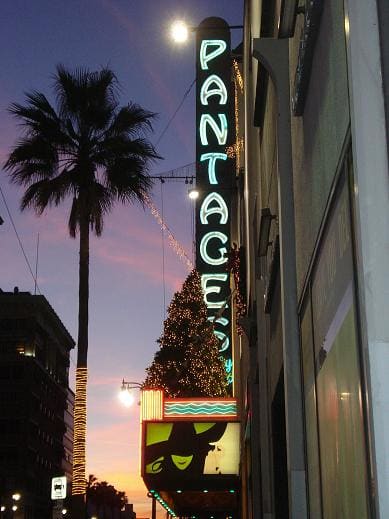
    Look for the sculpted goddesses on the roofline; the spiked finial atop the parapet; the zigzag metal frames around the first-story windows.

    Alexander Pantages built theaters across the West, and his last one is right in front of you on Hollywood Boulevard, just east of Vine. Look up past the marquee to the roofline. Sculpted goddesses stand along the top, and above them rises a slender spiked finial. Now look at the windows on the first story, outlined in metal zigzags. This is Art Deco at full volume, and it was built to sell one thing: the movies.Read the story

    Alexander Pantages was a vaudeville impresario who had built a whole chain of theaters across the West. This one was his last. It opened on June 4, 1930, with a Marion Davies picture on the screen and a live stage revue on the same bill. It was also the last movie palace ever built in Hollywood. And the timing could hardly have been worse. The Great Depression was arriving just as the curtain went up.

    The building you see is only part of the plan. The architect, B. Marcus Priteca, drew it as a twelve-story tower: two floors of theater with ten floors of offices stacked on top. The offices were never built. As late as 2007 there was talk of finally finishing the job. It still hasn't happened. So the Pantages has spent almost a century as the base of a skyscraper that doesn't exist.

    By 1932, the live acts were mostly gone, and Pantages sold out to Fox. The theater became a movie house. Then, in 1949, the billionaire Howard Hughes bought it for his RKO chain and moved his personal offices upstairs, to the second floor. That same year the Academy Awards moved in. For a decade, from 1949 to 1959, the Oscars were handed out right here, the first ones ever broadcast on television.

    Here's the turn. In January 1977, the Pantages closed as a movie theater. One month later it reopened with a stage musical, Bubbling Brown Sugar. Then came Beatlemania, Man of La Mancha, and Yul Brynner in The King and I. It never went back. Vaudeville had been Alexander Pantages's whole business, and nearly fifty years after he opened the place, live performers had finally reclaimed his stage.

    It turned out to be a very good stage to reclaim. At 180 feet wide, it's the second largest west of Chicago. After a ten-million-dollar restoration in 2000, The Lion King settled in for 27 months straight. Wicked and Hamilton followed. The five biggest weeks in Los Angeles theater history all happened in this building.

    One honest note before you go in, or look through the doors. Above the stage, the painted panels celebrate Apollo, California oil, and Native Californians, an image of the people whose land all of this was built on, painted in an era that rarely asked them.

    So this is where the boulevard you've walked ends up: a movie palace that outlived the movies, by going back to the show.

    That's the end of the walk. The stars under your feet run on in both directions, so take your time, and enjoy the show.

    The audio plays when you unlock the walk.

The whole walk

10 stories across Los Angeles

1 h 24 min · 10 stops · 2.2 mi

Starts at Hollywood Roosevelt Hotel and ends at The Pantages Theatre.

  • Plays right here in your browser, or in the app
  • One purchase for your group, on up to 4 phones
  • Refunded within 7 days if it isn't for you
Not going yet? Email me this walk

The link and where it starts. One email, nothing else.

The Stories app plays each stop by itself as you arrive, phone in your pocket. Get the app

Plan your walk

Add it to my calendar

Faster or slower walker? Work out your own time with the walking time calculator.

Paying, phones, offline and refunds are answered on the help page.

Know someone who'd love this walk? or see more gift ideas.

Questions people ask

How long does it take to walk the Hollywood Walk of Fame?

The Walk of Fame runs about 1.3 miles along Hollywood Boulevard plus three blocks of Vine Street. This tour covers its best-known stretch, from the Hollywood Roosevelt to the Pantages, in 2.2 miles and about 84 minutes.

Is the Hollywood Walk of Fame free?

Yes. The stars are set in public sidewalks. You pay only for theatre tours, movies or shows.

What are the stops on the Hollywood walk?

The Hollywood Roosevelt Hotel, the Chinese Theatre, the Dolby Theatre, the El Capitan, the Hollywood Masonic Temple, the Egyptian Theatre, Musso & Frank Grill, the Capitol Records Building, Hollywood and Vine and the Pantages.

About this tour and its sources

You're standing in front of the Hollywood Roosevelt Hotel, on Hollywood Boulevard. It opened on May 15, 1927, paid for by some of the biggest names in the movie business, who wanted a grand place to put up their guests.

Two years later, in 1929, this hotel hosted the very first Academy Awards. The winners had been announced three months in advance, so the evening ran on dinner rather than suspense, and the whole ceremony is said to have taken about fifteen minutes.

That's the idea behind this walk: the movies built this street. They put up the hotel behind you, and they did it on land that was Tongva country long before anyone shot a frame here. As you head along the boulevard, you'll see how the industry turned it into a stage: the movie palaces and their premieres, the stars set into the sidewalk and how a name gets there, the grill where screenwriters drank, and a corner that became a legend mostly through the radio.

The stars underfoot are distracting, so watch where you're going and cross only with the lights.

Now stay right here at the Roosevelt. The first story is about that awards night with no suspense at all.

Written by AI from these public sources and narrated by a synthetic voice. An automated fact-check compares up to 10 of the most specific claims in each story with them. Last run October 2026.

Share this walk