Stories
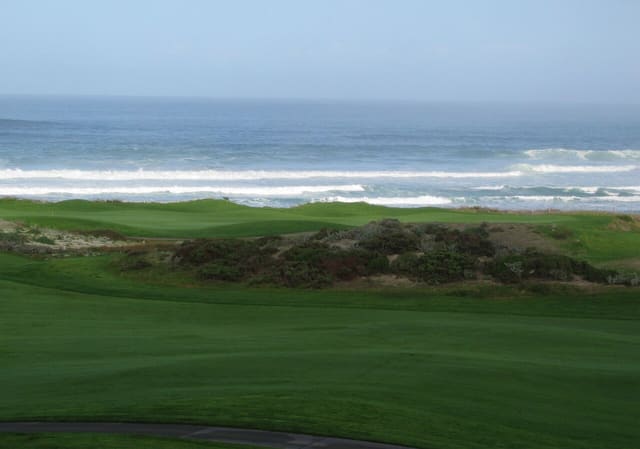
Spanish BayPhoto: Unknown author, CC BY-SA 3.0, via Wikimedia Commons
Driving tour · Pebble Beach

17-Mile Drive: Pacific Grove to Pebble Beach

Cypress headlands, shipwreck rocks, and legendary golf

41 min7 stops7.6 mi

Start the drive

Stop 1 plays free. All 7 for $4.99, for your whole group on up to 4 phones. Written from 23 public sources, every claim checked. Refunded within 7 days if it isn't for you.

The link and where it starts. One email, nothing else.

See the 7 stops

The 7 stops

  1. 1Start hereFree

    Pacific Grove Gate

    A Carriage Ride Built to Sell Land

    Free sample · 2:59
    0:002:59

    You're at the Pacific Grove Gate, where Sunset Drive meets 17-Mile Drive and the town gives way to forest. Just ahead is the gatehouse, where nonresidents pay a toll to keep going. That toll is the first clue to this whole road. You're about to drive through a forest of Monterey pine and cypress, and almost all of it is privately owned.

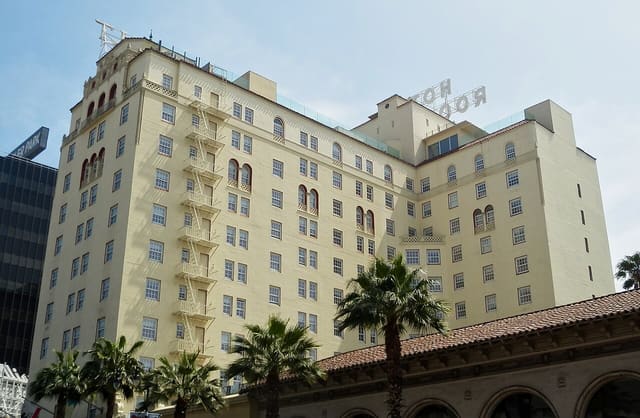
    To understand why, picture a different starting line. In the 1880s this road didn't begin at a gate. It began at the front steps of the Hotel Del Monte, a grand seaside resort over in Monterey. The hotel belonged to the Pacific Improvement Company, which was owned by the Big Four railroad barons: Charles Crocker, Mark Hopkins, Collis Huntington and Leland Stanford. These were the men who had funded the Central Pacific Railroad. Their railroad brought wealthy guests to Monterey, and their hotel gave those guests somewhere to stay.

    Then the company needed something for them to do. By 1892 it had laid out a scenic carriage road winding through the forest and along the coast toward Carmel. The hotel called it the 18-Mile Drive. History knocked a mile off somewhere along the way.

    Guests rode out by horse and carriage. They stopped at a beach to pocket agates and pebbles polished smooth by the waves, and they gawked at oddly shaped trees, one of them nicknamed the Ostrich Tree. In 1891, President Benjamin Harrison took the ride in a coach pulled by six bay horses, the harness trimmed with bunting and roses. A local paper reported his verdict: "This is a lovely spot. I only wish I could stay here a week."

    That wish was exactly the point. The drive was a pleasure outing, but it was also a sales pitch. The company wanted rich visitors to fall for the scenery and buy large residential plots on its land. Every ocean view along this road was, in a sense, a showroom.

    The people already living on that coast didn't fit the brochure. About 30 Chinese fishermen and their families had a village on the rocky shore near Stillwater Cove. Chinese American girls sold shells and polished pebbles to the passing tourists. As anti-Chinese hostility grew in Monterey, the Pacific Improvement Company worked to erase that community, tearing down attempts to rebuild the fishing village.

    By 1907, the carriages were gone, replaced entirely by automobiles. In 1919 a developer named Samuel Morse bought the company's land here, and his company still runs this road under a newer name, the Pebble Beach Corporation. The Hotel Del Monte didn't stay a hotel. After World War II, the Navy took it over, and today it's part of the Naval Postgraduate School.

    So when you pass that gatehouse, you're doing what Harrison did. You're a guest on somebody's private sales route, and the view is still the pitch.

    Drive southwest on 17-Mile Drive, then turn right onto Spanish Bay Drive, about two minutes. There, a famous golfer helped bring a little bit of Scotland to the California dunes.
  2. 22 min drive · 2 min story

    Spanish Bay

    A Scottish Links Out of a Sand Pit

    Read the story

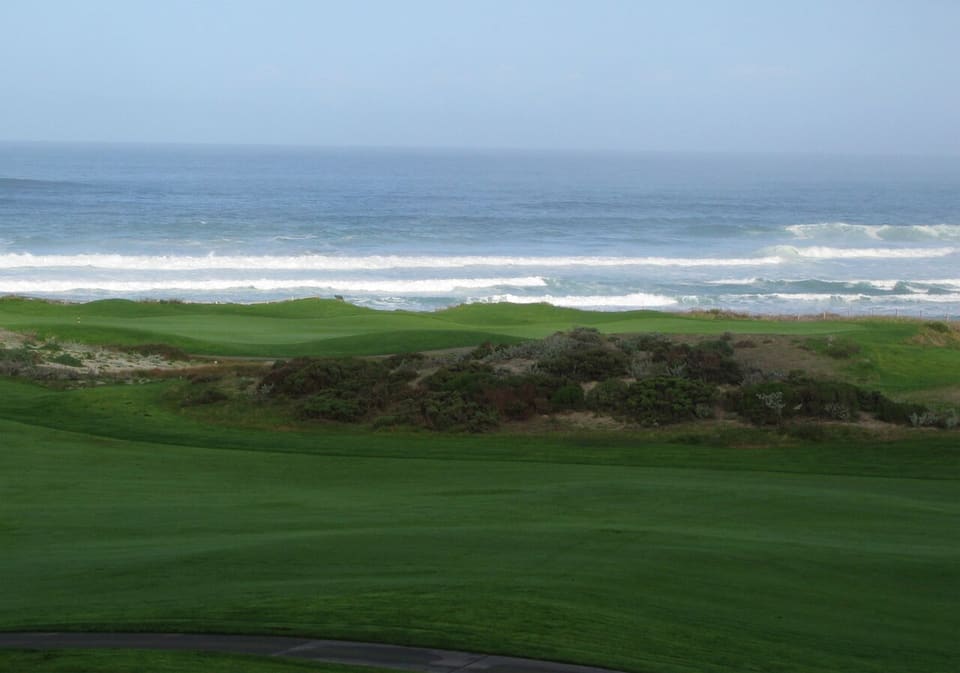
    You've just come through the Pacific Grove Gate, and you're now at Spanish Bay, at the northern tip of the 17-Mile Drive. Look past the buildings toward the ocean, at the low, rolling, open ground that runs down to the water. It doesn't look much like the rest of California. That's on purpose.

    Before it was golf, this was a sand-mining operation. When it ended, what remained was vast sandy wasteland, the sort of ground most developers would look at and sigh.

    In the early 1980s, three men looked at it and saw Scotland. Robert Trent Jones Jr. was a golf course architect. Tom Watson was one of the great players of his era. He had won the U.S. Open just down this road at Pebble Beach in 1982. Sandy Tatum was a San Francisco lawyer who had served as president of the United States Golf Association.

    They saw the same possibility in that wasteland: a true links-style course. Golf began on the windy, sandy coasts of Scotland, on ground called links land. Most American courses are green, watered and tree-lined. Here, on a worn-out sand pit by the sea, they could build something that resembled the real thing.

    The Links at Spanish Bay opened in 1987. Watson, asked what he thought of it, put it this way: "Spanish Bay is so much like Scotland, you can almost hear the bagpipes." So the resort took him at his word. It became tradition for a bagpiper to play at the end of the day to signal that the course was closing.

    Now imagine that sound drifting over this ground, in the dusk, with the Pacific behind it. A sand pit, remade as a piece of Scotland, and finished off with a lone piper.

    The course is changing again. In March 2026, Spanish Bay closed for renovations, so you may see work underway on that open ground instead of golfers. A sand mine turned into Scotland is getting another makeover.

    Drive northwest on Spanish Bay Drive, turn right onto 17 Mile Drive, turn right onto Spanish Bay Road, then bear right back onto 17 Mile Drive, about five minutes. Next is Point Joe, a stretch of rocks that fooled more than one ship's captain.

  3. 35 min drive · 2 min story

    Point Joe

    The Point That Looked Like Home

    Read the story

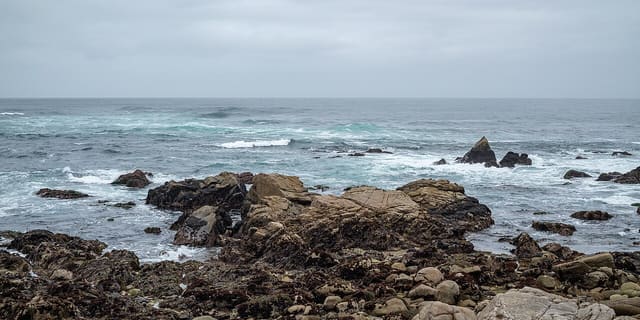
    You've pulled off 17 Mile Drive at Point Joe, a low, open stretch of coast just past Spanish Bay. If you're driving, park first, then look. Out past the edge of the road, find the dark granite rocks breaking the surf. The guides say that stone formed about 65 million years ago. It has been waiting a long time to fool somebody.

    Picture coming at this coast from the sea, in the days of sail. You're bound for Monterey and its bay. What you're looking for is an opening, a wide, calm bay tucked behind the land. In fog, at dusk, or in a hard swell, a gap in the coastline is what you've been praying for.

    Point Joe gave sailors exactly that impression. From offshore, this low bend in the land read like the entrance to Monterey Bay. It wasn't. A captain who turned in here wasn't steering for shelter. He was steering straight for those rocks. Pebble Beach's own guide to the drive says early mariners made this mistake, and that Point Joe became the site of many shipwrecks.

    Now the limits of what we know. The records gathered for this tour don't name a single ship or a single sailor lost here. What survives is the reputation: this is the place that looked like safety and wasn't. Even the name has wobbled. Pebble Beach material says the spot was also known as Pyramid Point. Exactly who Joe was is a question these sources leave open.

    The road you're on has a tidier story. By 1892 the Pacific Improvement Company, owned by the Big Four railroad barons, had laid out this scenic drive, which began at the Hotel Del Monte and was offered as a pleasure excursion for its guests. Hotel operators originally called it the 18-mile Drive. The same coast that fooled sailors became the view people came to see.

    Before you pull out, take one more look at where the swells hit the granite. Imagine it in fog, and the old mistake makes perfect sense.

    When you're ready, drive west and continue onto 17 Mile Drive, about 1.4 miles and three minutes, to the next stop.

  4. 43 min drive · 2 min story

    Bird Rock

    Who Gets the Rock Above the Surf

    Read the story

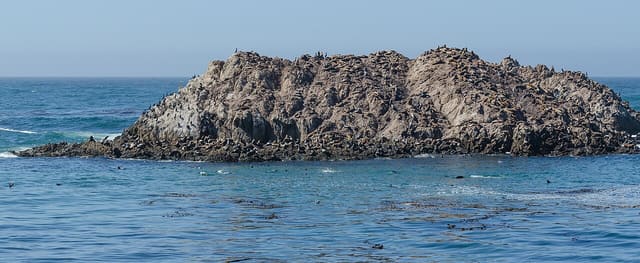
    You've pulled into the turnout at Bird Rock, on the 17-Mile Drive in the Del Monte Forest. If you're driving, park first, then look. Just offshore sits a low hump of rock with the swells breaking around its base. Find the waterline, where the rock turns dark and wet. That's where the best seats are.

    The road you came in on was laid out by the Pacific Improvement Company, and by 1892 it was a pleasure excursion for their hotel guests. Bird Rock is one of the scenic attractions listed for the drive. The people who planned the outing chose their views carefully. The rock's real tenants never needed a map.

    So watch the rock for a minute. Look for heavy shapes that seem to be napping near the waterline. Some of them may be harbor seals, and telling them from sea lions is a good game to play from here. Here's the trick: a harbor seal has no external ear flaps, only a small opening behind the eye. If you see ear flaps, you're looking at something else.

    Now notice how settled they look. That isn't chance. Harbor seals return repeatedly to the same rocky resting spots, called haul-outs, and those spots tend to sit near their feeding areas. A rock like this one is a bedroom next door to the kitchen. Climb out of the surf, rest, slip back in, eat. The surf below is the commute.

    That habit has a history. The Marine Mammal Protection Act of 1972 made it illegal to kill marine mammals anywhere in the United States. By 1984, California's harbor seal population numbered about 25,000. A rock that once might have been a risky place to nap became a place to simply nap.

    Which brings us to the part you can play. People should stay at least 50 meters from hauled-out harbor seals, because mothers may abandon their pups. That's about half a football field. If a seal is on the rock, you're already at a good distance, so enjoy the view from the turnout and let it rest.

    So take one more look at that rock. The hotel guests came for the scenery, and the seals came for the bedroom. Only one group ever got a better deal on the view.

    When you're ready, drive north, then turn right onto 17 Mile Drive. It's about 1.6 miles, roughly five minutes, to the next stop.

  5. 55 min drive · 3 min story

    Cypress Point

    The Woman Who Hired the Camouflage Doctor

    Read the story

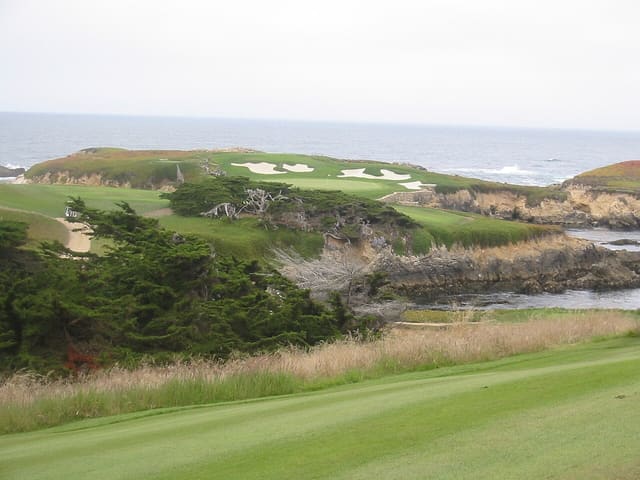
    You're on 17-Mile Drive at Cypress Point, and the fairways running between the dunes and the rocky shore belong to the Cypress Point Club. Only about 250 people are members, and non-members can play only if one invites them. Unless that happens, the drive is as close as you'll get. Keep your eyes on the road, and let the ocean on your side do the work.

    The person who made this course happen wasn't a golf architect. She was Marion Hollins, a Wall Street broker's daughter from Long Island. In 1921 she won the U.S. Women's Amateur. She also played polo on the Pebble Beach men's team, and she is known as a golf course developer, a rarity among women.

    For the course, Hollins hired Alister MacKenzie, but not first. Seth Raynor had laid out a routing and then died before it could be built. MacKenzie was an Englishman who had trained as a surgeon. During the Boer War he served as a civilian physician with the British Army, and there he first became aware of the principles of camouflage. In the First World War he made significant contributions to military camouflage, which he saw as closely related to golf course design. Build something so natural that nobody can tell where nature stops.

    Working with fellow architect Robert Hunter, MacKenzie sent the front nine into the Del Monte Forest, then brought the back nine out onto the rocky coastline. The famous one is the 16th, a tee shot of about 230 yards over the Pacific to a green guarded by bunkers. Miss, and your ball is in the ocean. One description calls Cypress Point the best 17-hole course in the world, because the closing hole is considered by some to be little more than a route back.

    And Hollins's reach went further than this coast. She was the reason Bobby Jones hired MacKenzie to design Augusta National. So the home of the Masters traces back to a woman who played polo with the men here in Pebble Beach. She was inducted into the World Golf Hall of Fame, but only in 2021.

    The club has a harder chapter too. From 1947 through 1990, Cypress Point was part of the pro-am tournament Bing Crosby founded. Then it was dropped from the rotation, because it had no non-white members and refused to admit one to comply with the tour's anti-discrimination guidelines. Since then, Condoleezza Rice has been admitted as a member.

    So the fairways beside you hold two stories: a woman who did what women rarely did in golf, and a club that was slow to open its doors.

    When you're ready, drive northeast and continue onto 17-Mile Drive for about a mile, roughly three minutes, to the Lone Cypress, one tree on a granite rock that became the peninsula's emblem.

  6. 63 min drive · 3 min story

    The Lone Cypress

    The Tree a Company Trademarked

    Read the story

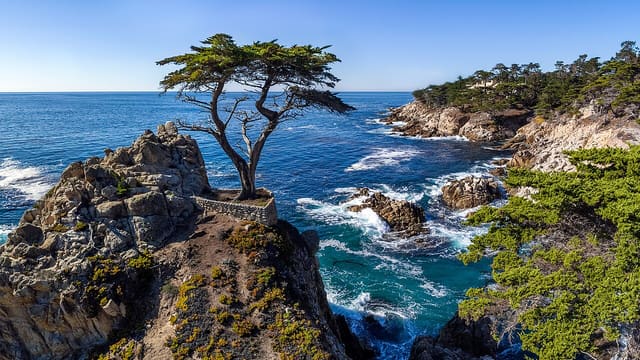
    You've pulled off 17-Mile Drive at the viewpoint above Carmel Bay, and out on that knob of granite, all by itself, is the Lone Cypress. Look at the base of the tree, where it meets the rock. That low stone wall wrapped around its roots is the first clue to this story: this tree has been looked after, guarded and even owned, more carefully than almost any tree in America.

    Nobody knows exactly how old it is. Counting rings would mean drilling into it, and no one wants to do that. The best guess is that it took root around 1750, when this coast belonged to Spain. The Monterey cypress is a picky species. It grows wild in only two places on Earth, right here in Pebble Beach and down the coast at Point Lobos.

    By the 1880s, painters and photographers had found it. Those early pictures show a full, dome-shaped crown, much rounder than what you see today. A century and more of wind and salt spray has been sculpting it ever since.

    Then, in 1919, the company that ran this land, now called the Pebble Beach Company, did something unusual. It registered a drawing of the tree as its trademark. And the company has said that the trademark protects not just the logo, but the tree itself. So yes: a living cypress on a rock in the Pacific is, in a sense, a registered corporate symbol. Photographers have been taking its picture for well over a century, and it's often called one of the most photographed trees in North America.

    Being famous turned out to be hard on it. In 1941, the company built that stone wall to stop erosion from undercutting the roots. In 1948, cables went up to help hold it steady. By 1969, so many visitors were scrambling out to touch it that the trampling was damaging the roots, so the tree was fenced off. In 1984, someone tried to set it on fire. No one ever found out who. The tree came through with only minor scorching.

    Its latest loss came from the weather. On February 16, 2019, a powerful Pacific storm system, the kind Californians call a Pineapple Express, tore away one of its limbs and changed its silhouette for good.

    Here's the hard truth behind all that care. The oldest Monterey cypress anyone has physical evidence for lived about 284 years. If the 1750 guess is right, this one is already close to that. The wall, the cables and the fence aren't really about keeping it forever. They're about giving it a little more time.

    When you're ready, continue east on 17-Mile Drive, bear left onto Cypress Drive, then carry on along 17-Mile Drive, about three minutes, to Pebble Beach Golf Links, the course that opened in 1919 and later climbed all the way to number one.

  7. 73 min drive · 2 min story

    Pebble Beach Golf Links

    The Chip Shot Pebble Beach Remembers

    Read the story

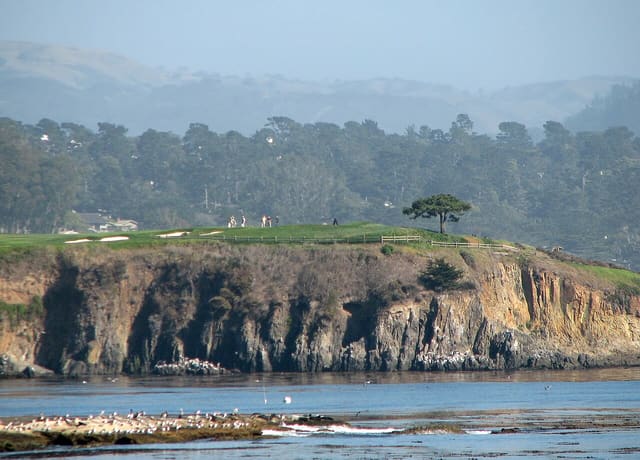
    You've reached Pebble Beach Golf Links, the course that 17-Mile Drive has been leading up to all along. Look past the cypress toward the water. The fairways run right to the edge of the rocks, and beyond them is Carmel Bay, opening onto the Pacific. That edge, where the grass ends and the ocean begins, is where this story happens.

    The course opened on February 22, 1919, and it began as part of the Hotel Del Monte, the railroad-built resort whose guests first toured this road. You might expect a famous architect. Instead it was laid out by two champion golfers, Jack Neville and Douglas Grant. Neville had one goal: put as many holes as possible along this rocky shoreline. He did it with a figure-8 layout that loops out to the cliffs and back.

    Five days after the opening, Samuel Morse formed the Del Monte Properties Company and acquired the whole estate: the forest, the lodge, the hotel. Locals called him the Duke of Del Monte. His Del Monte also barred African Americans from owning property here, a ban that wasn't lifted until the 1960s.

    The course, though, became legend, and one of its most famous moments came in 1982, at the U.S. Open. Tom Watson stood on the par-3 17th, a hole that plays out toward the ocean, needing a great shot. His caddie, Bruce Edwards, told him to get it close. Watson's answer is on the record: "Close, hell, I'm going to sink it."

    He did. Watson chipped in on the 17th and went on to win the U.S. Open.

    That hole already had a place in Open history. Ten years earlier, in 1972, Jack Nicklaus hit a 1-iron there that bounced once, struck the flagstick, and stopped beside the cup for a tap-in birdie. Two of the game's most famous shots, on the same short hole beside the same water.

    In 2001, Golf Digest named Pebble Beach the number one golf course in America, the first public course ever to earn that title. Anyone willing to pay some of the highest greens fees in the world can play it, and walk the same edge where those shots were struck.

    That's the end of the drive: from the railroad's carriage road to the cypress and the edge where golf meets the Pacific. Thanks for riding along.

The whole drive

7 stories across Pebble Beach

41 min · 7 stops · 7.6 mi

Starts at Pacific Grove Gate and ends at Pebble Beach Golf Links.

  • Plays right here in your browser, or in the app
  • One purchase for your group, on up to 4 phones
  • Refunded within 7 days if it isn't for you
Not going yet? Email me this drive

The link and where it starts. One email, nothing else.

Plan your drive

    How long

    About 41 min for 7.6 mi with all 7 stories. Going inside the sites adds time.

    Start and finish

    Starts at Pacific Grove Gate and ends at Pebble Beach Golf Links.

    Add it to my calendar

    Driving in? 17-Mile Drive entrance fee: what it costs, the five gates and the hours.

    Paying, phones, offline and refunds are answered on the help page.

    Know someone who'd love this drive? or see more gift ideas.

    Questions people ask

    Is there a toll for 17-Mile Drive?

    Yes. Nonresidents pay a toll per car at the gate, set by the Pebble Beach Company and posted there. This drive starts at the Pacific Grove Gate.

    Where is the best entrance to 17-Mile Drive?

    This tour enters at the Pacific Grove Gate, at the north end, and follows the coast south to Pebble Beach Golf Links, so the stops come in order with the ocean on your right.

    How long does 17-Mile Drive take?

    This route is 7.6 miles and takes about 41 minutes with all seven stories. Stopping at the viewpoints adds time; give it an hour or two.

    Can you see the Lone Cypress?

    Yes, from a viewpoint on the drive; it's the sixth stop. The tree stands on a granite outcrop above the water and is the Pebble Beach Company's trademark.

    Where does the tour start and end?

    It starts at the Pacific Grove Gate and ends at Pebble Beach Golf Links.

    About this tour and its sources

    You're at the Pacific Grove Gate, the northern entrance to 17-Mile Drive. Look at the gatehouse ahead. Unless you live inside Pebble Beach, this is where you pay a toll to drive a road. It may be the only toll in America charged mainly for the privilege of looking at trees.

    That toll is the thread of this whole tour. This coast of wind-bent cypress and dark granite is a private road because of railroad money. The Pacific Improvement Company, owned by the Big Four railroad barons, Crocker, Hopkins, Huntington and Stanford, ran the Hotel Del Monte. By 1892 it had laid out a scenic carriage road for its hotel guests, which the hotel called the 18-Mile Drive. In 1919 developer Samuel Morse bought the company's land, and today the Pebble Beach Corporation still runs the road.

    Ahead, the drive passes golf courses, the Lone Cypress, and granite shores like Point Joe, where early mariners mistook the point for the entrance to Monterey Bay, and many ships wrecked.

    Our first story begins with those carriage rides. Pay your toll, pull forward when the attendant waves you on, and keep to the posted speed. We'll start when you're safely through the gate.

    Pay the toll at the gatehouse and drive through the gate when the attendant waves you on. Pull over only where it's safe and allowed, and start the first story once you're through.

    Written from public sources and narrated by a synthetic voice. A fact-check compares up to 10 of the most specific claims in each story with those sources. Last checked October 2026.

    Share this drive