Route 66 in Illinois: Chicago to the Chain of Rocks Bridge
Nine stops from Lou Mitchell's in Chicago to the Chain of Rocks Bridge and its 22-degree bend over the Mississippi.
Chicago to Santa Monica is about 2,200 miles and 43 hours at the wheel, routed town to town on today's roads; straight down the interstates it's closer to 36 to 40. At 5 hours a day and 50 mph, that's 10 days. Most guides suggest about two weeks (Cruise America says 11 to 14 days), because the old road is slower and the towns are the point. Change the start, the finish and your day below, and the plan redraws with a town for every night. Two stretches, Illinois and Arizona, come with Dot telling a story at every stop.
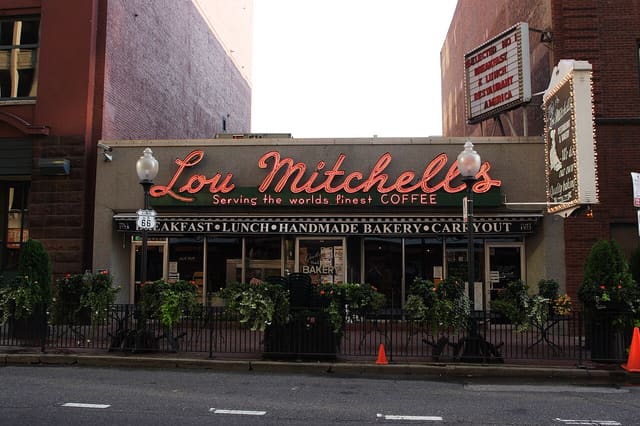
Day 1 starts in Chicago, and so does our Illinois drive. Its first stop is Lou Mitchell's, the diner on Jackson Boulevard where a lot of Route 66 trips begin with breakfast.
Stop 1 of the Route 66 in Illinois drive, told on the spot. All 9 stops are $4.99 for your group, on up to 4 phones.
Serving the World's Best Coffee. That modest little promise runs the whole length of the upper facade at Lou Mitchell's, spelled out on the original neon sign from 1949. Look up at the front of the building and you'll find it, high above West Jackson Boulevard in the Loop, a short walk from Union Station. Hold onto that sign. It's the last thing a lot of people saw before Chicago fell away behind them.
Route 66 began a few blocks east of here, near the lake. Generations of travelers stopped at Lou Mitchell's for one more proper breakfast before the long drive southwest, and the diner earned a nickname it still wears: the first stop on the Mother Road.
But here's the thing most people get backwards. Lou Mitchell's didn't open because of Route 66. It was already here. When the diner marked its hundredth birthday in 2023, Route 66 was still three years short of its own. The highway wasn't designated until November 11, 1926.
And Route 66 wasn't really built so much as named. The planners wanted the whole route open fast, so they stitched it together mostly from roads that already existed. Illinois had paved nearly all of its stretch by 1924, under the old name Illinois Route 4. That made Illinois the first of the eight states to finish its share, while long stretches out west were still gravel and dirt. Even that road had an older life: the earliest route from Chicago to St. Louis followed a Native American trail, later a stagecoach road. So a diner already serving coffee in the Loop simply woke up one day on the edge of America's most famous highway.
The road made the reputation. The novelist John Steinbeck called it the Mother Road in 1939, and drivers had a darker name for the narrow, dangerous Illinois stretch: Bloody 66. In 1949 the diner moved into the building you're looking at, neon and all. Then the interstates came, and Interstate 55 largely replaced the old road.
When people set out to rescue what was left, they came back here. In May 2002, the nationwide Route 66 restoration program was launched at Lou Mitchell's, and in 2006 the diner joined the National Register of Historic Places.
One more detail for the road. When the TV competition Top Chef came here, the challenge was twenty minutes at the egg station, which the staff call the hull. Some of the best cooks in the country, humbled by breakfast. Get some coffee, and look at that sign one more time before you go.
When you're ready, drive southwest, mostly on I-55, about 38 miles to Old Joliet Prison, a limestone fortress that opened before the Civil War.
We made two Route 66 driving tours, and the planner marks the days they fall on. Illinois runs from Lou Mitchell's diner in Chicago to the Chain of Rocks Bridge over the Mississippi, about 299 miles. Arizona runs from the Painted Desert Inn, east of Holbrook, over the hairpins of Sitgreaves Pass and down into Oatman, about 322 miles. Each stop's story plays by itself as you drive up to it, with your phone in your pocket, and the first stop plays free.
Nine stops from Lou Mitchell's in Chicago to the Chain of Rocks Bridge and its 22-degree bend over the Mississippi.
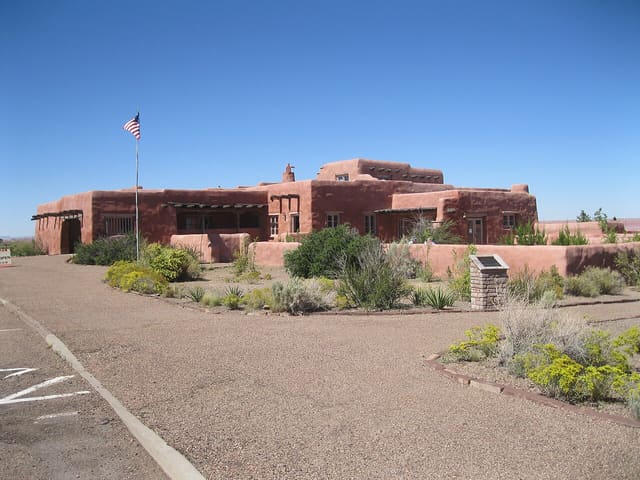
Seven stops from the Painted Desert Inn to Oatman, with the 1950 Wigwam Motel in Holbrook and the Winslow corner from a 1972 Eagles hit.
Comparing Route 66 apps? Here's how the audio guides for the road stack up.
| From | To | Miles | Driving time |
|---|---|---|---|
| Chicago, IL | St. Louis, MO | 309 | 6 h 27 min |
| St. Louis, MO | Tulsa, OK | 419 | 8 h 27 min |
| Tulsa, OK | Oklahoma City, OK | 110 | 2 h |
| Oklahoma City, OK | Amarillo, TX | 263 | 4 h 44 min |
| Amarillo, TX | Albuquerque, NM | 291 | 5 h 8 min |
| Albuquerque, NM | Flagstaff, AZ | 325 | 5 h 48 min |
| Flagstaff, AZ | Kingman, AZ | 151 | 2 h 43 min |
| Kingman, AZ | Barstow, CA | 196 | 4 h 12 min |
| Barstow, CA | Santa Monica, CA | 149 | 3 h 3 min |
Town center to town center on today's roads, routed on OpenStreetMap on November 14, 2026. No stops, no traffic.
We put 41 towns the old road ran through, from Chicago's Loop to Santa Monica, on OpenStreetMap, then asked a router for the drive between each pair on today's roads. Added up, that's 2,214 miles and about 43 hours at the wheel. The road itself ran 2,448 miles: the interstates that replaced it cut its corners, and the old road runs down the main streets.
So the planner asks how you'll drive. Town to town on today's roads, it uses the router's times, which take the interstate between towns but drive into each town's center; that averages about 52 mph, which is why it's slower than the 36 to 40 hours you'd need straight down the interstates. At 50 or 40 mph it spreads the same miles over more hours, which is closer to a trip that leaves the interstate for the old two-lane road, slows through the towns and stops for the neon. Each day it drives town to town and stops at the town nearest your limit, going up to 20 minutes over rather than stopping far short.
It doesn't know about traffic, road work, closed stretches of the old road or the clock: you cross three time zones, Central, Mountain and Pacific, and Arizona keeps Mountain Standard Time all year. Treat the plan as a first draft and check the roads before you go.
About 43 hours at the wheel from Chicago to Santa Monica, by our routing of 41 towns along it on today's roads. Most people take ten days to two weeks.
The original road ran 2,448 miles from Chicago to Santa Monica. Routed town to town on today's roads, the same trip is about 2,214 miles, because the interstates cut the old road's corners.
At 6 hours a day, town to town on today's roads, it's 8 driving days, the quickest pace that still isn't a slog. At 5 hours a day and 50 mph it's 10. Add a rest day for every few days of driving and you're close to two weeks.
At 5 hours a day heading west from Chicago, the planner stops in Litchfield, Lebanon, Tulsa, Elk City, Tucumcari, Grants, Flagstaff, Needles and San Bernardino. Change the hours and it picks the town nearest your limit each day.
East to west is the classic way, ending on the Santa Monica Pier, where an End of the Trail sign stands today. The miles and hours are the same either way, and the planner works in both directions.
Illinois, Chicago to St. Louis, is about 309 miles town to town: a long day or an easy two. Arizona from Holbrook to Oatman, through Winslow, Flagstaff, Williams, Seligman and Kingman, is about 270 miles of high desert, with the hairpins of Sitgreaves Pass at the end. Either fits a long weekend.
Routed on November 14, 2026. The tours' stops and lengths are read live from the tours on this site.