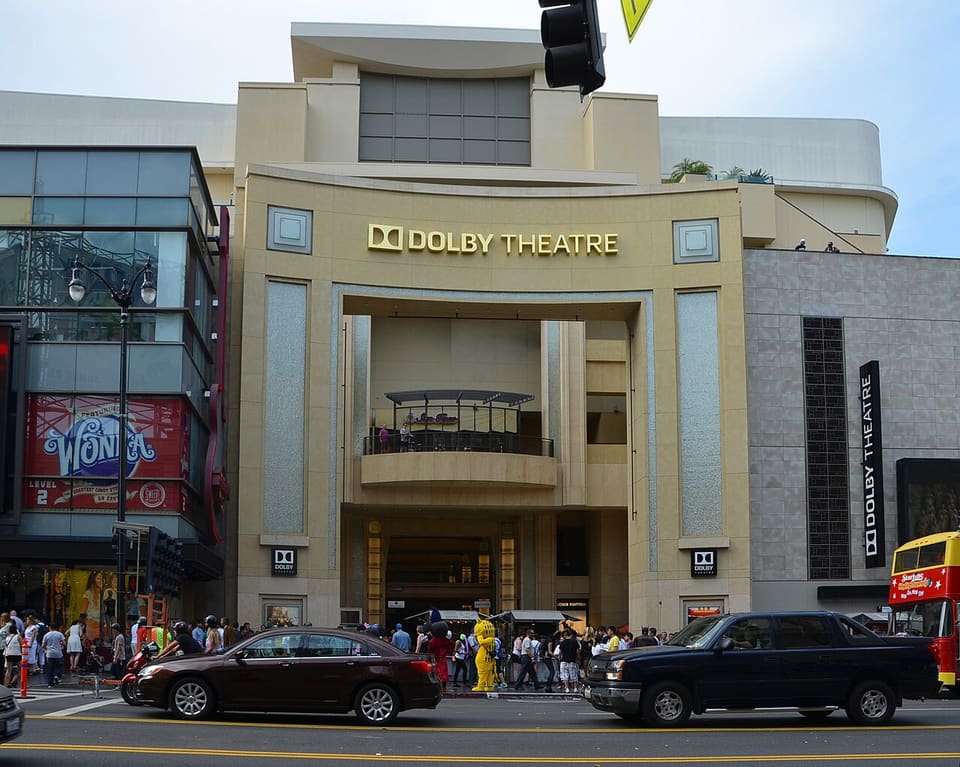
The whole storyStop 3 of Hollywood Walk of Fame Walking Tour: Chinese Theatre to Hollywood and Vine
The Oscars Finally Get a Home
You're standing at Hollywood and Highland, in the shopping complex locals still call by that corner's name, and the Dolby Theatre sits at the very back of it. Look down the long hall that runs from the boulevard toward the grand stairway. On both sides stand columns, and on those columns are the names of films that won Best Picture. Keep looking. A lot of the spaces are blank.
Those blanks are the story of this building. It was designed specifically with the Oscars in mind.
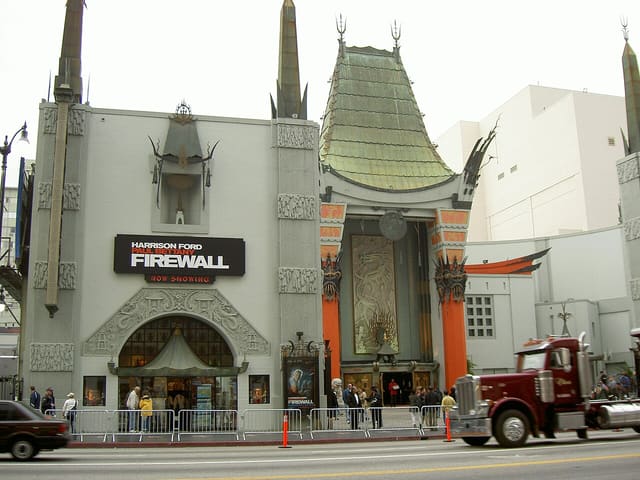
From 1929 to 2001, the Academy of Motion Picture Arts and Sciences staged 73 ceremonies at nine different venues. Grauman's Chinese, right next door, had a turn. The show also landed in big halls like the Dorothy Chandler Pavilion downtown and the Shrine Auditorium, and those caused logistical headaches for a ceremony that had become a live television broadcast.
So the Academy teamed up with a Canadian developer called TrizecHahn. Negotiations began in August 1997, and seven months later they agreed on a 20-year lease for a theater built around the show. The architect David Rockwell went to work, consulting extensively with the people who actually produce television in this town. What they built looks like a grand theater, but underneath it thinks like a TV studio. There's an underground cable bunker that crosses beneath the building to truck locations on the adjacent streets. There's a cockpit in the orchestra seats for the camera, sound and stage crews. The stage is one of the largest in the country, about 113 feet wide. The house, by comparison, is modest, around 3,300 seats.
It opened in November 2001, and on March 24, 2002, the Oscars came home to Hollywood for the first time since 1960, when the ceremony was held at the Pantages. Before the ceremony, the building gets dressed like a film set: red drapery hiding the storefronts, sometimes a different sign out front, and the red carpet running right up that stairway.
The name on the door has its own plot twist. It opened as the Kodak Theatre, after Eastman Kodak paid 75 million dollars for the naming rights. Then in early 2012 Kodak, the company that sold the world its film, filed for bankruptcy. For a while the movies' biggest stage was renamed the Hollywood and Highland Center, at its landlord's suggestion, until Dolby, the sound company, signed a 20-year naming deal.
And here's the turn nobody planned for. It was announced that starting in 2029 the Oscars will move to the Peacock Theater downtown. The Dolby was built to give the show a permanent home. Those blank columns are set up through 2071. Who will fill them in is suddenly an open question.
Hear it where it happened. It plays at stop 3 of Hollywood Walk of Fame Walking Tour: Chinese Theatre to Hollywood and Vine (3 min), narrated as you walk. Unlock the tour for the audio, or try stop 1 free first.