The whole storyStop 5 of Central Park Walking Tour: The Pond to Belvedere Castle
Capitol Dome Ironworkers Build a Footbridge
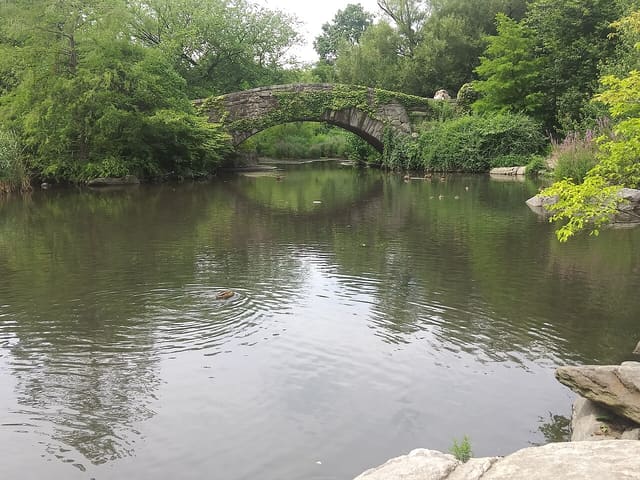
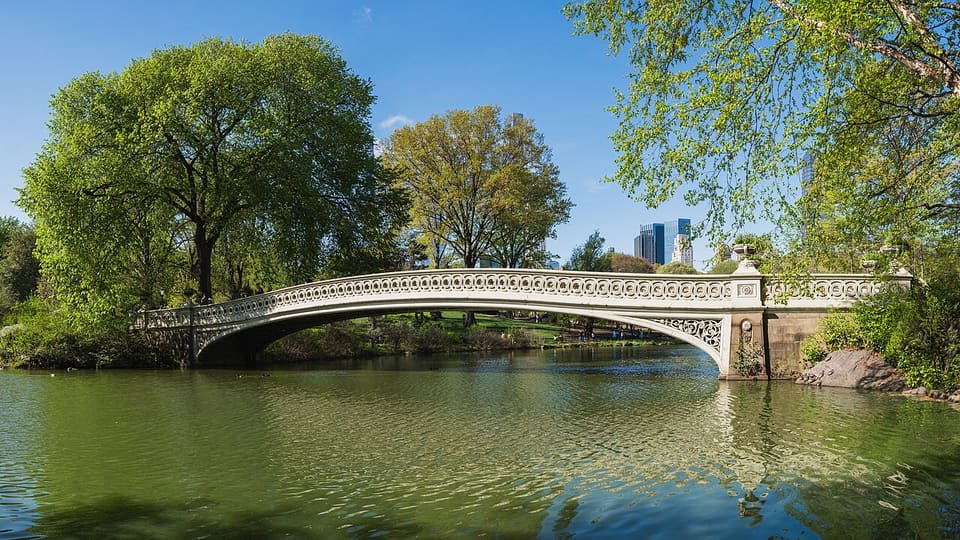
You're standing at Bow Bridge, the long, low span of cast iron that crosses the Lake just west of Bethesda Terrace. Look along its side and you'll see why it has that name. The whole bridge curves in one gentle arc, like an archer's bow laid on its back across the water. Now bring your eyes to the railing, that lacework of iron running the full length of the span. That railing is the heart of this story.
The man behind it was Calvert Vaux, the architect who designed Central Park with Frederick Law Olmsted. Olmsted shaped the land. Vaux shaped almost everything you walk across, under, or lean on. With his assistant, Jacob Wrey Mould, a designer with a gift for ornament, Vaux created 35 structures for this park, and he gave every one its own distinct style. No two bridges alike.
That was not the obvious choice. Many of the park's crossings were built as working structures, meant to carry people and traffic through the park without being noticed at all. Bow Bridge was the opposite. It sits right out in the open, over the widest stretch of the Lake, where everyone on the shore can see it. So Vaux and Mould made it something worth seeing. Their railing borrows from three different design traditions at once: Gothic, Neo-Classical and Renaissance. Look closely and the pattern keeps shifting as you walk.
To build the span itself, they turned to an ironworks firm called Janes, Kirkland and Company. That same firm did the ironwork for the dome of the Capitol in Washington. So the people who were raising the iron dome over Congress also built a footbridge for New Yorkers out for an afternoon stroll. You could say this bridge has excellent references.
Work on Bow Bridge ran from 1859 to 1862. Think about those dates. By the time it was finished, the country was at war with itself, and the Capitol dome was still going up over a divided nation. And here in New York, the city went on building a 60-foot bridge whose main job was to be lovely, to give people a graceful way across a lake that workers had shaped by hand.
That is really the idea behind it. Vaux believed ordinary people deserved beauty in their everyday paths, not just in museums and mansions. He got his wish, and then some. Today Bow Bridge is one of the most photographed spots in the entire park. Turn around and you'll probably see someone taking a picture right now.
When you're ready, head west off the bridge and bear right onto the 72nd Street Transverse, about nine minutes, to Strawberry Fields, a quiet garden named for a Beatles song.
Hear it where it happened. It plays at stop 5 of Central Park Walking Tour: The Pond to Belvedere Castle (3 min), narrated as you walk. Unlock the tour for the audio, or try stop 1 free first.