Route 66 in Arizona: Painted Desert to Oatman
From a painted-desert lodge built by the CCC to a gold-rush town where wild burros wander Main Street, this drive follows the Mother Road across…
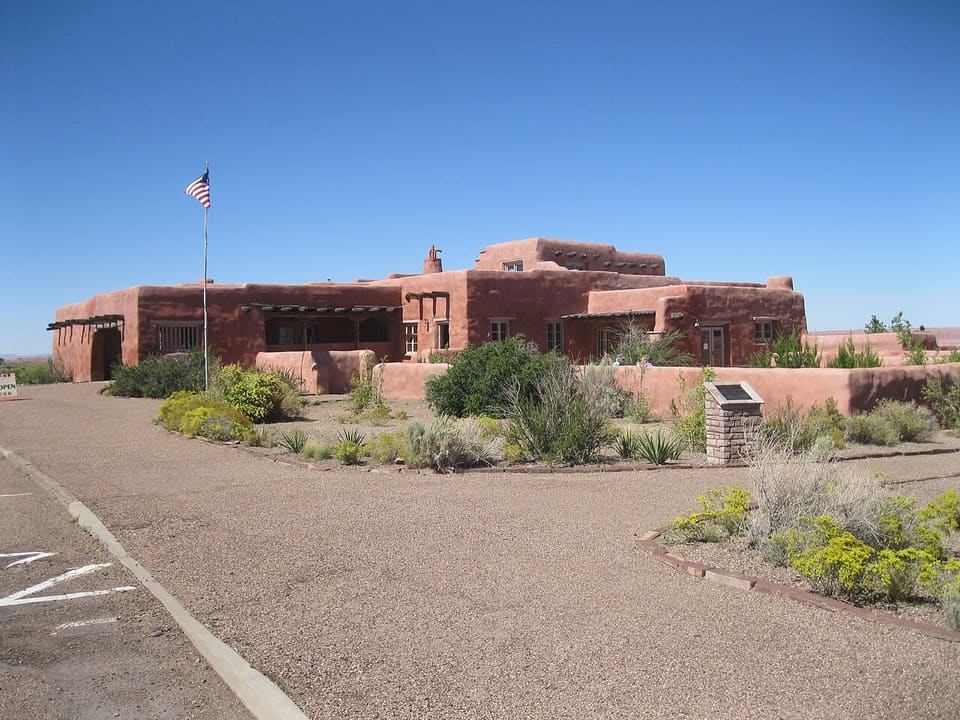 Photo: Photo: TheCatalyst31, CC BY-SA 3.0, via Wikimedia Commons
Trail to Onyx Bridge, Arizona
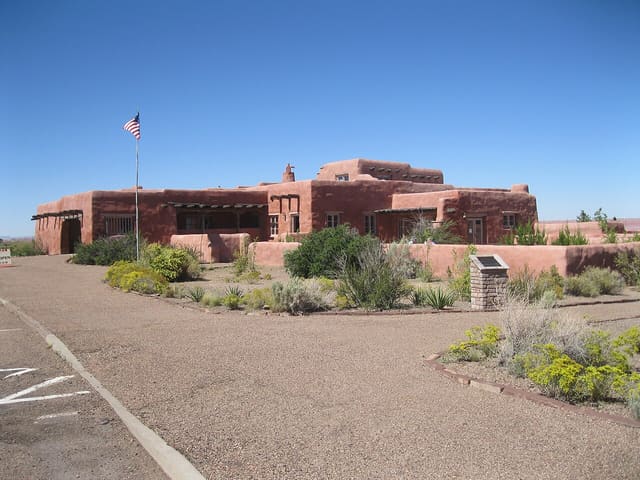
The Painted Desert Inn is a museum in Petrified Forest National Park, 2 miles from the north entrance at Kachina Point. Begun in the 1920s with petrified wood in its walls and rebuilt by the Civilian Conservation Corps from 1937 to 1940, it keeps Fred Kabotie's Hopi murals and has been a National Historic Landmark since 1987.
You're standing at the Painted Desert Inn, on the rim of the Painted Desert in Petrified Forest National Park. Look at the building itself: thick, rounded adobe-colored walls and flat roofs, built to look like a pueblo. Then look past it, out over the badlands, banded in reds and purples. Travelers on Route 66 came a long way for exactly this view.
The story starts in 1924, with a man named Herbert David Lore. Lore opened an inn here, at the edge of nowhere, and he built part of it out of the ground around him: petrified wood. People nicknamed it the Stone Tree House. Those logs had been trees about 225 million years ago, which may make it the only roadside stop in America with walls older than the dinosaurs.
In the 1930s the National Park Service took over, and the inn got a second life courtesy of the New Deal. Park Service architect Lyle Bennett drew up a Pueblo Revival design, and from 1937 to 1940 young men of the Civilian Conservation Corps rebuilt it by hand, folding part of Lore's old inn into the new one. Those were Depression-era jobs, and you're looking at what they made.
After the war, the Fred Harvey Company, famous for its railroad and roadside hospitality across the Southwest, took it over. Their designer, Mary Jane Colter, reworked the interior, and she brought in a Hopi artist she'd worked with before at the Grand Canyon, Fred Kabotie. In 1947 and 1948 Kabotie painted murals of Hopi life on the walls inside. One shows a journey through this very desert to gather salt. It matters who told that story. This land was home to Ancestral Pueblo farmers for centuries before they joined communities on the Hopi Mesas and at Zuni, and their descendants still live there. Kabotie was painting his own people's ground.
Harvey ran the inn from 1947 until it closed in 1963. Then came the turn. By the mid-1970s, demolition was on the table. The building was supposed to come down. Instead, the public pushed back. The inn went onto the National Register of Historic Places and reopened in 1976 as a Bicentennial travel center. In 1987 it became a National Historic Landmark, honored not just for its looks but for how New Deal money built it.
Nobody has slept here since 1947. But it's a museum now, Kabotie's murals are still on the walls inside, and in summer there's even an ice cream parlor. That's the whole idea of this tour in one building: a place the highway era nearly threw away, kept alive because people refused to let it go.
When you're ready, head southwest, mostly on I-40, about 28 miles and 40 minutes, to Holbrook. Your next room for the night, at least in spirit, is shaped like a tipi.
| Year | What happened |
|---|---|
| 1924 | Herbert David Lore registers his inn, nicknamed the Stone Tree House for the petrified wood built into it. |
| 1936 | The park, then Petrified Forest National Monument, buys the inn. |
| 1937–1940 | Civilian Conservation Corps crews rebuild it in the Pueblo Revival style, to a design by Park Service architect Lyle Bennett. It reopens on July 4, 1940. |
| 1947–1948 | The Fred Harvey Company takes over; its designer, Mary Colter, reworks the rooms, and the Hopi artist Fred Kabotie paints the murals. |
| 1963 | Structural damage closes it, and Fred Harvey moves to the new visitor center. |
| 1976 | Saved from demolition by public protest, it reopens as the Bicentennial Travel Center. |
| 1987 | It is named a National Historic Landmark. |
| 1990s | It reopens full time as a museum and bookstore. |
| 2004–2006 | The whole complex is rehabilitated. |
Open all year, with shorter hours than the rest of the park, which closes only on Thanksgiving and Christmas. Park times are Mountain Standard Time all year. An ice cream parlor opens downstairs in summer.
Inside the park: the entrance pass is $25 per private vehicle, or $15 per person on foot or by bike, good for 7 days.
On the rim overlooking the Painted Desert, off Interstate 40 and near the old alignment of Route 66. Stop 1 of the Route 66 in Arizona drive, so its story plays free.
Checked November 2026. Check the official site before you go.
No. It closed to travelers in 1963 and has been a museum and bookstore full time since the 1990s. In summer, an ice cream parlor opens downstairs.
Fred Kabotie, a Hopi artist, in 1947 and 1948, at the invitation of Mary Colter, the Fred Harvey Company's designer. They show the Buffalo Dance, a trek to a sacred salt lake and Tawa, the Hopi sun god.
Close to it. It sits off Interstate 40, near the old alignment of Route 66, and it once served Route 66 travelers meals, souvenirs and lodging.
From a painted-desert lodge built by the CCC to a gold-rush town where wild burros wander Main Street, this drive follows the Mother Road across…
Stop 1 of 7 on Route 66 in Arizona, before Wigwam Motel, Holbrook.