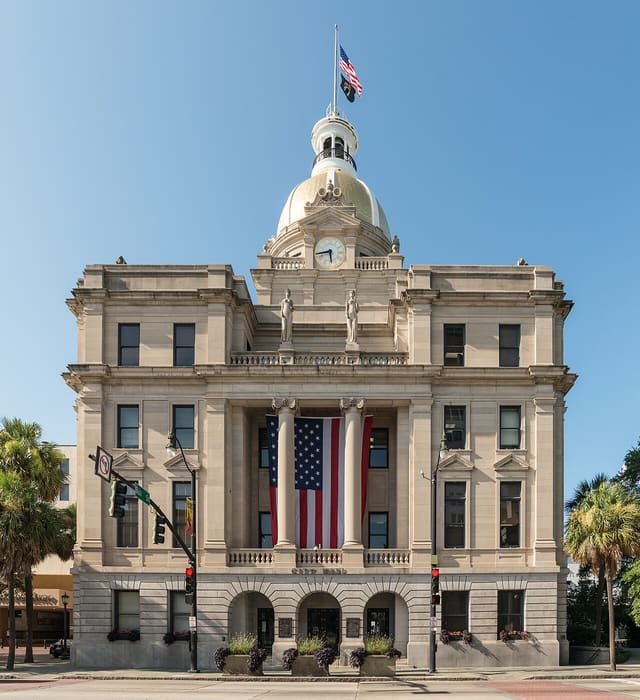
Savannah Walking Tour: City Hall to Forsyth Park
Eight stops from City Hall, begun in 1904, to Forsyth Park, by way of Johnson Square, the first of the city's squares, laid out in 1733.
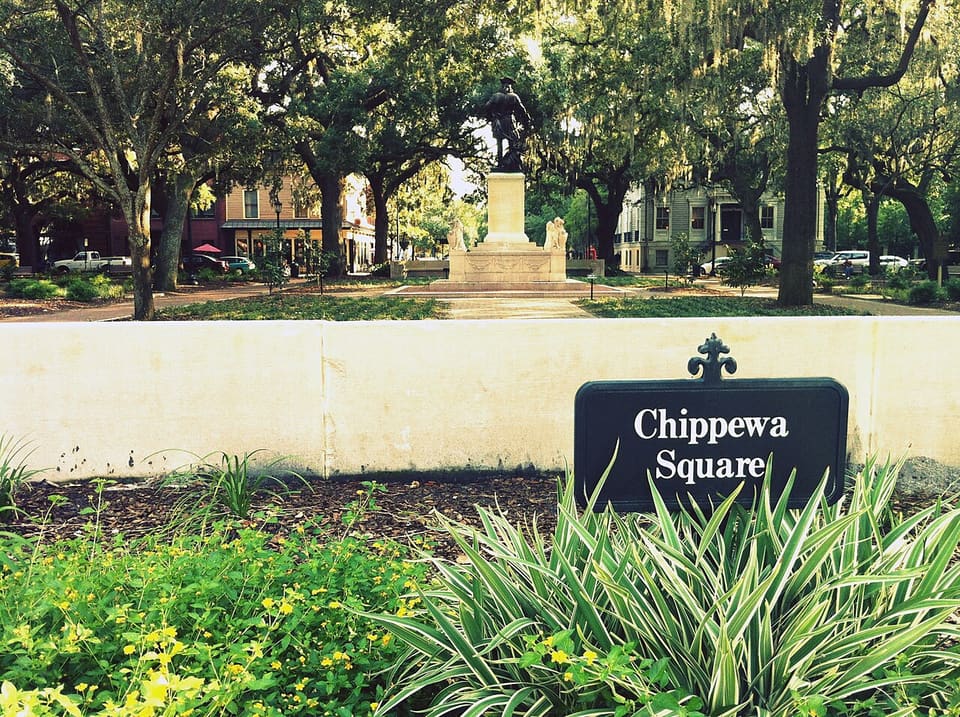
Chippewa Square is stop 6 of our squares walk: the Oglethorpe statue, the War of 1812 name, and the bench that was never the park's. Hear it free.
Stop 6 of the Savannah walk, told on the spot. All 8 stops are $4.99 for your group, on up to 4 phones.
A drawn sword catches the light on the bronze figure atop the tall pedestal in the middle of Chippewa Square, halfway down Bull Street. That's James Oglethorpe, the man who founded Georgia, standing in full uniform. Notice which way he's facing: south. He isn't looking at the city he planned. He's watching for the enemy.
Oglethorpe was a British army officer and member of Parliament. In 1729 he chaired a committee investigating Britain's debtors' prisons, and out of that work came an idea: a new colony where the poor could start again. That was the sales pitch. The other half of it was military. Georgia would be a buffer, a wall of settlers between the rich plantations of the Carolinas and the Spanish in Florida.
So when Oglethorpe sailed here in 1732, he came as a soldier as much as a reformer. He held nearly all the power in the colony, and he banned both slavery and alcohol. The land itself was not empty. It was Native country, and the town rose on the bluff only after Oglethorpe came to terms with the Yamacraw leader Tomochichi. Georgia's later growth would push Native people off far more of it.
Then the war came. In 1740 Oglethorpe marched south and laid siege to the Spanish fort at St. Augustine. It failed. Two years later the Spanish invaded Georgia, and this time Oglethorpe beat them. He tried St. Augustine once more, failed again, sailed home, and never came back.
Here's the turn. Oglethorpe's slavery ban didn't outlast him. It was overturned within a decade of his leaving, and the colony he imagined as a place for free working people became a slave society like its neighbors.
The square came much later, laid out in 1815 and named for American soldiers killed at the Battle of Chippawa in the War of 1812. Savannah kept building around squares like this one for generations after Oglethorpe's first one. The statue arrived in 1910, the work of sculptor Daniel Chester French and architect Henry Bacon, the pair who would later give the country the Lincoln Memorial. To make room for it, the city moved two busts of Confederate officers out of this square and down to Forsyth Park, where you'll end today. So in 1910, Savannah chose which past would stand at the center of its square. It picked the founder, and it posed him the way he saw himself: a commander guarding the border.
One more thing. On the north side of the square, in 1994, Tom Hanks sat on a bench and told the world life was like a box of chocolates. Visitors still come looking for that bench. It was never here. It was fiberglass, a movie prop, and it now lives in the Savannah History Museum.
Walk east, turn right onto Floyd Street, left onto East Perry Street, then right onto Abercorn Street, about eight minutes. Ahead rise two spires, home to the Catholics that Oglethorpe's colony once kept out.
The Forrest Gump bench was a fiberglass prop, set on the north side of Chippewa Square for the film and never one of the park's own benches. One of the props is on show at the Savannah History Museum, 303 Martin Luther King Jr. Blvd, a 10-minute walk west, open daily from 9 to 4 for $12 an adult. The other prop is kept at Paramount in Los Angeles. Below are both spots, the walk between them, and the other places in Savannah you saw in the film.
The Forrest Gump bench scene was filmed on the north side of Chippewa Square, at Bull and McDonough Streets. Two more of the film's Savannah places are a short walk from it.
| Place | In the film | Where | From Chippewa Square |
|---|---|---|---|
| Chippewa Square, north side | Forrest's bench, a fiberglass prop | Bull and McDonough Streets | You are there |
| Savannah History Museum | One of the prop benches, on display | 303 Martin Luther King Jr. Blvd | 0.48 mi, 10 min on foot |
| Sorrel-Weed House, Madison Square | The opening shot of the feather was filmed from its roof | 6 West Harris Street | 0.29 mi, 6 min |
| Forsyth Park fountain | The fountain appears in the film | Forsyth Park, south end of Bull Street | 0.62 mi, 13 min |
Walking times are our own, routed on OpenStreetMap's footpaths on November 21, 2026.
To see the Forrest Gump bench, buy a ticket to the Savannah History Museum: the bench is inside, in the old Central of Georgia Railway station next to the main visitor center.
Open daily from 9 a.m. to 4 p.m.; $12 for an adult.
From Chippewa Square, 0.48 miles and about 10 minutes west. From Johnson Square, 0.74 miles and 16 minutes.
The visitor center lot next door has 298 spaces: the first hour is free, then $1 an hour.
Chippewa Square has the Oglethorpe Monument at its center, and four landmarks around it.
By the sculptor Daniel Chester French and the architect Henry Bacon, unveiled in 1910. Oglethorpe faces south, toward Spanish Florida, with his sword drawn.
Laid out in 1815 and named for the American soldiers killed at the Battle of Chippawa in the War of 1812.
First Baptist Church (1833), the Independent Presbyterian Church, the Philbrick-Eastman House (1847) and the Savannah Theatre.
Chippewa is one of five on Bull Street. The Savannah squares guide has all 22 and a walk through every one.
Our squares walk stops at Chippewa Square: it is stop 6 of 8, on a 2.3-mile route from City Hall to Forsyth Park that takes about 1 hour 20 minutes.
Stop 1 is free, no sign-up. The whole walk is for your group, on up to 4 phones.
Eight stops from City Hall, begun in 1904, to Forsyth Park, by way of Johnson Square, the first of the city's squares, laid out in 1733.
More in town: Savannah.
Plan the rest of your Savannah trip with these guides, each checked on the same day.
On the north side of Chippewa Square in Savannah, at Bull and McDonough Streets.
One of the prop benches is, at the Savannah History Museum, 303 Martin Luther King Jr. Blvd. The other is kept at Paramount in Los Angeles.
Not the film's. That bench was a fiberglass prop, never one of the park's own, and one of the props is now at the Savannah History Museum.
$12 for an adult, the Savannah History Museum's admission. It is open daily from 9 a.m. to 4 p.m.
The bench scenes in Chippewa Square, and the opening feather from the roof of the Sorrel-Weed House on Madison Square. The Forsyth Park fountain appears in the film too.
These facts come from the pages below, each read on November 21, 2026; the walking and driving times are our own routing.
Checked November 2026. Fares, schedules and seasons change: check the official sites before you go.