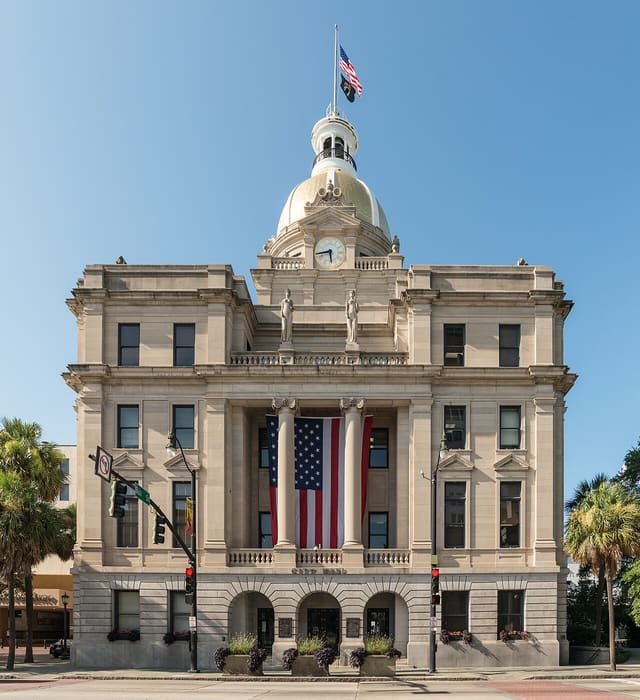
Savannah Walking Tour: City Hall to Forsyth Park
Eight stops from City Hall, begun in 1904, to Forsyth Park, by way of Johnson Square, the first of the city's squares, laid out in 1733.
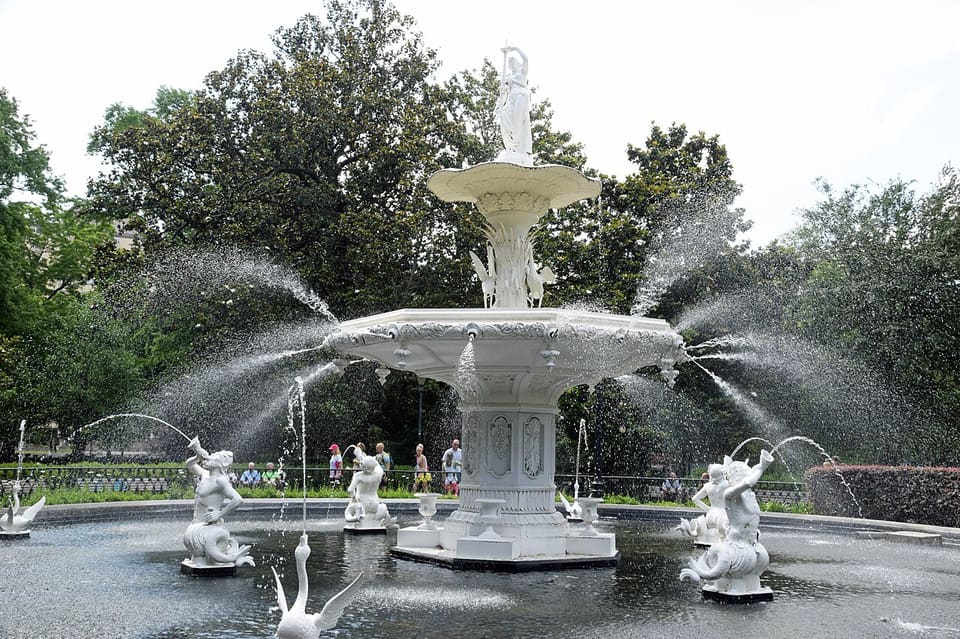
The Forsyth Park fountain, dyed green every St. Patrick's Day, is the last stop of our squares walk. Hear its story free.
Stop 8 of the Savannah walk, told on the spot. All 8 stops are $4.99 for your group, on up to 4 phones.
After the last of the squares, Bull Street finally lets the city go, and it opens into trees. Find the spot where the path meets the fountain, then turn and look back north up Bull Street, the way you came. The cast-iron fountain sits right on that line, splashing away in the middle of its basin. Most people stop for the photograph. The ground around it is the better story.
All day you've walked through James Oglethorpe's plan, ward after ward, each one built around a small square. But by 1853 every one of the original planned wards was full. Savannah had run out of room for squares.
The park started small. The first ten acres were donated by William Brown Hodgson in the 1840s. In 1851 the park grew and took the name of John Forsyth, a former governor of Georgia. The fountain's design comes from the work of the French sculptor Michel Lienard, and it was manufactured at an iron foundry in the Bronx that also made ironwork for the dome of the U.S. Capitol.
Now turn and face south, past the fountain, to the long open stretch beyond. Here's the strange part. That southern end was never really meant to be a park at all.
In 1859, the city made a deal with Savannah's volunteer militia companies. The militia gave up its old parade ground, and in exchange it got this southern stretch as its new one. The city subdivided the old parade ground into lots and reported it had profited by many thousands of dollars. What the city never did was make a formal transfer.
That loose end sat there for 64 years. In 1923 the city formally admitted it had taken the benefits of the swap without making a formal transfer, and it confirmed the militia's title as if a deed of exchange had been made. So the lawn you're about to cross has an owner, and it isn't the city. The owners let the public use it, in exchange for a property tax exemption and the city's upkeep and security.
The soldiers left their mark on it, too. The Confederate monument was unveiled in 1874 and is one of the first and largest in Georgia. It honors men who fought for a government founded to protect slavery. At the far south end stands The Hiker, a Spanish-American War soldier. He is here because Savannah contributed more soldiers per capita than any other city in Georgia.
So this is where Oglethorpe's plan ends: not with another square, but with a parade ground the city traded for, never quite paid for on paper, and has been borrowing ever since.
Walk south from the fountain along the central path toward the open parade ground, and look for the Confederate monument and then The Hiker at the far end. Mind the deed as you go: you're standing on militia land.
The best time to visit Savannah is spring, March to May, or fall, October and November: average highs of 70 to 85°F, and less rain than in summer. June to September brings highs of 86 to 92°F and the most rain; January is the coldest month, with an average low of 40°F. The figures are NOAA's 1991–2020 normals for the Savannah/Hilton Head airport. Below them: the dates to plan around, what closes and when, and how the weather changes a walk.
Savannah has mild winters, warm springs and falls, and hot, wet summers; here is every month.
| Month | Average high | Average low | Rain | Rainy days |
|---|---|---|---|---|
| January | 61.4°F | 40.0°F | 3.28 in | 5.6 |
| February | 65.1°F | 42.9°F | 2.80 in | 4.7 |
| March | 71.4°F | 48.6°F | 3.50 in | 5.0 |
| April | 78.2°F | 55.2°F | 3.39 in | 4.2 |
| May | 84.7°F | 63.4°F | 3.62 in | 5.3 |
| June | 89.6°F | 70.7°F | 6.65 in | 8.5 |
| July | 92.3°F | 73.7°F | 5.75 in | 8.5 |
| August | 90.8°F | 73.3°F | 5.46 in | 8.4 |
| September | 86.4°F | 69.0°F | 4.35 in | 6.5 |
| October | 79.0°F | 58.6°F | 3.72 in | 4.2 |
| November | 70.2°F | 48.0°F | 2.39 in | 4.1 |
| December | 63.7°F | 42.6°F | 3.21 in | 5.4 |
NOAA's 1991–2020 monthly normals for Savannah/Hilton Head International Airport, read on November 21, 2026. A rainy day has at least a tenth of an inch.
Plan a Savannah trip around St. Patrick's Day on March 17, when the city holds its parade, and the holidays, when most museums close.
| When | What happens | Plan for it |
|---|---|---|
| March 17, 2027, a Wednesday | The St. Patrick's Day parade, and the Forsyth Park fountain is dyed green | Book a room early. The Tybee light closes on parade day. |
| June 1 to November 30 | The Atlantic hurricane season | Watch the forecast for the coast, and Tybee above all. |
| Every Saturday | The Forsyth Farmers Market, 9 a.m. to 1 p.m. | Start your Saturday in Forsyth Park. |
| Mondays and Tuesdays | Telfair's three sites close on Mondays, the Tybee light on Tuesdays | Do the squares and the cemeteries those days. |
| Thanksgiving, November 26, 2026 | Telfair, Wormsloe and Fort Pulaski close; the cathedral closes to visitors; no ferry or DOT shuttle | Walk the squares; nearly everything outdoors stays open. |
| Christmas Day and New Year's Day | No ferry or DOT shuttle; Telfair and Fort Pulaski close, and Wormsloe on Christmas | Telfair opens 10 a.m. to 3 p.m. on Christmas Eve and New Year's Eve. |
Dates and closures from each site and the city, read on November 21, 2026; the 2027 parade date from WTOC.
Yes, mild ones: the average high moves from 61°F in January to 92°F in July.
Highs of 71 to 85°F and about five rainy days a month. The best weather for walking all day, with St. Patrick's Day in March.
Highs of 86 to 92°F and 8 or more rainy days a month from June to August; June is the wettest month, at 6.65 inches. Walk early, and keep the museums for midday.
Highs of 79°F in October and 70°F in November, and the driest month of the year, November, at 2.39 inches. A good time for the ghost walk, with dark by evening.
Highs of 61 to 65°F, lows near 40°F. Bring a layer for the evening walks.
Whatever the season, take Savannah's two walks at the cool end of the day, since both are outdoors and take an hour or a little more: the squares walk in the morning, 8 stops over 2.3 miles from City Hall to Forsyth Park, about 1 hour 20 minutes, and the ghost walk after dark, 7 stops over 1.6 miles from the Pirates' House to Mercer House, about an hour.
Stop 1 is free, no sign-up. The whole walk is for your group, on up to 4 phones.
Eight stops from City Hall, begun in 1904, to Forsyth Park, by way of Johnson Square, the first of the city's squares, laid out in 1733.
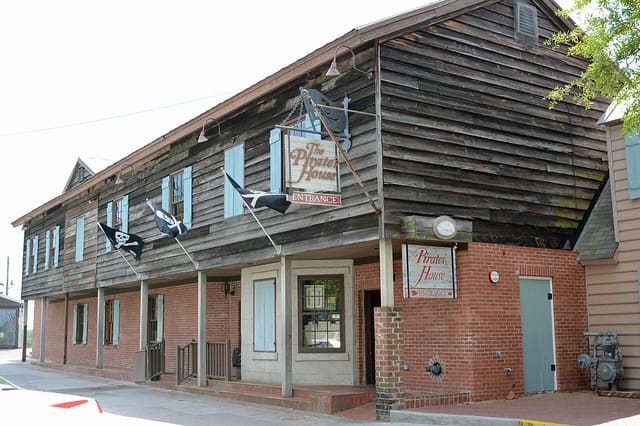
Savannah's squares hide pirates, plague victims, duels and a famous killing, and each stop here pairs the legend with the record behind it.
More in town: Savannah.
Plan the rest of your Savannah trip with these guides, each checked on the same day.
April or October. Average highs are 78 to 79°F, with about four rainy days in each, by NOAA's 1991–2020 normals.
June, with 6.65 inches on average. July and August follow at 5.75 and 5.46 inches; November is the driest month, at 2.39.
July averages a high of 92.3°F and a low of 73.7°F, and June through September all average highs above 86°F.
For mild walking, yes: average highs of 63.7°F and lows of 42.6°F. Check the holiday closures: no ferry or shuttle on Christmas Day, and Telfair, Wormsloe and Fort Pulaski close.
The Atlantic hurricane season runs from June 1 to November 30.
Two days for the Historic District on foot; three with a day out to Wormsloe, Fort Pulaski and Tybee Island.
These facts come from the pages below, each read on November 21, 2026; the walking and driving times are our own routing.
Checked November 2026. Fares, schedules and seasons change: check the official sites before you go.