The whole storyStop 5 of Philadelphia Walking Tour: Independence Hall to Elfreth's Alley
The House That Isn't There
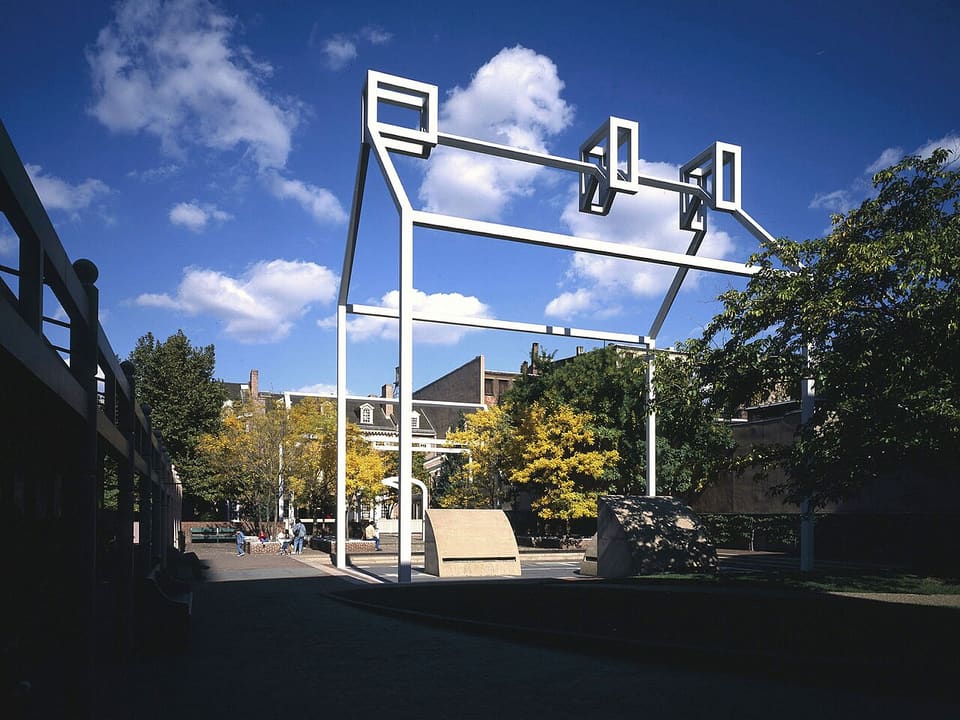
You're standing in Franklin Court, a quiet courtyard tucked into the middle of the block behind Market Street. Look up at the big white steel frame in front of you, a house drawn in the air with square tubes, roof peak and all. That outline marks where Benjamin Franklin lived, and where he died.
Franklin had this house built in 1763. He was a printer, a scientist, a diplomat and a statesman, but he was not often at home. Franklin was overseas for a significant part of the years he owned it, though he was in Philadelphia for much of his time in the Second Continental Congress and at the Constitutional Convention. He didn't move in for good until 1785.
And he wasn't finished building. In 1787, the summer of the Constitutional Convention, Franklin had a print shop built here for his grandson, Benjamin Franklin Bache, who would publish the Philadelphia Aurora there. The smaller steel frame beside the house marks that shop. The old printer was setting up the next printer. Franklin died here in 1790.
The story has a harder side, and it belongs to this address. Franklin enslaved people. Late in life he also served as president of the Pennsylvania Abolition Society. Both are true.
Then the house disappeared. In 1812, twenty-two years after his death, it was torn down so the courtyard could be redeveloped into income-producing property. The most famous man in Philadelphia, and his house simply vanished.
Starting in 1950, the National Park Service bought up the lots, and in the 1950s and 60s archaeologists dug for whatever was left. They found foundations. What they didn't have was enough historical information to reconstruct the buildings properly. So when the architects Venturi and Rauch designed this courtyard for the Bicentennial, they didn't invent a convincing fake. Instead they drew the outline in square steel tubing.
Look down at your feet. The changes in the paving mark the arrangement of the rooms. And those low concrete hoods let you look down at the archaeological remains beneath, the part of Franklin's house that survives.
Here's the twist. The ghost frames went up in 1976, and other historic sites have since copied the idea. By 1986 the Park Service was already noting that they should be evaluated once they reached fifty years old, and listed them as non-historic, contributing. So the stand-in for the lost house is on its way to being historic itself.
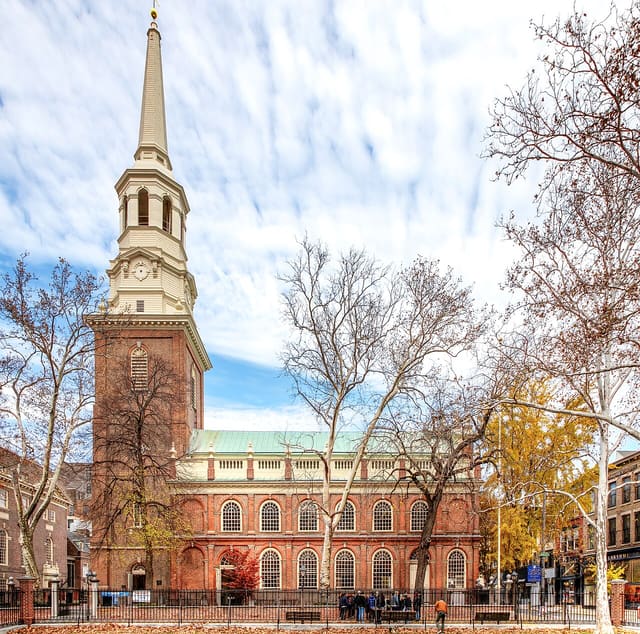
When you're ready, walk north about six minutes to Christ Church, where Franklin had a pew and where the steeple once towered over the whole city.
Hear it where it happened. It plays at stop 5 of Philadelphia Walking Tour: Independence Hall to Elfreth's Alley (3 min), narrated as you walk. Unlock the tour for the audio, or try stop 1 free first.