The whole storyStop 4 of Philadelphia Walking Tour: Independence Hall to Elfreth's Alley
The Builders Who Finally Built Their Own
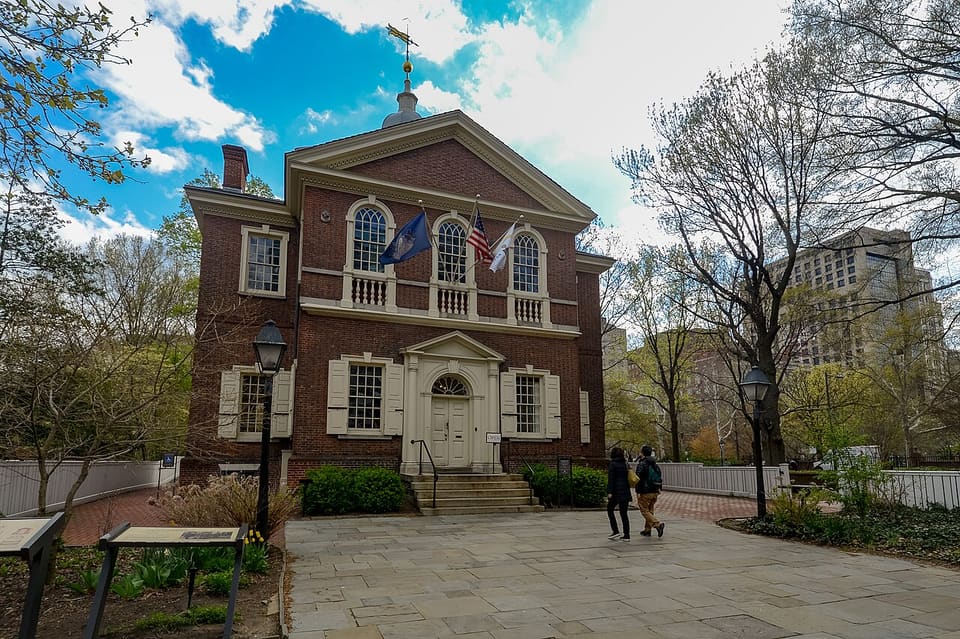
You're standing on Chestnut Street, looking at a two-story brick building set back from the street. That's Carpenters' Hall. Look up to the very top and find the weathervane. Then bring your eyes back down to the front door. Fifty-six men walked through it in the autumn of 1774 to start a revolution, and they were guests.
The hosts were carpenters. In 1724, Philadelphia's master builders formed the Carpenters' Company, a guild to share their knowledge and protect their trade. These were the men who built the city's houses and churches. And for almost fifty years, they had no building of their own. They met in rented rooms in taverns, like a club with no clubhouse.
In 1768 they finally bought this lot, a few hundred feet from Benjamin Franklin's home. One of their own, a Scottish-born builder named Robert Smith, drew the plans. He borrowed from the town halls of his native Scotland and the country villas of Italy. Construction was finished in August 1774. The paint was barely dry.
Two weeks later, delegates from across the colonies arrived in Philadelphia for what became the First Continental Congress. They needed a room. John Adams, the lawyer from Massachusetts, wrote down what happened on the morning of September 5. The delegates gathered at a tavern, then walked over here and looked the place over. They admired the room, and a chamber holding what Adams called an excellent library. In his words, "The general cry was, that this was a good room." So the carpenters' brand-new hall became the first meeting place of the Continental Congress.
They stayed until October 26. Inside, they passed and signed the Continental Association, a pact to stop trading with Britain, and each colony was expected to enforce it. That was the turn: protest became organized, shared, binding.
In the same weeks, the Congress resolved to stop importing enslaved people and to end the slave trade within the colonies. Be precise about what that meant. It closed a door to new captives. It freed no one already enslaved, and slavery itself went on for generations.
This room wasn't finished making history. In June 1776, a Pennsylvania conference met here and declared the province independent of Britain, a few weeks before the Declaration down the street.
And here's the quiet part. The guild never let the building go. The Carpenters' Company still owns Carpenters' Hall today, and they let you in for free. The craftsmen who spent half a century in borrowed tavern rooms ended up lending theirs to a country.
Hear it where it happened. It plays at stop 4 of Philadelphia Walking Tour: Independence Hall to Elfreth's Alley (3 min), narrated as you walk. Unlock the tour for the audio, or try stop 1 free first.