The whole story
Smoke, a Misread Fire, and Return Fire
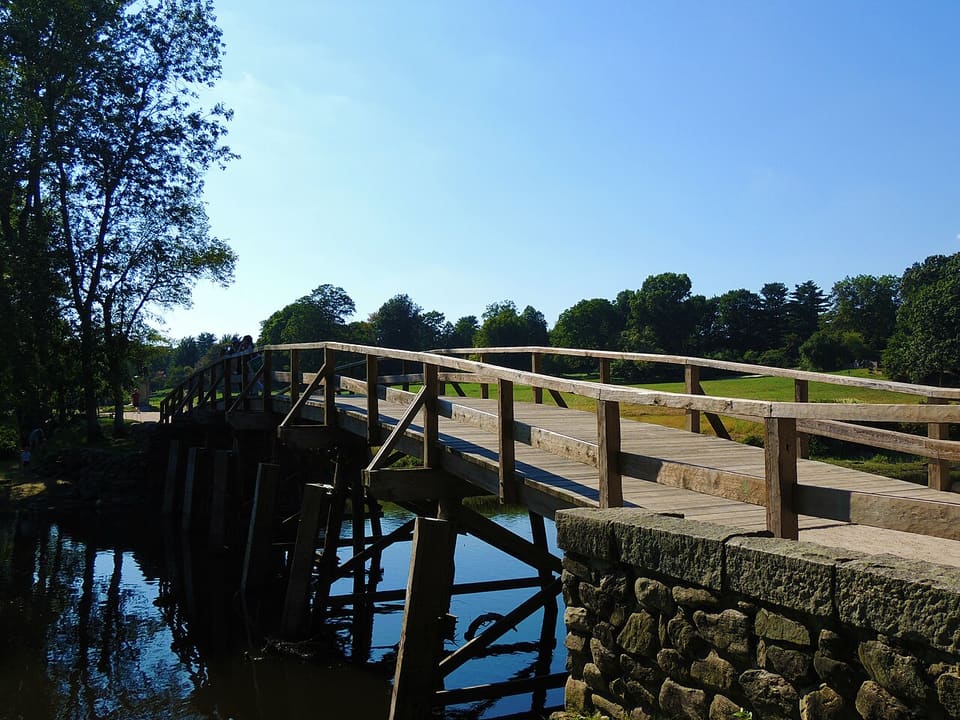
You've reached the North Bridge in Concord, where this tour ends. Once you're parked and on foot, walk out toward the river and find the low wooden bridge arching over the slow, dark water of the Concord River. On the far side stands a bronze farmer with a musket, the Minute Man statue. On this near side, a plain granite obelisk. Between them, the bridge. This is where the fight of April 19, 1775 turned.
By mid-morning that day, British troops had come to Concord to seize or destroy military supplies. Three light infantry companies from the 4th, 10th and 43rd Regiments, under Captain Walter Laurie, were holding this bridge, roughly 90 men. Across the river, the colonial side kept growing. Minutemen and militia gathered until there were about 400 of them.
Then, around 9:30, they noticed smoke rising toward the town.
The British were burning some wooden gun carriages they had found. But the militia beyond the bridge believed the regulars had set fire to Concord itself, their homes, their families. So they advanced in military order toward the bridge, intending to stop the burning.
Laurie's men crossed to this eastern bank and took up position. The British fired a few warning shots, followed by a full volley. Several Americans were killed or wounded in that first round. And Major John Buttrick of Concord commanded the words still quoted here: "Fire, fellow soldiers, for God's sake fire!"
The Americans returned fire, and the British immediately retreated back toward Concord. Three British soldiers were killed and nine wounded. Two Americans were killed and four wounded. It was the first time American forces advanced in formation on the British regulars, inflicted casualties, and routed them. That helped set off the British retreat back to Boston. Ralph Waldo Emerson would call the moment the "shot heard round the world."
Now the twist. The bridge you're looking at isn't that bridge. In 1793 the town built a new bridge downriver and had the old one torn down, and for 82 years no bridge stood here at all. For the 1874 centennial, a bridge was built that has been called whimsical, with side pavilions covered in interwoven twigs. Later came a concrete version. Hurricane Diane destroyed it in 1955, and the wooden bridge under your feet went up in 1956.
The statue has its own story. Daniel Chester French's Minute Man was meant to be stone, but the medium switched to bronze, cast from ten Civil War-era cannons. It shows a young farmer stepping away from his plow, a musket in his hand, to join the fight.
Hear it where it happened. Unlock its tour for the audio.