The whole storyStop 5 of Brooklyn Bridge and Lower Manhattan Walking Tour
Leaving the Footprints Open to the Sky
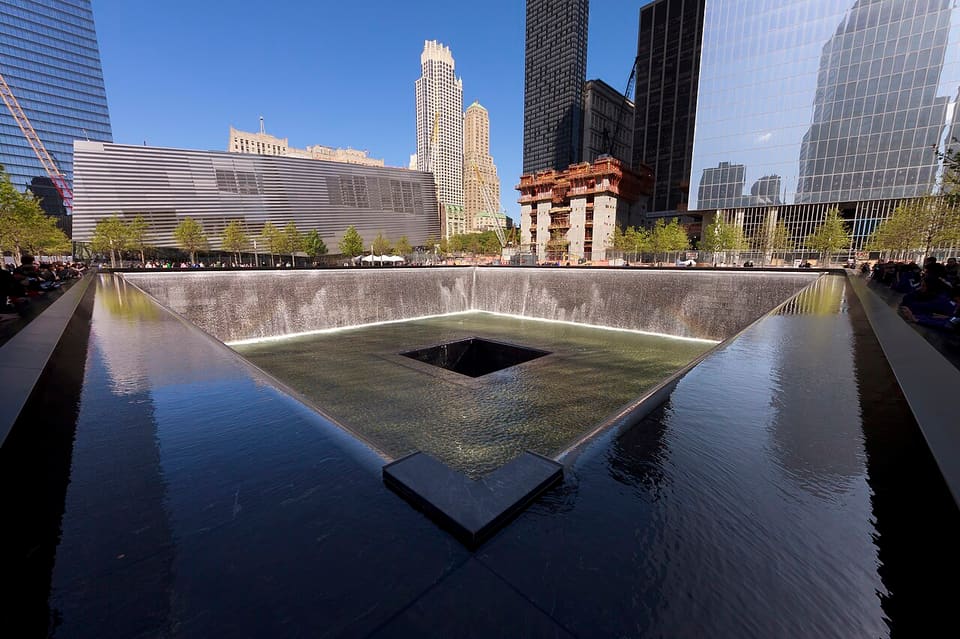
You're standing on the memorial plaza at the World Trade Center site, under rows of swamp white oak trees. Walk toward one of the two great square pools. Each one sits exactly where one of the Twin Towers stood. Watch the water. It pours down all four walls, gathers, and then falls again into a smaller void at the center, where you can't see the bottom.
This memorial honors the 2,977 people killed on September 11, 2001, here, at the Pentagon, and in a field near Shanksville, Pennsylvania. It also honors six people who are easy to forget: the six killed when a bomb went off beneath the World Trade Center on February 26, 1993. Their names are here too.
The design came out of an international competition launched in 2003. Entries arrived from around the world, and a jury of thirteen narrowed them to eight finalists. One came from Michael Arad, an Israeli-American architect, working with the landscape architect Peter Walker. They called it Reflecting Absence.
Arad's entry broke a rule. The master plan for the whole site, drawn up by the architect Daniel Libeskind, asked for buildings to overhang the footprints of the towers. Every other finalist went along with that. Arad was the only one who didn't. He left the footprints open to the sky. In January 2004, his design won.
It wasn't smooth from there. When construction crews arrived in March 2006, some victims' relatives came to protest, wanting the memorial built above ground rather than sunk below it. Cost estimates climbed past a billion dollars, and the plans had to be scaled back. Along the way, ordinary people kept the project going. In 2007 a touring exhibit visited 25 states, and visitors signed steel beams later used in the memorial's construction. At its first stop, in South Carolina, the guests of honor were students from White Knoll Middle School, who back in 2001 had raised more than half a million dollars to buy New York's fire department a new truck. Middle schoolers. A fire truck.
The memorial was dedicated on the tenth anniversary, September 11, 2011, and opened to the public the next day.
Now look at the parapets around the pool, where the names are cut through the metal. They aren't in alphabetical order. They're arranged by what the designers called meaningful adjacencies: people placed beside those they lived and worked with, and died with. So the order on that wall isn't random. Each name sits near the people who belonged beside it.
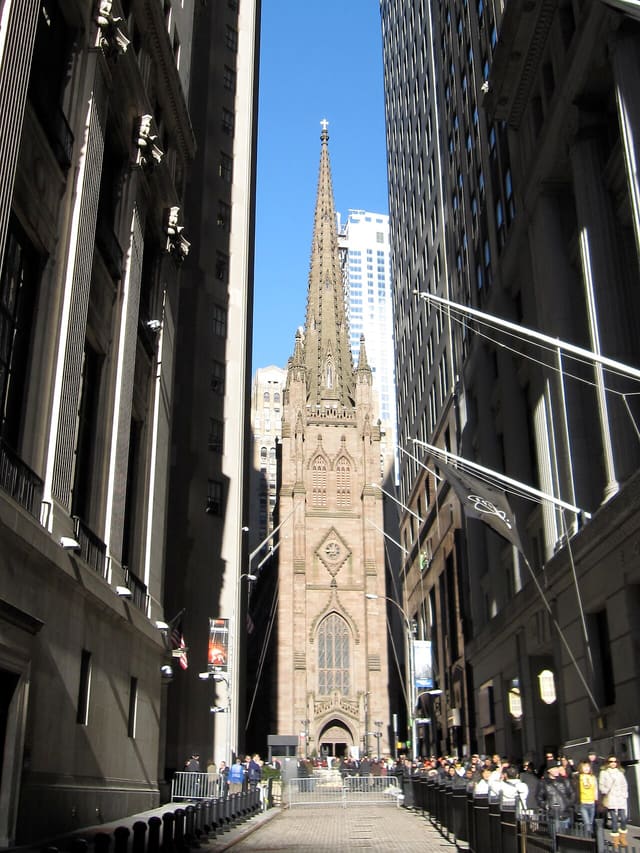
When you're ready, walk east, about eight minutes, to Trinity Church, where a churchyard far older than these towers faces straight down Wall Street.
Hear it where it happened. It plays at stop 5 of Brooklyn Bridge and Lower Manhattan Walking Tour (3 min), narrated as you walk. Unlock the tour for the audio, or try stop 1 free first.