The whole storyStop 2 of Chicago Loop Architecture Walking Tour
Crows, Politicians, and a Cautious Skyscraper
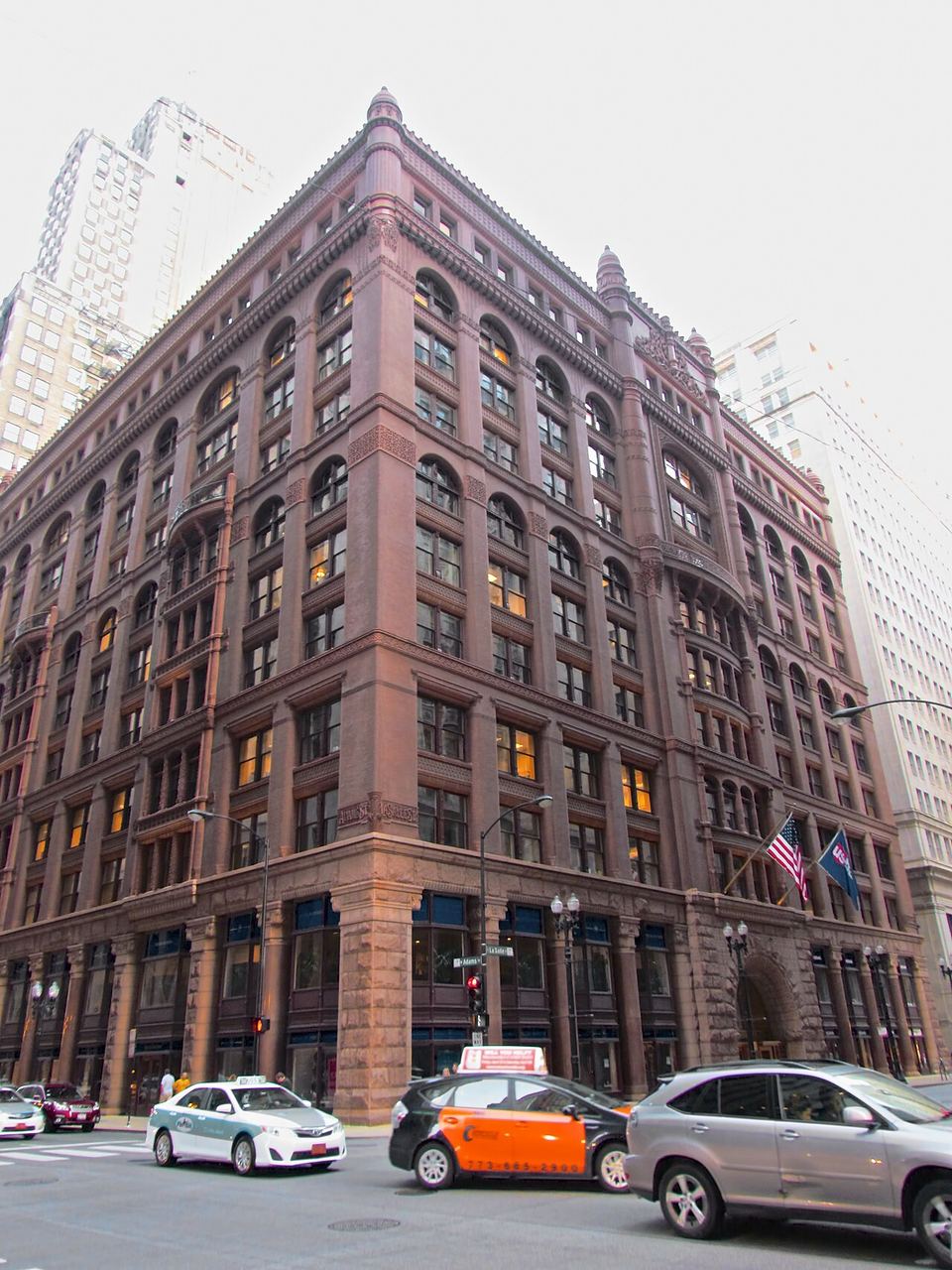
You're on South LaSalle Street, a short walk up from the Board of Trade, standing in front of a reddish-brown building twelve stories tall. This is the Rookery, finished in 1888, and it's considered the oldest standing high-rise in Chicago. Look at the stonework around the entrance. Find the carved birds. They're a joke, and the joke is older than the building.
After the Great Chicago Fire of 1871, the city needed somewhere to govern from, fast. On this very lot, a big iron water tank had survived the flames. So Chicago built a makeshift city hall right around it. Crows and pigeons flocked all over the outside. Chicagoans called the place the rookery, for the birds, and for the politicians inside, who were said to be just as crooked. For a while, that old water tank even held part of the public library's books.
When a Boston investor named Peter Brooks put up a new office building here, he toyed with other names. The Rookery won. Chicago kept the insult and carved it in stone.
The architects were Daniel Burnham and John Wellborn Root, partners since 1873. Burnham was the dealmaker, a man who had failed at gold mining, politics and selling plate glass before architecture finally stuck. Root was the artist and the engineer. They believed in this building enough to move their own offices into it, and their library on the eleventh floor is still there.
Their problem was underfoot. Chicago sits on swampy soil, and a heavy building can sink into it. Root's answer was a floating foundation: iron rails and beams laid in a crisscross grid and sealed in concrete, a kind of homemade bedrock for the weight to rest on.
Now here's the part the plaque won't dwell on. The Rookery is a building with one foot in the future and one foot nervously in the past. Inside, it uses iron and steel framing, a step toward the steel skeletons that would make true skyscrapers possible. But the outer walls are mostly old-fashioned load-bearing masonry. Metal-framed walls appear on only two sides, on only two floors. The developers simply weren't sure metal could hold the building up. That's why the bottom stories wear those thick, rough granite blocks. They're meant to look sturdy, because sturdiness was still the selling point.
Inside is a two-story light court under a skylight of about 5,000 panes of glass. Between 1905 and 1907, a young Frank Lloyd Wright remade the lobby, covering Root's ornate ironwork with white marble. It's his only work in the Loop.
So the most important thing about this building may be how unsure it was. Chicago invented the skyscraper one careful wall at a time. And it named the experiment after its pigeons.
Hear it where it happened. It plays at stop 2 of Chicago Loop Architecture Walking Tour (3 min), narrated as you walk. Unlock the tour for the audio, or try stop 1 free first.