The whole storyStop 7 of Chicago Loop Architecture Walking Tour
Three-Foot Walls in a City of Glass
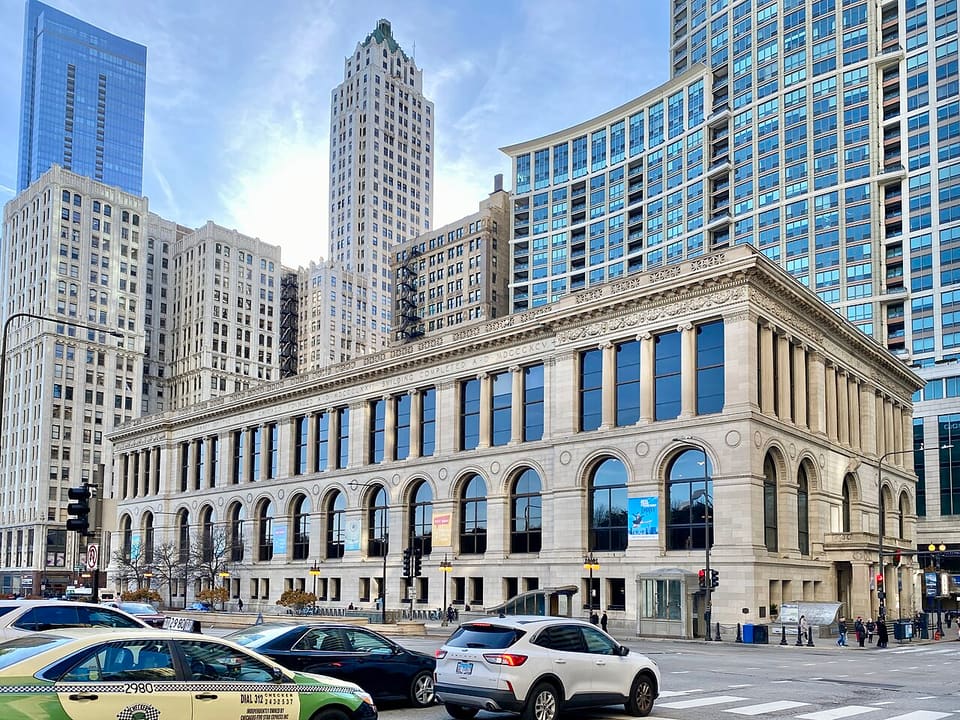
You're standing on East Washington Street, just across Michigan Avenue from Millennium Park, in front of the building Chicagoans call the Cultural Center. Look at the arched doorway and its bronze-framed doors, then at the pale gray stone around them. That's Bedford Blue limestone sitting on a granite base, and behind it the walls are about three feet thick.
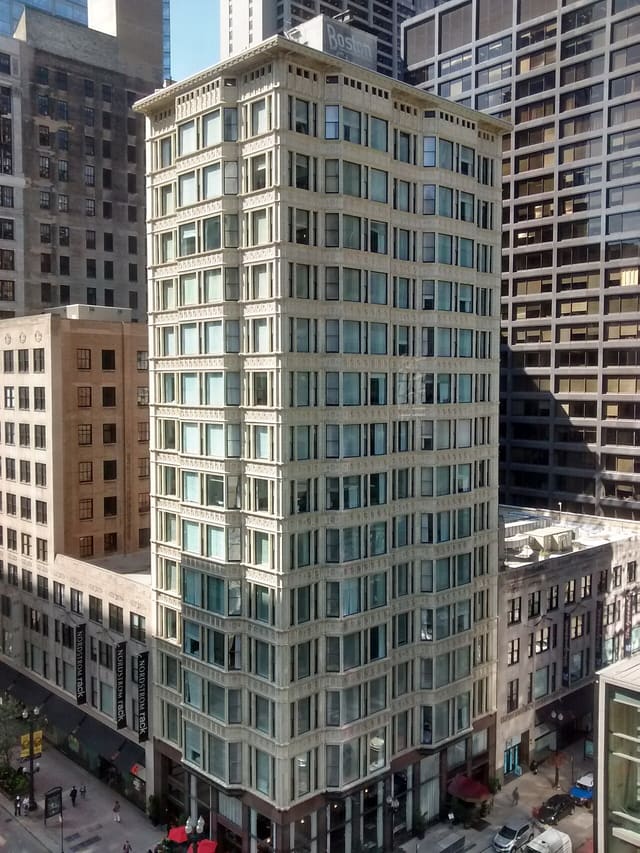
Keep that number in mind, because of where you've just been. A few blocks back, the Reliance Building was going up in these same years with walls that were mostly plate glass. Chicago was inventing the skyscraper, the light steel frame, the building as a cage of windows. And when the city wanted its great public library, it built this: a masonry palace, designed not by a Chicago firm at all but by Shepley, Rutan and Coolidge of Boston.
The building opened in 1897 and cost nearly 2 million dollars. It had two masters under one roof. The south wing, where you're standing, was the city's central library. The north wing belonged to the Grand Army of the Republic, the organization of Union veterans of the Civil War, who donated the land and got a memorial hall and rotunda of their own. Men who had fought at places like Shiloh and Gettysburg met upstairs while Chicagoans borrowed books downstairs.
The point of all that marble was a statement. This was a city barely 25 years past the Great Fire, often mocked as a town of stockyards and grain traders, announcing that it had culture too. Inside, the grand staircase is white Carrara marble set with green marble from Connemara in Ireland and mosaics of glass and mother of pearl. The stairway to the fifth floor was modeled on the Bridge of Sighs in Venice. In a lending library. Chicago never did anything halfway.
The library eventually outgrew the palace. In 1978, Lois Weisberg, the city's commissioner of cultural affairs, pushed to turn it into an arts center, and when the new Harold Washington Library opened across the Loop in 1991, the books were gone for good. What stayed was a free, city-run cultural center, the first in the nation, with more than 1,000 programs a year. The mayor uses the building as the city's official reception venue, welcoming presidents, royalty and diplomats.
Here's the surprising part. Upstairs is a Tiffany glass dome nearly 40 feet across, made of more than 60,000 pieces of glass. The city says it's the largest Tiffany dome in the world. Over the decades it got covered in grime and, unbelievably, paint. In 2021 and 2022, restorers cleaned it piece by piece and stripped the paint from the Civil War memorial rooms too.
So the building that looked old-fashioned next to the glass towers turned out to hold some of the finest glass in Chicago. It just kept it indoors.
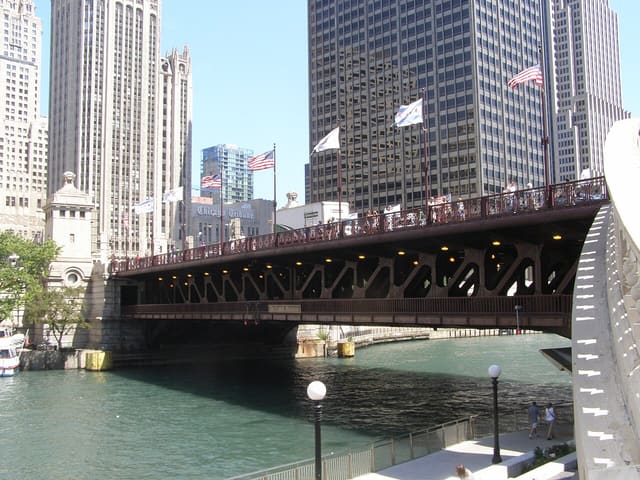
When you're ready, walk north, take the Pedway, turn right onto North Dearborn Street, then turn sharp right onto the Riverwalk, about 23 minutes. You'll end at the Michigan Avenue Bridge, where a plan for a grand boulevard rewired the city.
Hear it where it happened. It plays at stop 7 of Chicago Loop Architecture Walking Tour (3 min), narrated as you walk. Unlock the tour for the audio, or try stop 1 free first.