The whole storyStop 4 of Chicago Loop Architecture Walking Tour
The Cornice That Came Back
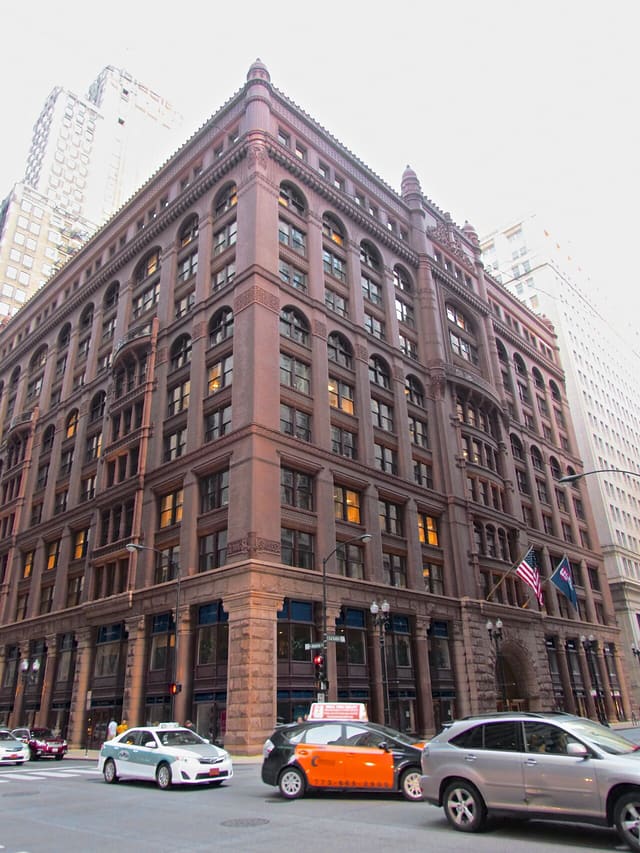
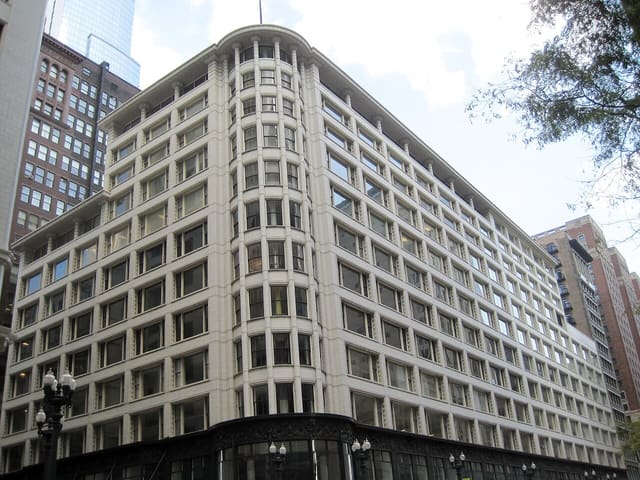
You're standing on West Adams Street at Dearborn, in front of the Marquette Building. Look at the windows first. Each bay is a wide pane of glass with a narrow window on either side. Chicagoans call that a Chicago window, and this building is one of the best places in the city to see it.
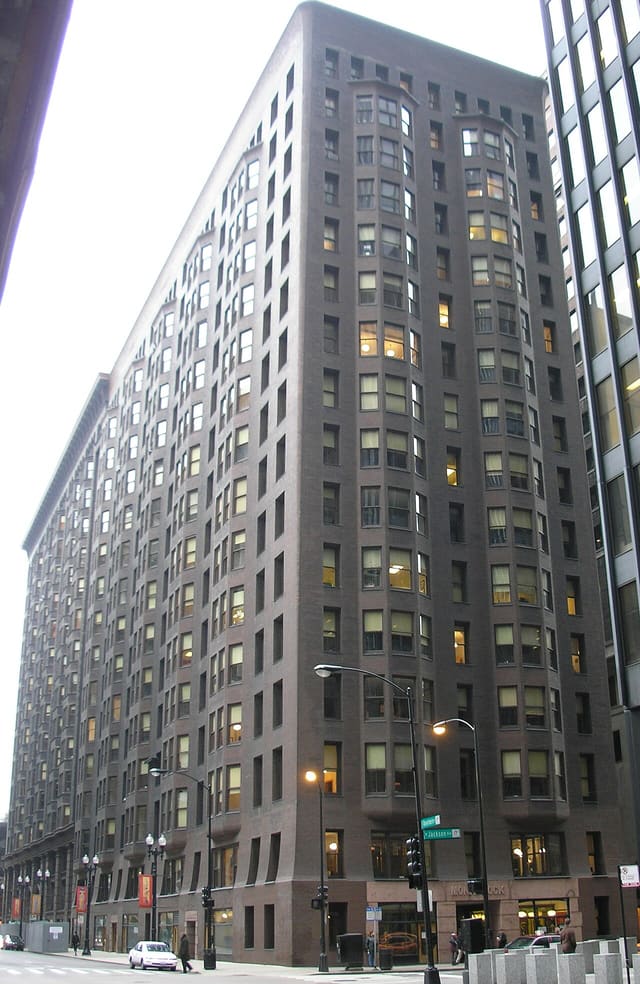
You just left the Monadnock, where Burnham and Root stacked brick until the walls had to be enormously thick at the bottom. The Marquette went up in 1895, built by the George A. Fuller Company and designed by William Holabird and Martin Roche. It's 16 stories too. But here a steel frame carries the weight. The brown terra cotta walls hold up nothing but themselves, so the windows could grow wide. That grid of glass on the front is the frame showing through.
The Marquette was a working building, and it lived like one. In the 1930s more than 30 railroad companies kept their downtown offices here. Decades of Loop soot turned the reddish terra cotta nearly black. And around 1950 someone made a practical decision. They added an extra story and removed the decorative cornice, the projecting crown along the top edge. For about half a century the Marquette stood here without its crown.
The turn came from an unlikely owner. In the 1970s, Bankers Life and Casualty, the insurance company of John D. MacArthur, bought the building. After MacArthur died in 1978, it became the headquarters of the foundation that bears his name, the one best known for its so-called genius grants. In 2001 the MacArthur Foundation began a restoration that took years. Crews cleaned the soot off the masonry and rebuilt the cornice. Now look up to the very top of the building. That crown is a reconstruction, the 1895 skyline returned in 2006.
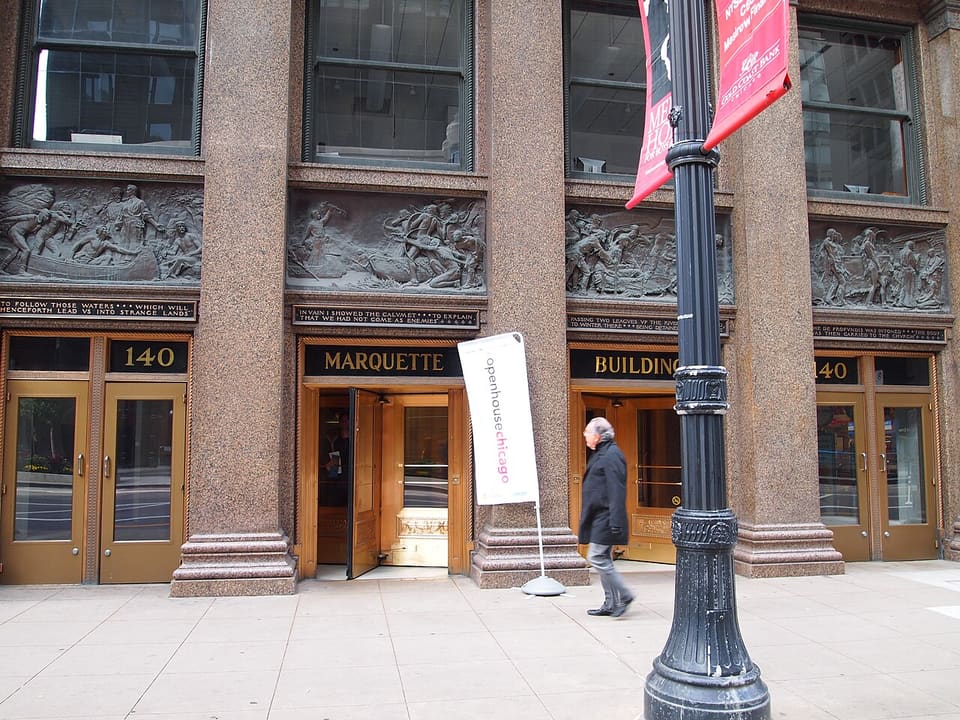
Now look at the entrance. The four bronze panels above the doors are by the sculptor Hermon Atkins MacNeil. They follow Father Jacques Marquette, the French Jesuit missionary who traveled through this region in 1674 and spent that winter near here. The last panel shows his burial. Check the revolving doors for carved panther heads. Inside, the lobby is ringed with a mosaic from Louis Comfort Tiffany's studio, made with Tiffany glass and mother-of-pearl, telling Marquette's story and showing the Native people he met. Those people already lived here. Within a few generations they had been pushed off this land, and the city that took it decorated its offices with their image.
One last thing. After the September 11 attacks many Loop buildings closed their lobbies to passers-by. The Marquette didn't. Its lobby still runs through toward Clark Street, a warm, dry shortcut in a Chicago winter, with Tiffany mosaics thrown in for free.
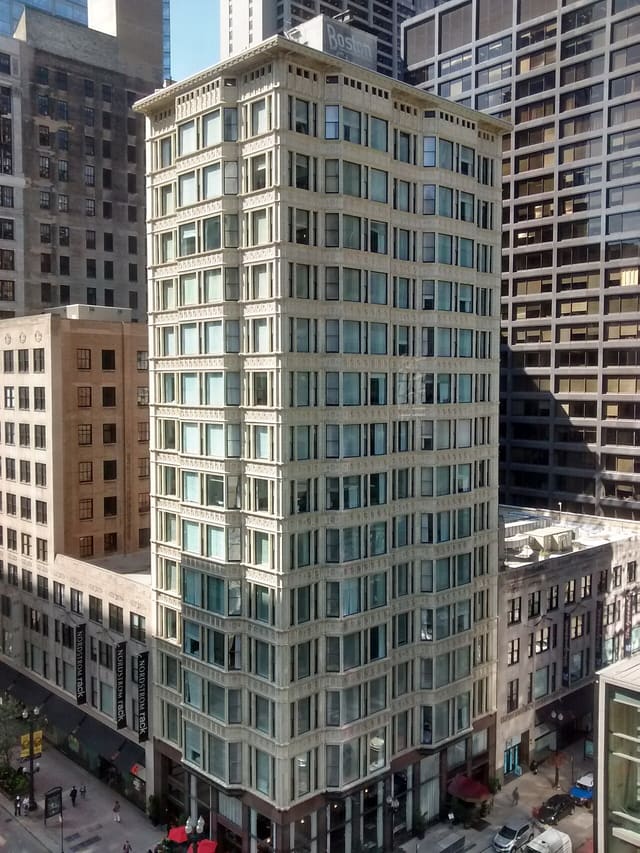
When you're ready, walk east, about eight minutes, to the Reliance Building, where the glass takes over almost the whole front.
Hear it where it happened. It plays at stop 4 of Chicago Loop Architecture Walking Tour (3 min), narrated as you walk. Unlock the tour for the audio, or try stop 1 free first.