The whole storyStop 4 of St. Augustine Walking Tour: Nights of Lights and the Old City
Four Children Who Wouldn't Promise
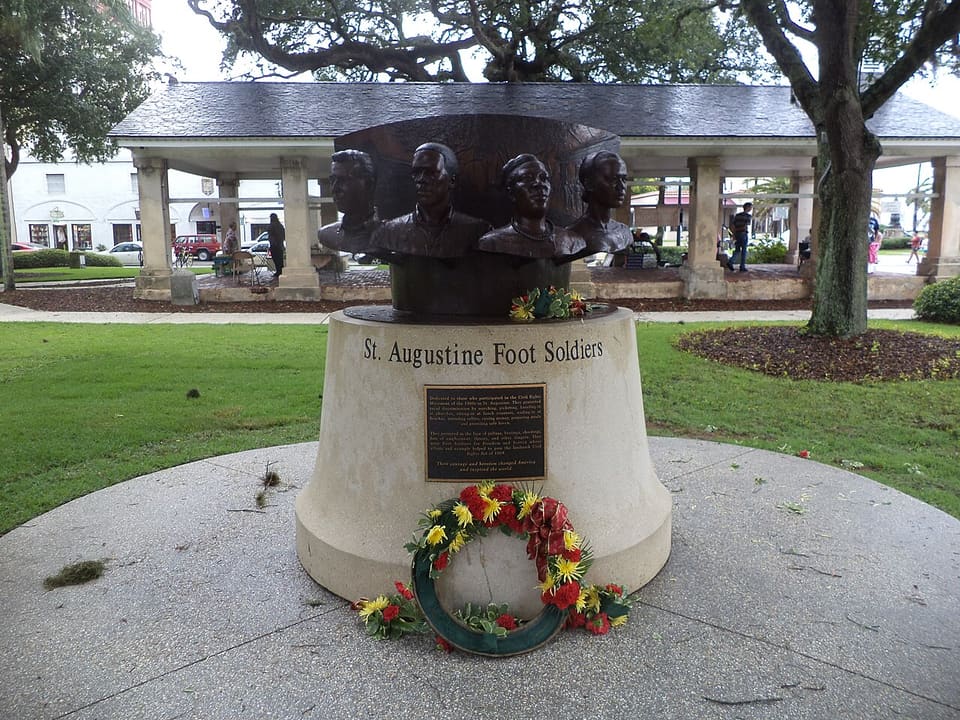
You're standing in the plaza at the heart of old St. Augustine, under the holiday lights. Look for the bronze monument here. It honors the foot soldiers, the ordinary people who marched for civil rights in this city. It was unveiled in May 2011, in this same downtown plaza where demonstrators had been attacked.
In the early 1960s, St. Augustine was a tourist town of about 15,000 people, and it was getting ready for a party. Its 400th anniversary was coming in 1965, and the world's press was expected. City officials planned a celebration of the Spanish past, and they left African Americans out of the planning. Black residents were nearly a quarter of the town. Almost a decade after the Supreme Court ordered schools desegregated, only six Black children here had been admitted to white schools. One of their families had its home burned.
The man who pushed back was Dr. Robert Hayling, an Air Force veteran and the first Black dentist in Florida elected to the American Dental Association. He set up his practice here in 1960 and joined the local NAACP. A letter-writing campaign had won only a small victory, and Hayling thought it lacked direct action. So he founded a Youth Council, and its young members staged wade-ins at segregated swimming pools.
On July 18, 1963, young Black protesters sat down at the Woolworth's lunch counter. Sixteen young protesters and seven juveniles were arrested and imprisoned. The authorities offered them a deal: go free if you promise to stop protesting. Four of the juveniles refused. Two girls and two boys: JoeAnn Anderson, Audrey Nell Edwards, Willie Carl Singleton and Samuel White. They became known as the St. Augustine Four, and they were sent to reform school and kept there for six months. Jackie Robinson, the baseball great, helped publicize their case as an injustice. Florida's governor and cabinet finally freed them in January 1964.
Meanwhile, the danger around Hayling grew. In September 1963, at a Klan rally outside town, Klansmen seized Hayling and three other activists and beat them with fists, chains and clubs. The sheriff arrested four white men, but he also charged the four unarmed Black men with assaulting the armed crowd. The charges against the Klansmen were dismissed, and Hayling was convicted. When Klan night riders terrorized Black neighborhoods, Hayling's people often drove them off with gunfire. Here, nonviolent protest and armed self-defense stood side by side.
Then, in spring 1964, Hayling called on northern college students to come to St. Augustine for spring break, not for the beach, but for the movement. Martin Luther King Jr.'s Southern Christian Leadership Conference had been contacted for help too. The St. Augustine movement helped bring about the Civil Rights Act of 1964.
So when you look at that bronze, think of four children who were offered their freedom for a promise, and said no.
When you're ready, walk north about five minutes, roughly 350 meters, to the next stop.
Hear it where it happened. It plays at stop 4 of St. Augustine Walking Tour: Nights of Lights and the Old City (3 min), narrated as you walk. Unlock the tour for the audio, or try stop 1 free first.