The whole storyStop 2 of St. Augustine Walking Tour: Nights of Lights and the Old City
A Minorcan Homestead and an Unproven Title
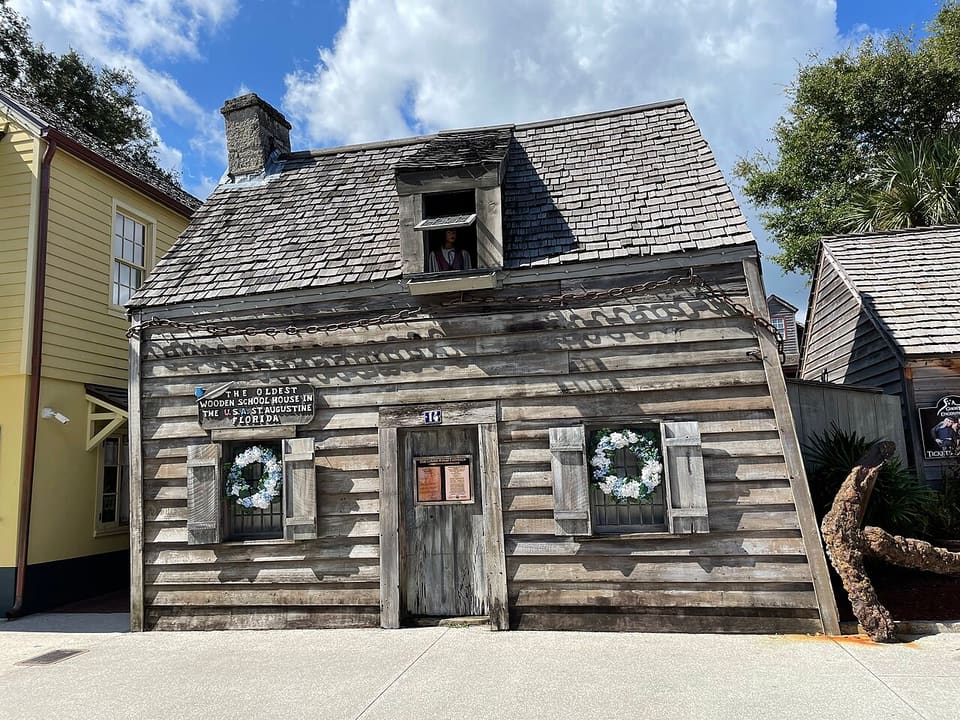
You're on Saint George Street, just inside the City Gates, the two stone pillars you walked past a moment ago. On your right, at number 14, is a small, dark wooden house that looks like it wandered in from another century. Look at the walls themselves. In a town famous for stone, this one is made of boards.
The name over the door is the Oldest Wooden School House, but the man at the center of this story is Juan Genopoly. The museum here describes the place as his homestead, a Minorcan family home set up in the late 1700s. To understand who Genopoly's people were, you have to look about 70 miles down the coast.
In 1768 a British planter named Andrew Turnbull brought well over a thousand settlers to Florida for a plantation called New Smyrna. Most were from Minorca, an island off Spain, along with Greeks and Italians. They came as indentured workers. The promise was land of their own one day.
That is the world Minorcan families like Genopoly's came out of: people who arrived as bound laborers on someone else's plantation, and whose descendants ended up making homes in St. Augustine. A homestead like this one is what that story looks like when it is built of boards instead of told in a history book.
Now for the title. The museum presents this as the Oldest Wooden School House, and invites visitors to see what it calls an original American treasure. That is the museum's own description, and it is worth hearing as exactly that. The sources we have say the homestead was established in the late 1700s. They don't give a precise year, and they don't tell us who taught here or when the first lesson happened. So take the schoolhouse name as the museum's claim, not as a settled record.
And notice how carefully the title is worded. Not the oldest school. The oldest wooden one. In a city known for its stone buildings, that one word does a lot of quiet work. Wood rots, burns and blows away in storms. So a wooden house still standing on a street this old is the remarkable part, whatever year the first student sat down.
What the museum does stand behind is whose homestead this was: a Minorcan family's, set up in the late 1700s, right here by the gates.
When you're ready, walk south on Saint George Street, about eight minutes and roughly 540 meters, to the next stop.
Hear it where it happened. It plays at stop 2 of St. Augustine Walking Tour: Nights of Lights and the Old City (2 min), narrated as you walk. Unlock the tour for the audio, or try stop 1 free first.