The whole storyStop 4 of Old Town Alexandria Walking Tour: Duke Street to the Waterfront
The Ballroom That Moved to New York
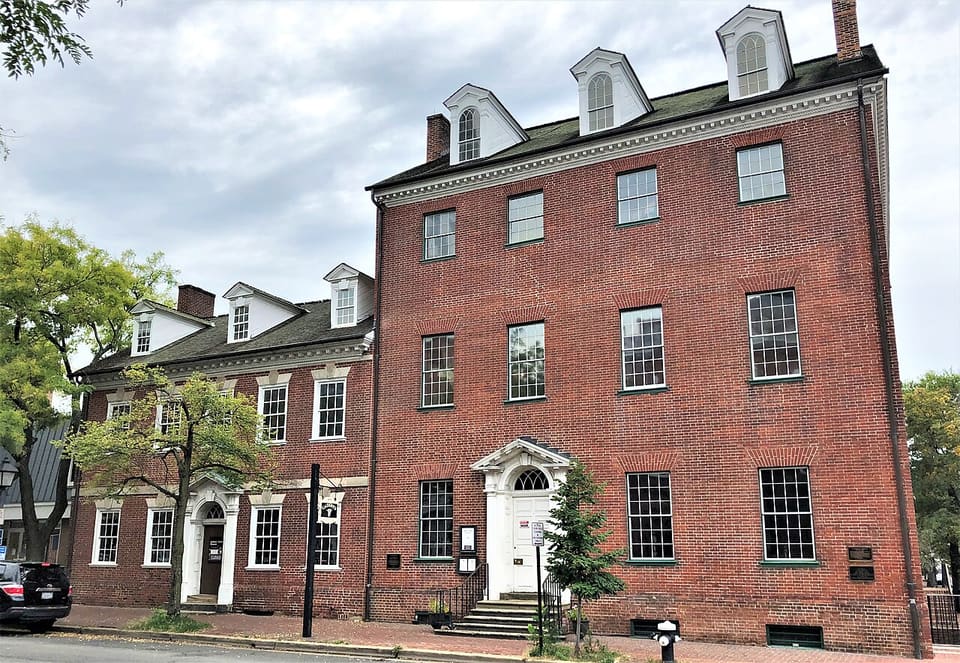
You're on North Royal Street at the corner of Cameron, standing in front of Gadsby's Tavern. It's really two buildings side by side: a smaller tavern built around 1785, and the larger City Tavern and Hotel, finished in 1792. Look up at the second floor of that bigger building. Behind those windows is a ballroom, and where that ballroom has been for the last century is the story here.
In George Washington's day, this corner was where Alexandria came to be seen. The town was a busy Potomac port, and the taverns here were where merchants made deals, travelers slept, and politicians ate and argued. An Englishman named John Gadsby ran the place from 1796 to 1808, and his name stuck. Washington came often. Twice he attended the Birthnight Ball, the town's yearly party in honor of his birthday, held while he was alive to enjoy it. Thomas Jefferson was given a banquet in the ballroom in 1801. Adams, Madison and Monroe all came through. In 1824 the Marquis de Lafayette was feted here on his return tour of America.
That famous hospitality had a cost the guests rarely saw. The city's own museum says it plainly: a large enslaved labor force made it possible. The cooking, the serving, the fires and the beds were largely the work of enslaved people.
Then the town's best room fell on hard times. By 1900 the hotel had closed. The rooms that had held grand balls were cut up into odd shops and rental apartments. And in 1917, the Metropolitan Museum of Art in New York came calling. The Met bought the ballroom's woodwork: the musicians' gallery, the cornice, the door frames, the mantelpieces. They even took the front doorway. Alexandria's most elegant room was crated up and shipped north.
Here's the twist. That sale probably saved it. The buildings themselves were threatened with demolition. A former city councilman and postmaster named Clint Knight, who led the local American Legion post, mortgaged his own home to help buy the tavern. The Legion and other groups kept the fight going for decades, and in 1976 the city reopened the buildings as a museum. Upstairs, the restorers built a copy of the ballroom, reproduced from the original that was sitting in Manhattan.
So the room behind those windows is a faithful stand-in. The ballroom where Washington danced at his own birthday party is three hundred and some miles away, in the Met's American Wing, where it's now called the Alexandria Ballroom.
One more thing. Staff and townspeople will tell you about a young woman who died here in 1816, after making everyone present swear never to reveal her name. They kept the promise. Her grave in St. Paul's Cemetery reads only "Female Stranger," and the story goes that she still haunts Room 8. There's no record of the ghost. The grave is real.
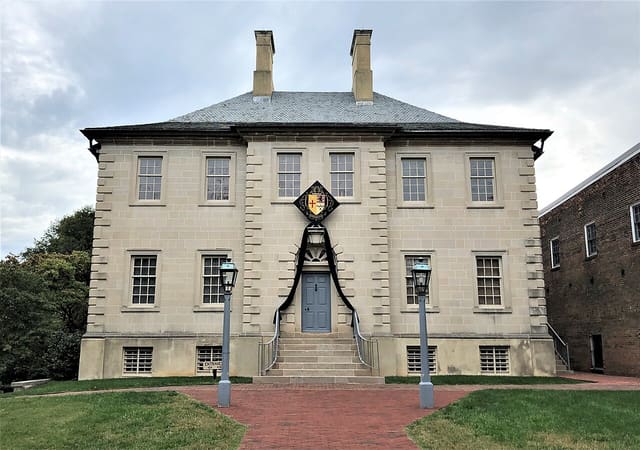
When you're ready, walk north about three minutes to Carlyle House, the stone mansion built by a Scottish merchant when Alexandria was still finding its feet as a port.
Hear it where it happened. It plays at stop 4 of Old Town Alexandria Walking Tour: Duke Street to the Waterfront (3 min), narrated as you walk. Unlock the tour for the audio, or try stop 1 free first.