The whole storyStop 5 of Old Town Alexandria Walking Tour: Duke Street to the Waterfront
Two Staircases and the Man at the Door
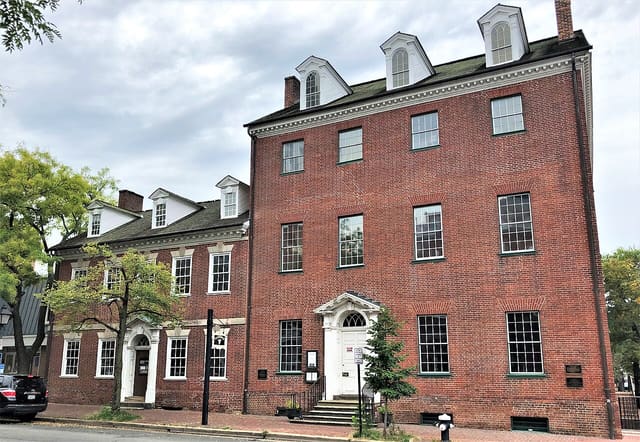
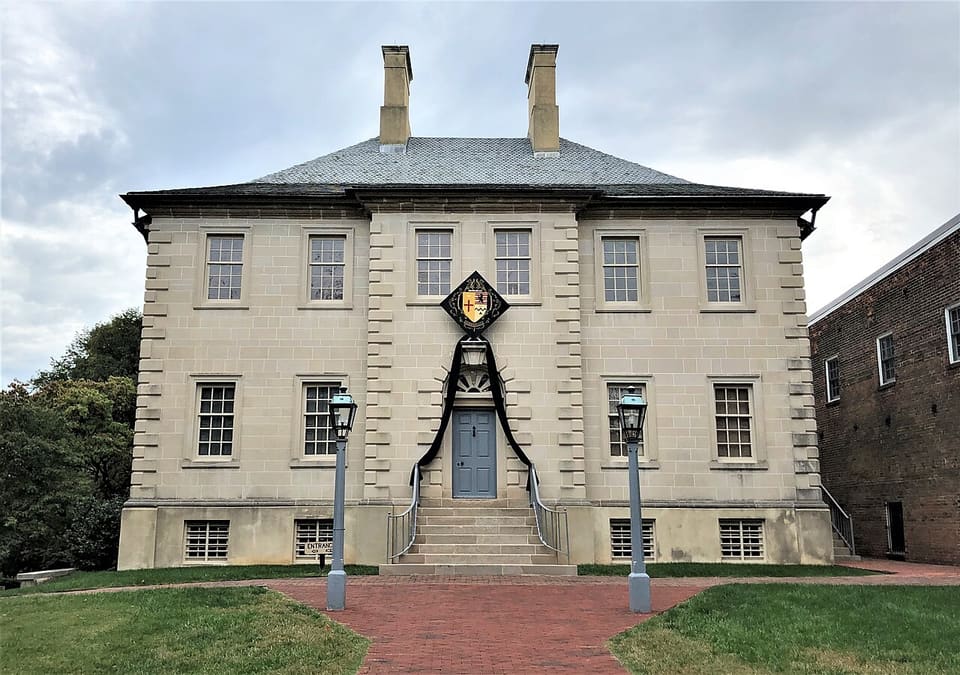
You're on North Fairfax Street, just a block from Gadsby's, looking at the grandest house in Old Town. Notice first what it's made of. Everything around you is brick. This is stone, the only eighteenth-century stone mansion of its kind in Alexandria. Now find the front door: the arch over it, the bold keystone at the top, and the dressed stones stacked at the corners of the house.
It was built by John Carlyle, a Scottish merchant who came to Virginia to trade and stayed to help found this town. When the new lots of Alexandria were auctioned in 1749, Carlyle bought in. Two years later he started building, and by 1753 the house was finished, facing a waterfront where his ships came and went.
Here's the dry part. Town rules said houses couldn't waste space on front yards. Carlyle sat on the board of trustees that made those rules. So he bought two lots instead of one, numbers 41 and 42, and gave himself the only wide front yard in the neighborhood. The rules held. Carlyle simply bought his way around them.
But look at that stone again and ask who set it. Carlyle built this house with indentured labor and with enslaved labor. People bound to work for years, and people held as property for life, cut, hauled and laid what you're looking at. Even the nails were hammered out by hand at a forge.
And the house was designed for two kinds of people. Inside, a wide main staircase rises from the center hall, where guests danced. Off to the right is a second staircase, narrow, running from the kitchen and cellars up through every floor. That one was for the people who kept the fires lit and the dishes counted. They were meant to move through the house without being seen.
The man who was always seen was named Moses. When a guest came through that arched door, Moses met them in the hall. The house's records call him a servant, and that word hides more than it says. In a Virginia household built on enslaved and indentured work, a man called a servant was usually not free to leave. The surviving account gives us only his first name. Upstairs, a woman named Penny likely cared for Carlyle's daughters, sleeping beside them on winter nights to share their warmth.
So stand back and take in the symmetry, every window balanced against its twin. It was built to impress a visitor at the door. The first face that visitor saw was Moses.
When you're ready, walk west about a minute, roughly 70 meters, to the Stabler-Leadbeater Apothecary, where a Quaker family's shelves once filled orders from Mount Vernon.
Hear it where it happened. It plays at stop 5 of Old Town Alexandria Walking Tour: Duke Street to the Waterfront (3 min), narrated as you walk. Unlock the tour for the audio, or try stop 1 free first.