 Photo: Daniel Schwen, CC BY-SA 4.0, via Wikimedia Commons
1Start hereFree
The Alamo
The Church That Was Never Finished
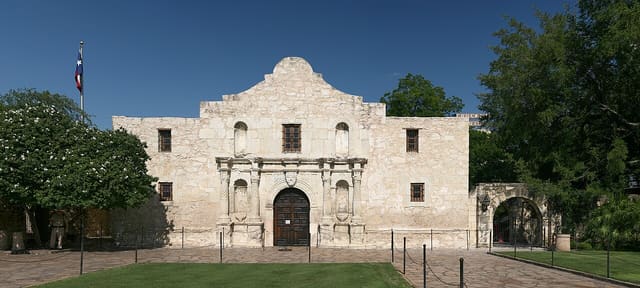
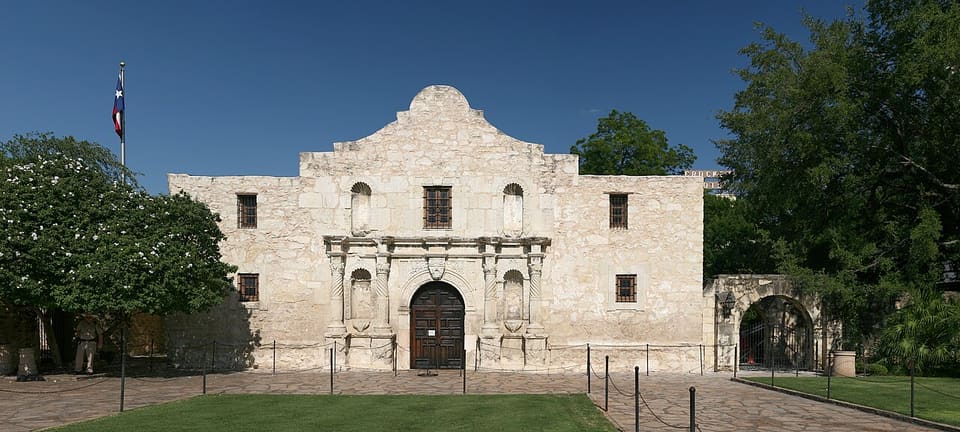
Free sample · 2:46You're standing on Alamo Plaza, facing the most famous doorway in Texas. Look at the stone front of the old church, and find the carved niches on either side of the door, two low and two high. Then let your eyes rise to that curved hump along the top, the shape everyone draws when they draw the Alamo. Hold on to that hump. It isn't what it seems.
The Alamo started as a mission, and the soldiers came later. In 1718 a Spanish expedition founded Misión San Antonio de Valero near a community of Coahuiltecan people, part of Spain's effort to convert American tribes to Christianity. By 1744 over 300 Indian converts lived here, relying on 2,000 head of cattle and 1,300 sheep for food and clothing. They also defended it. In 1745, 100 mission Indians drove off a band of 300 Apaches. The mission was built on their labor and their land.
The church in front of you was begun in 1758, after an earlier church collapsed. Its limestone walls are four feet thick. It was meant to rise three stories, topped by a dome, with bell towers on either side. The first two levels were finished. The towers and the third story were never begun, and the dome was never built.
In 1793 the mission was secularized and then abandoned. Ten years later it became a fortress for a Spanish military company, and the name Alamo, Spanish for cottonwood tree, probably came with them. In December 1835, during the Texas Revolution, Mexican General Martín Perfecto de Cos surrendered the fort to the Texian Army.
On February 23, 1836, about 1,500 Mexican troops marched into San Antonio de Béxar under President General Antonio López de Santa Anna. Inside were Texians led by co-commanders James Bowie and William B. Travis, along with Davy Crockett. The siege lasted 13 days. In the early morning hours of March 6, the Mexican Army advanced, and the defenders were wiped out. Bowie and Crockett were among the dead.
Now, that hump. It wasn't there for the battle. In 1849 the U.S. Army began renting the place as a quartermaster's depot, and the curved gable and roof of the church date from that work. Later the buildings next door were sold to a mercantile company and run as a wholesale grocery store, until Adina De Zavala and Clara Driscoll convinced the state legislature in 1905 to buy them.
So the shape you know best is a later addition, on a church that was never finished. Keep that in mind as you look at it.
When you're ready, walk north about 170 meters, roughly three minutes, to the Menger Hotel.
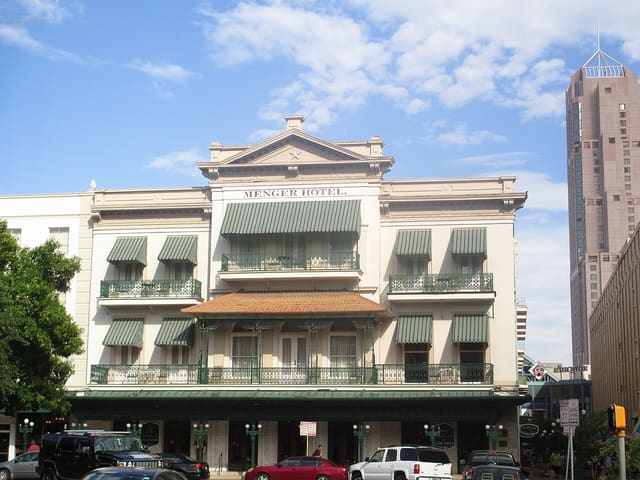 Photo: Billy Hathorn, CC BY-SA 3.0, via Wikimedia Commons
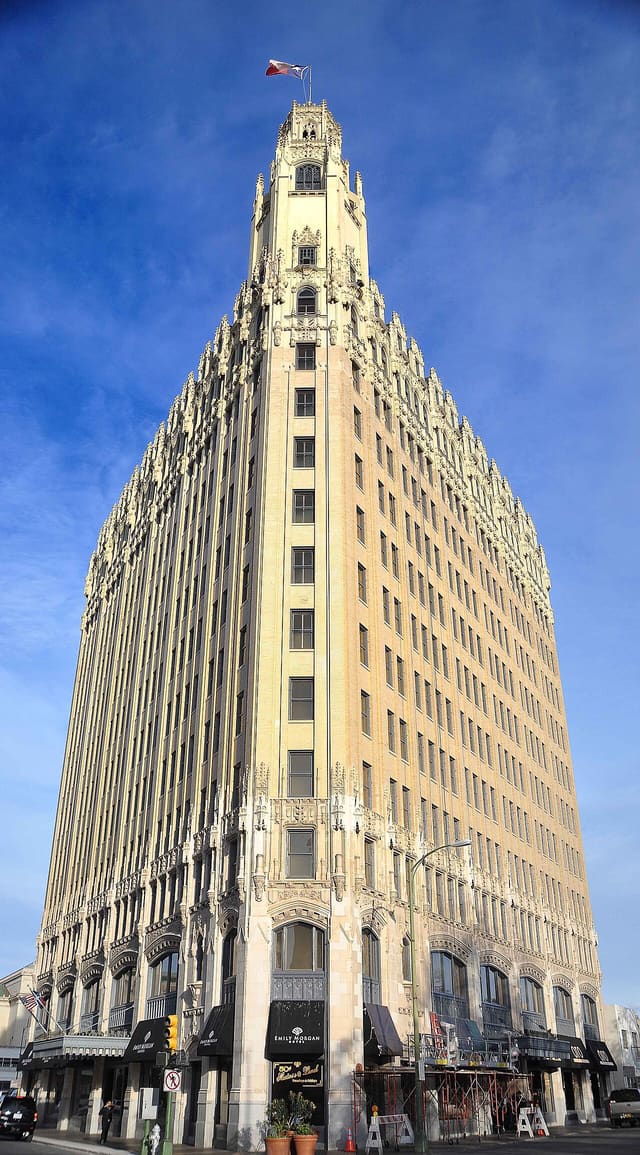 Photo: Mattstone911, CC BY-SA 3.0, via Wikimedia Commons
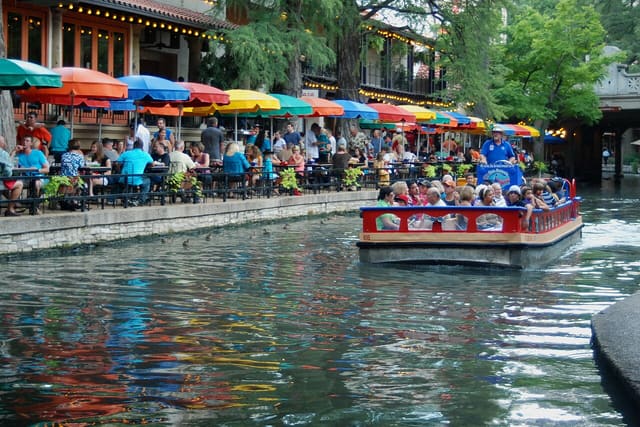 Photo: Mark Bonica from Durham, NH, USA, CC BY 2.0, via Wikimedia Commons
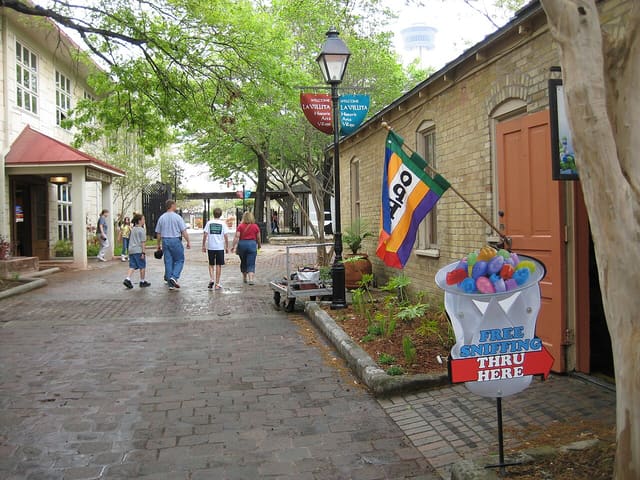 Photo: Johnpeter2008 at en.wikipedia (Public domain), via Wikimedia Commons
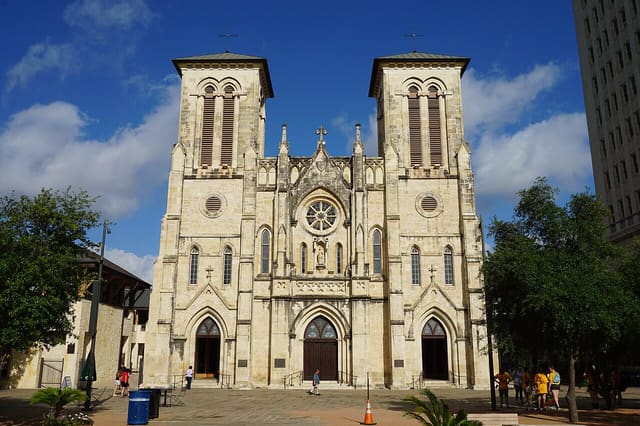 Photo: Michael Barera, CC BY-SA 4.0, via Wikimedia Commons
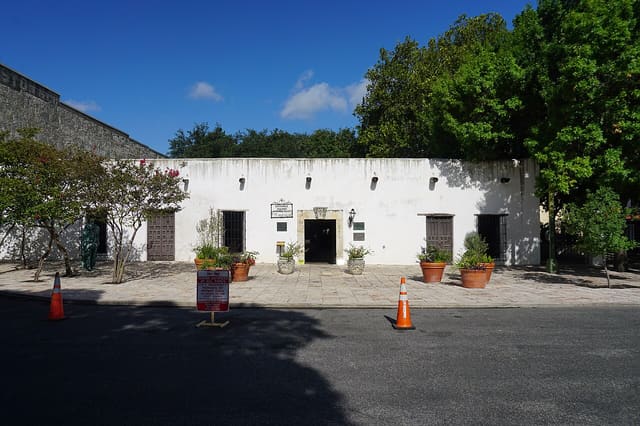 Photo: Michael Barera, CC BY-SA 4.0, via Wikimedia Commons