Salem 1692: The Witch Trials Walk
Walk the ground where neighbors accused neighbors, where nineteen people were hanged and one pressed to death, and where a town later struggled over…
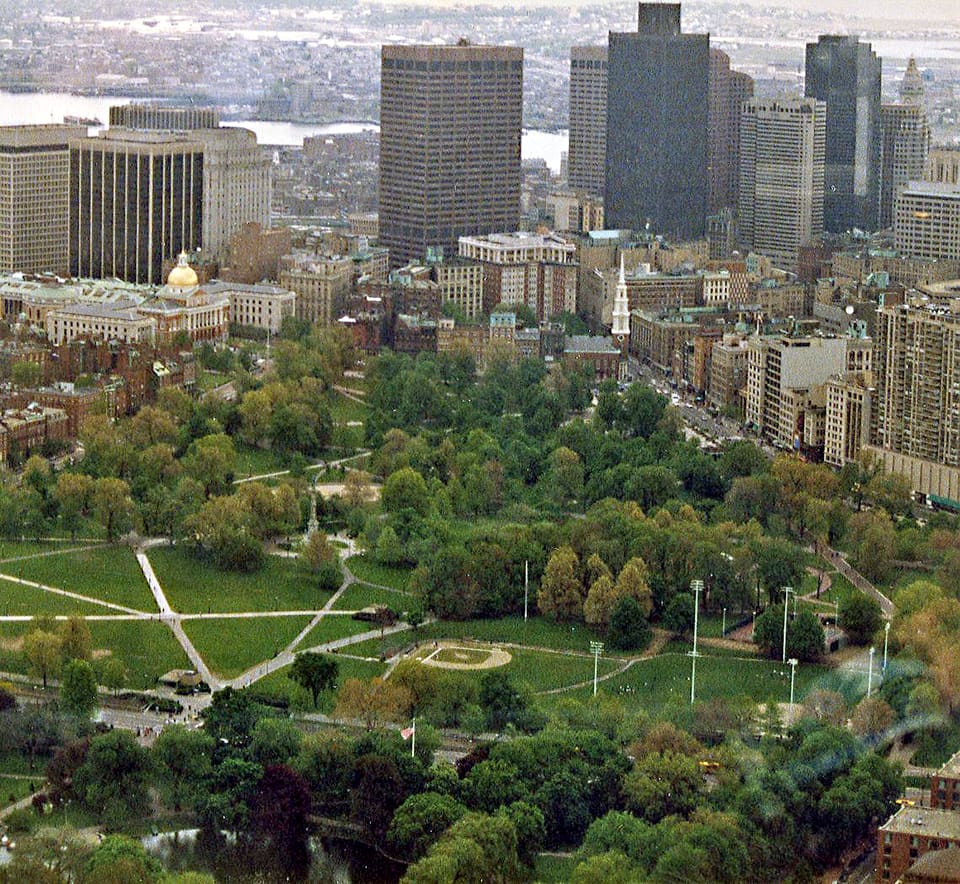 Photo: Phillip Capper from Wellington, New Zealand, CC BY 2.0, via Wikimedia Commons
Ten stops where Boston's colonists argued, gambled and risked everything.
1 h 17 min10 stops2 mi
Stop 1 free · $12.99 unlocks all 10 · up to 4 phones · refund within 7 days
Your receipt and links are on their way by email.
Start the walkKeep the screen on and tap each stop as you reach it.
Each story plays by itself when you arrive, offline, phone in your pocket.
You're standing on Boston Common, by the visitor center on the Tremont Street side. Look across the open grass and paths, and up the slope to your right you'll catch a gold dome on the hilltop. That's the State House, your next stop. Now turn your eyes the other way, west, toward the low far edge of the park, out toward Charles Street. On the night this story happens, that far edge was water.
First, the bargain. In 1634 the Puritan town bought 44 acres for £30 from William Blaxton, the man who had lived alone on the peninsula for five years and had grown tired of his Puritan neighbors. The governor raised the money through a one-time tax on residents, six shillings a head. The town got a cow pasture.
Then, in 1768, the pasture got soldiers. Boston had made itself a problem for the Crown, and Britain sent Redcoats to sit on the town. They camped and drilled right here, among the grazing cattle. The cows, by the way, stayed on. They were formally banned only in 1830, so the King's army spent these years sharing its parade ground with the neighbors' livestock.
On the night of April 18, 1775, about 700 British Regulars gathered in the dark at the foot of the Common, down where that western edge met the Back Bay. Their orders pointed them toward Concord. Boats were waiting at the shoreline. The soldiers were rowed across the bay to Cambridge, and from there the march began. The Common had been a British camp before the war, and it was from here that the troops set off for Lexington and Concord. The occupation of the Common itself ended only when the British left Boston in March 1776.
Now look west again. That shoreline is gone. In the 1800s Boston filled in the Back Bay, and the water's edge where those soldiers stepped into their boats lies somewhere under lawn and city.
The Common has a darker record too. It was the town's execution ground, with public hangings until 1817. The most famous victim was the Quaker Mary Dyer, hanged from a great oak on June 1, 1660, for repeatedly defying a law that banned Quakers from the colony. The ground where Redcoats drilled and cattle grazed was also the place where a woman died for her faith.
When you're ready, walk northwest, then turn right onto Lafayette Mall, about seven minutes, toward that gold dome.
You're standing on Boston Common, the oldest public park in the country. Look across the open grass toward the gold dome rising on the hill. That's the Massachusetts State House, and the walk will climb to it. But first, the ground under your feet. In 1634, the town of Boston bought about 44 acres of this land from William Blaxton, the first English settler on the peninsula, for 30 pounds. The money came from a tax of six shillings per resident. Before English settlement, this was the homeland of the Massachusett people. For about two centuries the Common was a cow pasture, and cows were not formally banned until 1830. The cradle of liberty had a lot of livestock in it. This ground kept changing roles. British troops camped and drilled here in 1768. Public hangings took place here until 1817. And the people who later challenged the Crown were merchants, printers, silversmiths and ministers, with families and a great deal to lose. Why did they risk it? Every stop gives a piece of the answer. This is a working city, so cross with the lights, watch the brick underfoot, and take your time. Now, stay right here on the Common. Your first story begins on a night when this pasture became a shore.
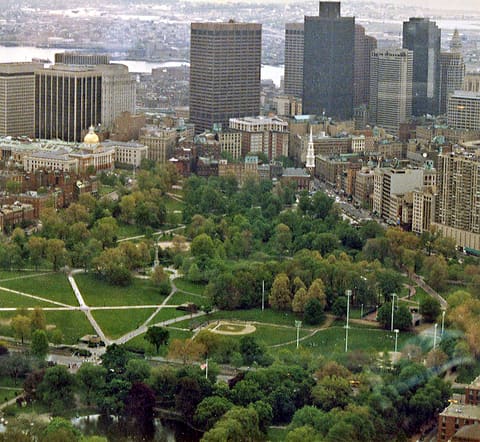
Boston Common
You're standing on Boston Common, by the visitor center on the Tremont Street side.
Open this story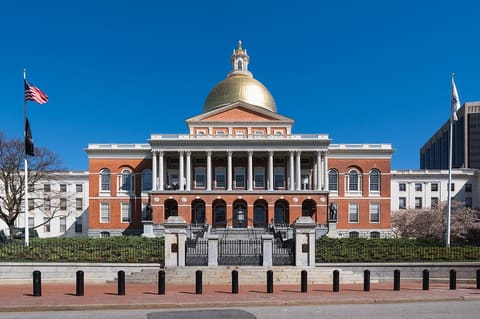
Massachusetts State House
You've just crossed Boston Common, and now you're on Beacon Street, looking up at the Massachusetts State House.
Unlock to hear this stopWalk northwest, then turn right onto Lafayette Mall (about 460 m, 7 min).
About this stop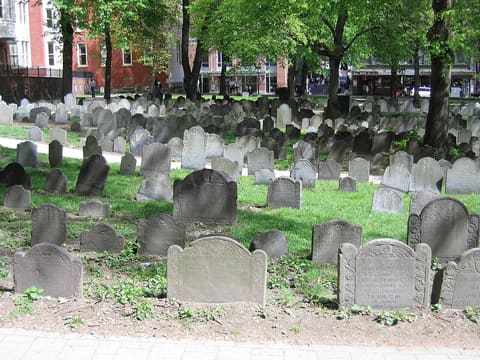
Granary Burying Ground
You're on Tremont Street, just through the heavy stone gateway of the Granary Burying Ground, with the white spire of Park Street Church at your shoulder.
Unlock to hear this stopWalk north, then turn right onto Tremont Place (about 400 m, 6 min).
About this stop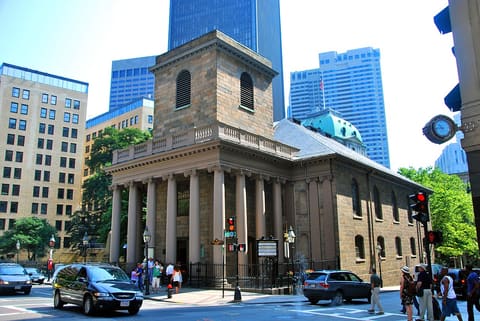
King's Chapel
You're standing at the corner of Tremont and School Streets, in front of King's Chapel.
Unlock to hear this stopWalk southeast (about 260 m, 4 min).
About this stop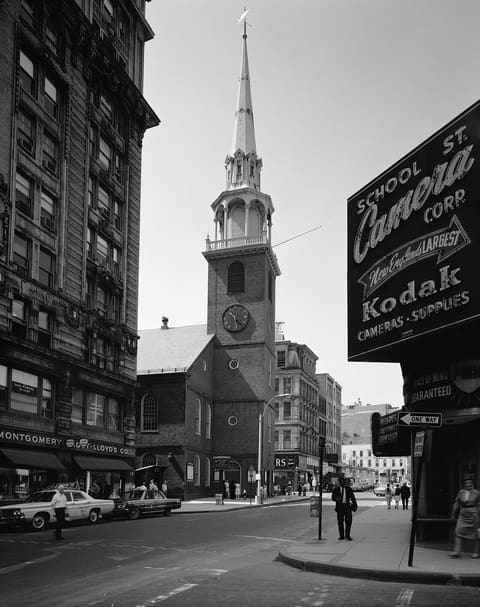
Old South Meeting House
You're at the corner of Washington and Milk Streets, in what Bostonians call Downtown Crossing.
Unlock to hear this stopWalk west (about 310 m, 5 min).
About this stop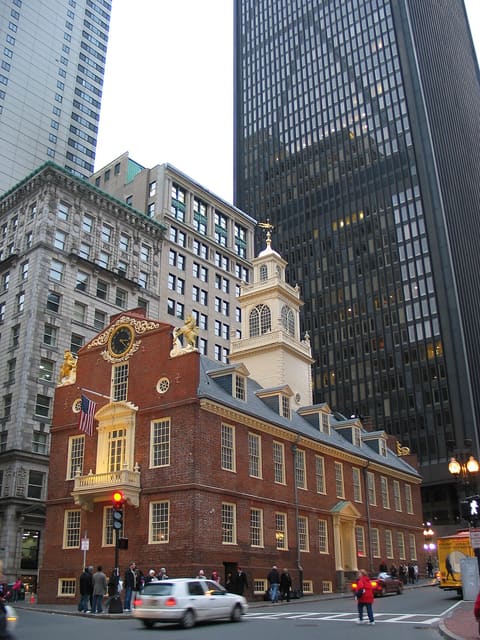
Old State House
You're on Washington Street, looking at the small brick building with the tall tower, boxed in by office towers.
Unlock to hear this stopWalk northwest on Milk Street (about 250 m, 4 min).
About this stop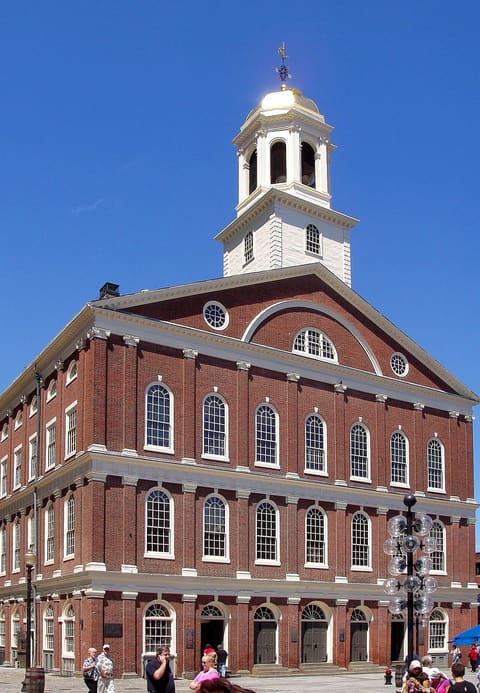
Faneuil Hall
You're standing in Faneuil Hall Square, in front of the red brick building Bostonians have called the Cradle of Liberty for more than 250 years.
Unlock to hear this stopWalk east (about 260 m, 4 min).
About this stop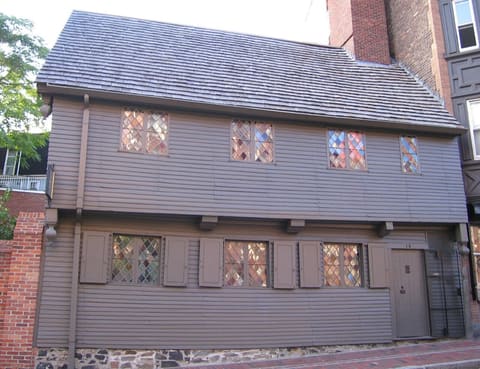
Paul Revere House
You're in North Square, in the heart of the North End, and the dark wooden house on the northwest side of the square is the Paul Revere House.
Unlock to hear this stopWalk south, then turn left onto Merchants Row (about 530 m, 8 min).
About this stop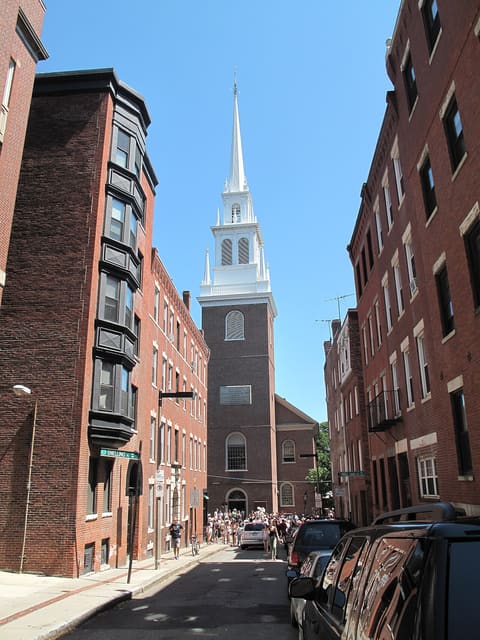
Old North Church
You're on Salem Street in the North End, outside Christ Church, the building all of Boston calls Old North.
Unlock to hear this stopWalk north (about 390 m, 6 min).
About this stop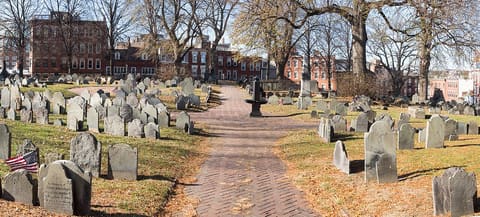
Copp's Hill Burying Ground
You're at the top of the North End now, on Copp's Hill, among the slate headstones of the second-oldest burying ground in Boston.
Unlock to hear this stopWalk northwest (about 320 m, 5 min).
About this stop$12.99 once · all 10 stops · up to 4 phones · refund within 7 days if it didn't work for you.
About 1 h 17 min for 2 mi with all 10 stories. Going inside the sites adds time.
GPS auto-play starts each story when you reach the stop, with your phone locked in your pocket. Download the tour and it works offline.
The trail links 10 historic sites in Boston, from Boston Common to Copp's Hill Burying Ground. The stops include a 1634 common, the 1713 Old State House, Faneuil Hall from 1742, and Old North Church from 1723. The narration covers how each site connects to the city's colonial and Revolutionary past.
The tour facts don't cover bars, so I can't say which is the oldest. The stops are historic sites, and the oldest building on the route is the Paul Revere House, built around 1680.
It's a short walk of about 2 miles that passes 10 historic sites in order. The first stop plays free on the web page, so you can hear the audio before deciding whether to unlock the full tour.
Walking the 2-mile route takes about 39 minutes at a brisk pace, 48 at an easy pace, or 60 strolling. The narration adds about 30 minutes, so plan roughly 90 minutes at an easy pace with the audio.
Old North Church, built in 1723, is the oldest standing church in Boston. The Massachusetts State House, whose cornerstone was laid on July 4, 1795, is another stop on the route.
The walk itself is on public streets, and the first stop plays free on the web page. Unlocking the full audio tour costs $12.99 as a single purchase, which also works offline in the Stories app.
No. After you unlock, the tour plays right here in your browser: keep the screen on and tap each stop. The free Stories app adds GPS auto-play, so each story starts by itself when you arrive, with your phone in your pocket, and works offline.
One purchase covers your group on up to 4 phones. Share the link from your receipt, or everyone can sign in to the app with the same email.
In the app, yes: download the tour on Wi-Fi before you go. In the browser you need a signal, which is fine on most city streets; open the tour once before you leave.
Any time. It is self-guided, so there are no departure times and no group to keep up with. Pause for coffee and pick up where you left off.
Yes. If the tour did not work for you, email support@getstories.app within 7 days and we will refund it.
Stories writes each tour from public sources, checks every claim against them, and narrates it with a synthetic voice. A person reviews each tour before it goes live. The sources are listed at the end of this page; if you spot a mistake, tell us at support@getstories.app.
Walk the ground where neighbors accused neighbors, where nineteen people were hanged and one pressed to death, and where a town later struggled over…
Stories writes each tour from public sources and checks every claim against them; a synthetic voice narrates it, and a person reviews it before it is published. Last reviewed October 2026.