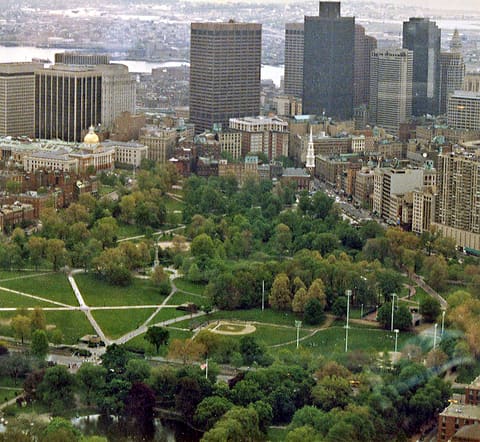
Freedom Trail Walking Tour
Walk from the Common to Copp's Hill and meet the merchants, preachers, printers and craftsmen who talked a colony into rebellion. Stand where…
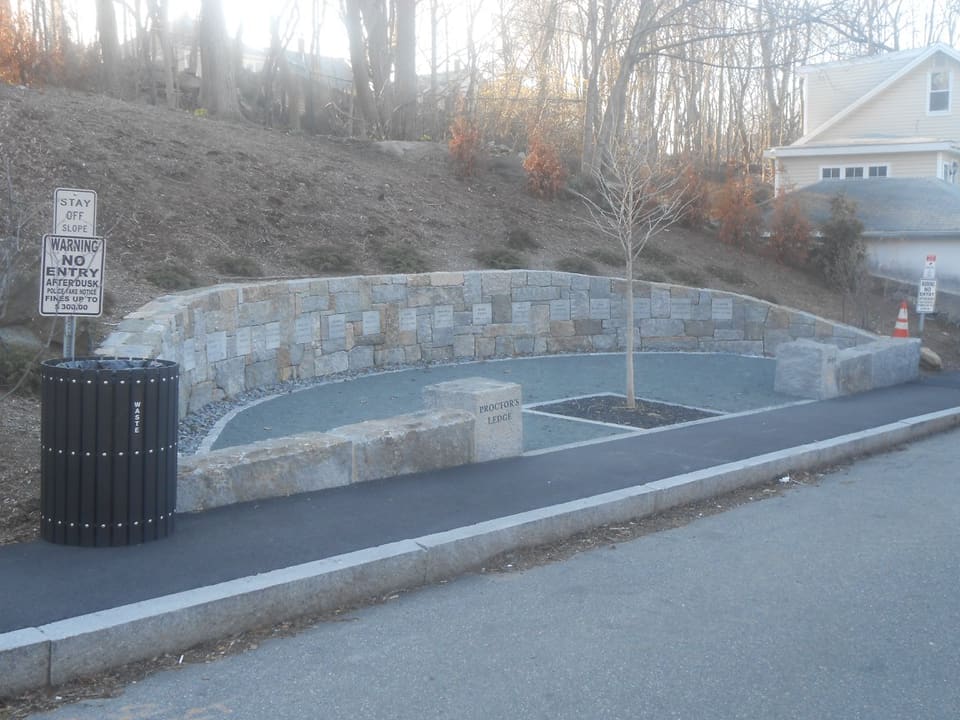 Photo: Jangseung92, CC BY-SA 4.0, via Wikimedia Commons
Follow the accused from courtroom to gallows to memory
1 h 15 min7 stops2.2 mi
Stop 1 free · $12.99 unlocks all 7 · up to 4 phones · refund within 7 days
Your receipt and links are on their way by email.
Start the walkKeep the screen on and tap each stop as you reach it.
Each story plays by itself when you arrive, offline, phone in your pocket.
You're standing on Pope Street, at the foot of what Salem has always called Gallows Hill. It doesn't look like much: a quiet residential neighborhood, houses close on every side, about a mile from downtown. In front of you is a curved wall of granite set against a rocky slope. Look at the names cut into that stone. There are nineteen of them, and for more than 300 years, nobody could say for certain that this was where they died.
In 1692, Salem hanged nineteen people for witchcraft. Fourteen were women and five were men. The first was Bridget Bishop, a woman from Salem Town who had already outlived two husbands and had a reputation her neighbors gossiped about. She was hanged on June 10. Eighteen more followed her over that summer and early fall.
Then Salem did something very human. It looked away. Within a few years, the trials had become a shame the town wanted behind it. Maps of Salem from around 1700 mark Gallows Hill, but not a single spot on it where anyone was put to death. The memory didn't vanish. It just lost its address. For generations, people assumed the hangings happened up at the summit, and the summit is where the legend settled.
In 1921, a local historian named Sidney Perley went back to the old records and came to a different conclusion. He thought the executions happened lower down, near the base of the hill, on a rocky outcrop called Proctor's Ledge. Perley was convincing enough that the City of Salem bought part of the ledge. But a historian's hunch is not proof, and the question stayed open.
The answer came in January 2016. A team from the University of Virginia, called the Gallows Hill Project, combined historical records with modern research and confirmed it: Perley had been right. This ledge, the one in front of you, was the place. A year later, in 2017, the city dedicated this memorial.
So here's the odd truth of where you're standing. Some of the most famous executions in American history happened in what is now, more or less, a neighborhood with backyards.
And the reckoning has been just as slow as the remembering. Massachusetts started reversing convictions in 1711, then cleared more victims in 1957 and again in 2001. The last convicted Salem witch, Elizabeth Johnson Jr., wasn't officially exonerated until 2022. That's 329 years after she was found guilty. Before you go, read a few of those names on the wall out loud to yourself. For a long time, almost nobody here did.
When you're ready, walk north on Pope Street, turn right onto Boston Street, left onto Federal, then right onto Monroe Street. It's about seventeen minutes to the Witch House, home of a judge who helped send people to this ledge.
You're standing at Proctor's Ledge, a rocky slope at the edge of a quiet neighborhood. Look at the low curved stone wall in front of you, and the names set into it. In 1692, this is where Salem hanged people it had convicted of witchcraft. Nineteen people died this way that year: fourteen women and five men. The first was Bridget Bishop, on June 10. For centuries, Salem wasn't sure where it had happened. Maps from around 1700 mark Gallows Hill but show no marker for the execution site. The town built a whole identity on witches, and somehow mislaid the place where real people were killed. It took until 2016 for researchers at the University of Virginia to confirm this ledge, and until 2017 for the city to dedicate a memorial here. That is what this walk is about. We'll ask what really happened in 1692, who it happened to, and how Salem has chosen to remember it, and to forget it. You'll meet judges and ministers, a man who refused to enter a plea, and a famous writer still wrestling with his family's part in it. Before you go, read a few of the names on the wall. The first story starts with them.
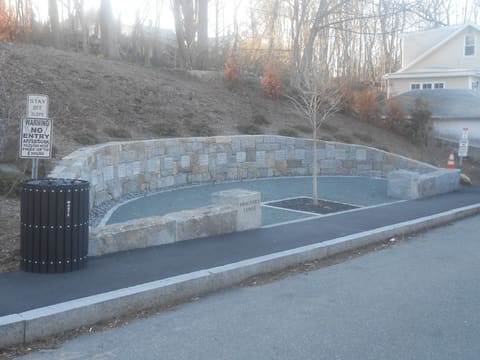
Proctor's Ledge Memorial
You're standing on Pope Street, at the foot of what Salem has always called Gallows Hill.
Open this story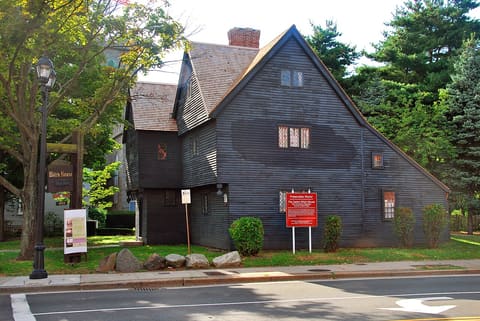
The Witch House
You're on Essex Street, at the corner of North Street, and the dark timber house set back from the sidewalk is the one everyone in Salem calls the Witch House.
Unlock to hear this stopWalk north on Pope Street, turn right onto Boston Street, turn left onto Federal Street, then turn right onto Monroe Street (about 1.1 km, 17 min).
About this stop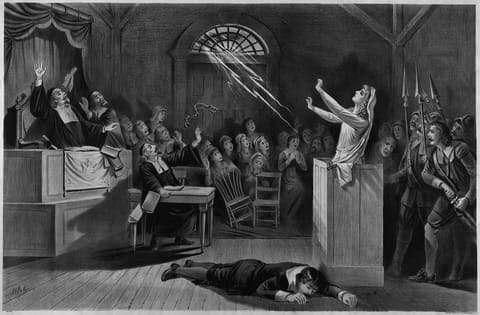
Site of the 1692 Court House
You're standing near Lynde Street in downtown Salem, and the thing to look at here is something you can't see.
Unlock to hear this stopWalk south (about 320 m, 5 min).
About this stop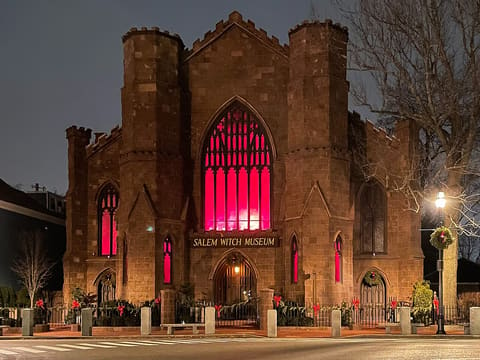
Salem Witch Museum
You're on Washington Square North, with Salem Common spread out behind you.
Unlock to hear this stopWalk east, then turn left onto Kimball Court (about 500 m, 7 min).
About this stop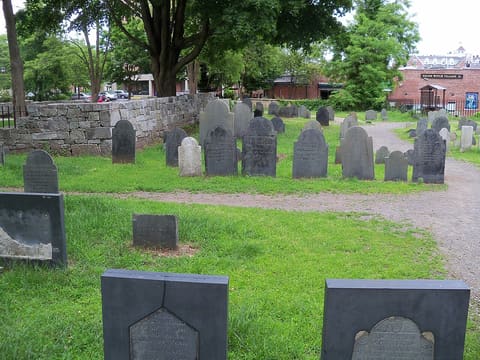
Charter Street Cemetery
You're on Charter Street, at the gate of the cemetery Salem has long called the Old Burying Point.
Unlock to hear this stopWalk south on Kimball Court, turn left onto Axelrod Garden Walkway, then turn right onto Charter Street (about 550 m, 8 min).
About this stop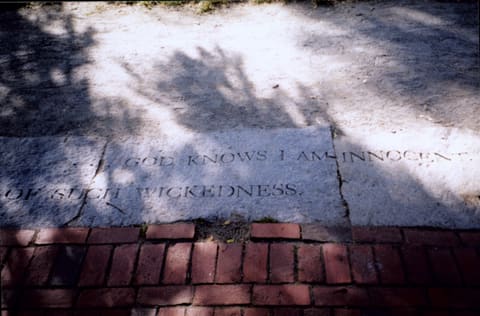
Salem Witch Trials Memorial
You're on Liberty Street, just off Charter Street, with the old burying ground right at your back.
Unlock to hear this stopWalk east (about 140 m, 2 min).
About this stop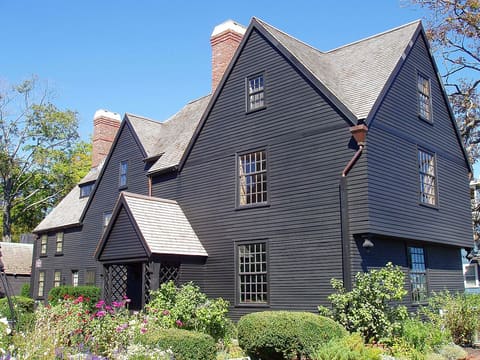
The House of the Seven Gables
You're on Derby Street, at the edge of Salem Harbor, and the dark, many-peaked house in front of you is the one everyone calls the House of the Seven Gables.
Unlock to hear this stopWalk north, turn left onto Derby Street, turn right onto Hardy Street, then turn right onto Turner Street (about 900 m, 13 min).
About this stop$12.99 once · all 7 stops · up to 4 phones · refund within 7 days if it didn't work for you.
About 1 h 15 min for 2.2 mi with all 7 stories. Going inside the sites adds time.
GPS auto-play starts each story when you reach the stop, with your phone locked in your pocket. Download the tour and it works offline.
The tour visits seven sites in Salem, Massachusetts, starting at Proctor's Ledge Memorial, where nineteen people were hanged for witchcraft in 1692, and ending at The House of the Seven Gables. Other stops include The Witch House, the site of the 1692 Court House, and Charter Street Cemetery.
The first stop, Proctor's Ledge Memorial, plays free on the web page with no app or account needed. Unlocking the full tour costs $12.99 as a single purchase, and it works on the web and in the Stories app, where it can be used offline.
The route is 2.2 miles (3.5 km). Walking alone takes about 43 minutes at a brisk pace, 53 minutes at an easy pace, or 67 minutes strolling, and the narration adds about 25 minutes.
The Witch House is the stop where Jonathan Corwin, who bought the unfinished house in 1675 at age 35, lived for more than 40 years. Corwin was a judge in 1692, and people accused of witchcraft were brought to his house for pretrial examinations in spring 1692.
Nineteen people were hanged for witchcraft in Salem in 1692: fourteen women and five men. Giles Corey was pressed to death for refusing to enter a plea.
In 1921 local historian Sidney Perley concluded the executions took place near the base of Gallows Hill on Proctor's Ledge. In January 2016 the University of Virginia's Gallows Hill Project confirmed the site, and the City of Salem dedicated the Proctor's Ledge Memorial in 2017.
No. After you unlock, the tour plays right here in your browser: keep the screen on and tap each stop. The free Stories app adds GPS auto-play, so each story starts by itself when you arrive, with your phone in your pocket, and works offline.
One purchase covers your group on up to 4 phones. Share the link from your receipt, or everyone can sign in to the app with the same email.
In the app, yes: download the tour on Wi-Fi before you go. In the browser you need a signal, which is fine on most city streets; open the tour once before you leave.
Any time. It is self-guided, so there are no departure times and no group to keep up with. Pause for coffee and pick up where you left off.
Yes. If the tour did not work for you, email support@getstories.app within 7 days and we will refund it.
Stories writes each tour from public sources, checks every claim against them, and narrates it with a synthetic voice. A person reviews each tour before it goes live. The sources are listed at the end of this page; if you spot a mistake, tell us at support@getstories.app.
Walk from the Common to Copp's Hill and meet the merchants, preachers, printers and craftsmen who talked a colony into rebellion. Stand where…
Stories writes each tour from public sources and checks every claim against them; a synthetic voice narrates it, and a person reviews it before it is published. Last reviewed October 2026.