The whole storyStop 6 of Freedom Trail Walking Tour
The Shooting Below the Lion and Unicorn
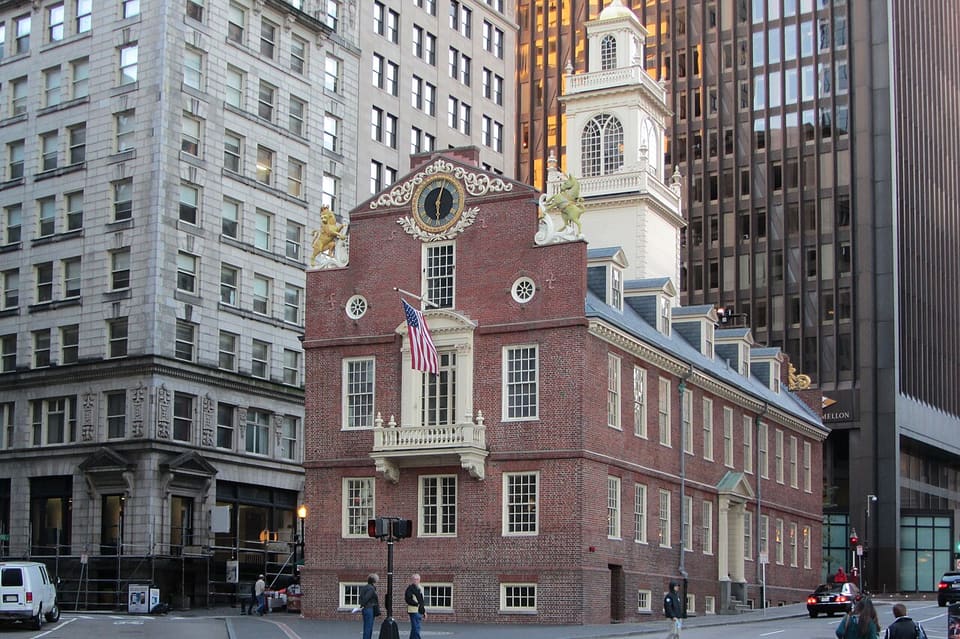
You're on Washington Street, looking at the small brick building with the tall tower, boxed in by office towers. This is the Old State House, finished in 1713, and the oldest public building in Boston. Look up at the roof's edge for the gilded lion and the unicorn, the symbols of the British Crown. Now walk around to the east side, under the balcony, and find the circle of cobblestones in the ground ringed with brass stars. That marks a killing.
In 1770 this was the seat of the King's government in Massachusetts, and the street running east to the harbor was called King Street. British regiments had been posted in Boston since 1768 to back up unpopular taxes. Soldiers and townspeople had been at each other's throats for a year and a half.
On the night of March 5, 1770, a crowd gathered around a lone British sentry and started abusing him. Captain Thomas Preston came with seven more soldiers. By then three or four hundred people were throwing clubs, stones and snowballs. One soldier fired. The others fired too, without an order from Preston.
Five men died. They were Crispus Attucks, a sailor of African and Native descent, along with Samuel Gray, James Caldwell, Samuel Maverick and Patrick Carr. Some of them were buried near young Christopher Seider, whose funeral you heard about at the Granary.
The soldiers were arrested and charged with murder. And in a town that wanted them hanged, the lawyer who agreed to defend them was John Adams, a Patriot himself and a future president. Defending the redcoats could have ended his career. Adams argued that the soldiers deserved a fair trial like anyone else, and that a mob had cornered them. Preston was acquitted in a separate trial. Of the soldiers, six were acquitted. Two were convicted of manslaughter and branded on the thumb, which the law allowed in place of hanging.
Here's the part the plaque leaves out. Even the name was a weapon. In Britain it was the Incident on King Street. It was Samuel Adams, Paul Revere and their allies who called it a massacre, and Revere's colored engraving, The Bloody Massacre, spread that version through all thirteen colonies. A fair trial and a famous picture told two very different stories about the same few minutes, and the picture won the argument.
Six years later, the Declaration of Independence was read to Bostonians from that balcony. And one last absurd-but-true detail: the basement of this royal government house is now a subway entrance, State station, so commuters walk through it every morning, right past the place where the shots were fired.
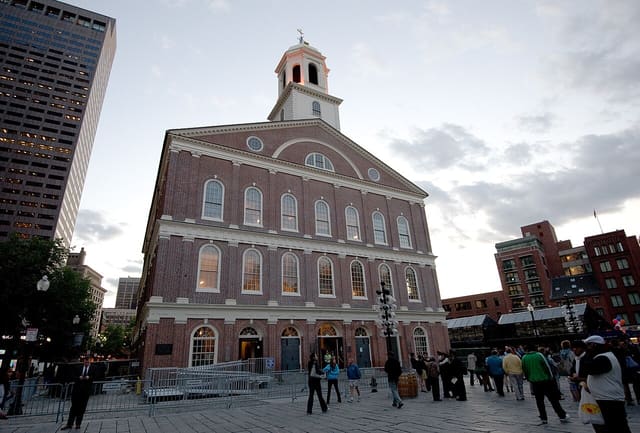
When you're ready, walk east about four minutes to Faneuil Hall, the meeting hall that sat right through these arguments.
Hear it where it happened. It plays at stop 6 of Freedom Trail Walking Tour (3 min), narrated as you walk. Unlock the tour for the audio, or try stop 1 free first.