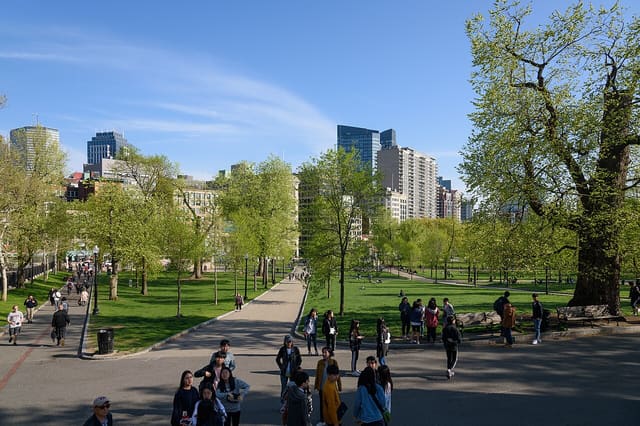
Freedom Trail Walking Tour
Walk from the Common to Copp's Hill and meet the merchants, preachers, printers and craftsmen who talked a colony into rebellion.
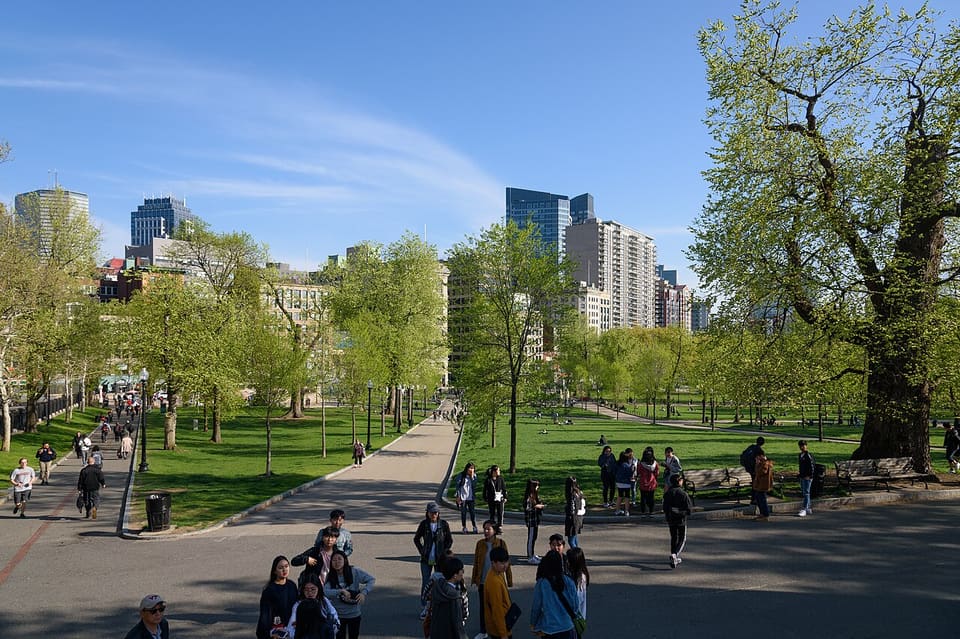 Photo: King of Hearts, CC BY-SA 4.0, via Wikimedia Commons
139 Tremont Street, Boston, Massachusetts
Boston Common is the oldest city park in the United States, 50 acres in downtown Boston that began in 1634 as a town cow pasture. It is free and open every day. The Freedom Trail starts at its visitor center, 139 Tremont Street, open daily from 8:30 a.m. to 4 p.m.
You're standing on Boston Common, by the visitor center on the Tremont Street side. Look across the open grass and paths, and up the slope to your right you'll catch a gold dome on the hilltop. That's the State House, your next stop. Now turn your eyes the other way, west, toward the low far edge of the park, out toward Charles Street. On the night this story happens, that far edge was water.
First, the bargain. In 1634 the Puritan town bought 44 acres for £30 from William Blaxton, the man who had lived alone on the peninsula for five years and had grown tired of his Puritan neighbors. The governor raised the money through a one-time tax on residents, six shillings a head. The town got a cow pasture.
Then, in 1768, the pasture got soldiers. Boston had made itself a problem for the Crown, and Britain sent Redcoats to sit on the town. They camped and drilled right here, among the grazing cattle. The cows, by the way, stayed on. They were formally banned only in 1830, so the King's army spent these years sharing its parade ground with the neighbors' livestock.
On the night of April 18, 1775, about 700 British Regulars gathered in the dark at the foot of the Common, down where that western edge met the Back Bay. Their orders pointed them toward Concord. Boats were waiting at the shoreline. The soldiers were rowed across the bay to Cambridge, and from there the march began. The Common had been a British camp before the war, and it was from here that the troops set off for Lexington and Concord. The occupation of the Common itself ended only when the British left Boston in March 1776.
Now look west again. That shoreline is gone. In the 1800s Boston filled in the Back Bay, and the water's edge where those soldiers stepped into their boats lies somewhere under lawn and city.
The Common has a darker record too. It was the town's execution ground, with public hangings until 1817. The most famous victim was the Quaker Mary Dyer, hanged from a great oak on June 1, 1660, for repeatedly defying a law that banned Quakers from the colony. The ground where Redcoats drilled and cattle grazed was also the place where a woman died for her faith.
When you're ready, walk northwest, then turn right onto Lafayette Mall, about seven minutes, toward that gold dome.
Yes, if you are starting the Freedom Trail or want somewhere free to walk in downtown Boston. There is no ticket, the Red and Green lines stop at Park Street on the Common itself, and the visitor center has maps and books guided tours. It makes a good first stop before a day on foot, and in season children will want the Frog Pond and the carousel.
It is a park, not a museum, so the history is mostly under your feet rather than on display. If you want it explained as you walk, book one of those tours or play the free story on this page. If the swan boats are what you came for, they are in the Public Garden next door.
| Year | What happened |
|---|---|
| 1634 | The town buys 44 acres from William Blaxton for £30, as a cow pasture. |
| 1660 | The Quaker Mary Dyer is hanged on June 1, for defying the law that banned Quakers from the colony. Many accounts place the hanging on the Common; a 1911 study puts the gallows about a mile south, on Boston Neck. |
| 1768 | British troops camp and drill on the Common, among the grazing cows. |
| 1775 | On the night of April 18, about 700 British Regulars gather at the foot of the Common, on the Back Bay, and are rowed across toward Cambridge to march on Lexington and Concord. |
| 1776 | The occupation ends when the British leave Boston in March. |
| 1817 | The last public hanging on the Common. |
| 1830 | Mayor Harrison Gray Otis bans the cows. |
| 1979 | Pope John Paul II says Mass for about 400,000 people on October 1. |
| 1987 | The Common is named a National Historic Landmark. |
The boats left from the western edge of the park, close to today's Charles Street. The original water line roughly followed that street, so when about 700 Regulars gathered at the foot of the Common on the night of April 18, 1775, their boats were waiting at the shore.
That shore is gone, filled in during the 1800s. Cross the park to its western edge and this is what stood around you.
| Today | In April 1775 |
|---|---|
| Charles Street, the western edge of the Common | Roughly where the water began. |
| The Public Garden, across the street | Mudflats of the Back Bay. The garden was established in 1837 on filled land. |
| The Back Bay neighborhood, past the garden | A tidal bay. Filling began in 1857 and was done by 1882. |
| The Common's lawns | A British camp since 1768, with cows grazing around it. |
| Where | What |
|---|---|
| Visitor center | 139 Tremont Street. Maps, brochures, tour bookings and souvenirs, with the trail starting beside it. |
| The Embrace | Four bronze arms locked in a hug, 20 feet tall, for Martin Luther King Jr. and Coretta Scott King, by the artist Hank Willis Thomas. Unveiled January 13, 2023, in Freedom Plaza, between the visitor center and the Boston Massacre Monument. |
| Frog Pond | A skating rink in winter, a reflecting pool in spring and fall, and a spray pool and carousel in summer. |
| Soldiers and Sailors Monument | A victory column on Flag Staff Hill for the Civil War dead. |
| Robert Gould Shaw Memorial | At Beacon and Park streets, across from the State House, for Shaw and the 54th Massachusetts. |
| Central Burying Ground | On the Boylston Street side, where the painter Gilbert Stuart and the composer William Billings are buried. |
| The Great Elm | A plaque marks the spot where the elm stood until a storm brought it down in 1876. |
The walking route that starts here is the Freedom Trail, 2.5 miles long with 16 official sites, ending at the Bunker Hill Monument in Charlestown. Our audio walk covers 10 of those sites, from the Common to Copp's Hill Burying Ground in the North End, in 2 miles and about 49 minutes of walking, or 1 hour 17 minutes with every story played.
Going all the way to Bunker Hill? Our Freedom Trail map has all 16 sites in order, the walk between each, which ones charge to go inside and the ferry back from Charlestown.
| Stop on our walk | From the stop before | Total from the Common |
|---|---|---|
| Massachusetts State House | 7 minutes | 7 minutes, 0.3 miles |
| Granary Burying Ground | 6 minutes | 13 minutes, 0.5 miles |
| King's Chapel | 4 minutes | 17 minutes, 0.7 miles |
| Old South Meeting House | 5 minutes | 22 minutes, 0.9 miles |
| Old State House | 4 minutes | 26 minutes, 1.1 miles |
| Faneuil Hall | 4 minutes | 30 minutes, 1.2 miles |
| Paul Revere House | 8 minutes | 38 minutes, 1.5 miles |
| Old North Church | 6 minutes | 44 minutes, 1.8 miles |
| Copp's Hill Burying Ground | 5 minutes | 49 minutes, 2 miles |
Times and distances come from the route our walk follows, read November 10, 2026. They count walking only, so going inside the buildings adds time.
Walkers may cross the park at any hour. City rules close Boston parks from 11:30 p.m. to 6 a.m. except for going through on the paths, and the Friends of the Public Garden give the Common's hours as 6:30 a.m. to 11 p.m. The visitor center at 139 Tremont Street is open daily, 8:30 a.m. to 4 p.m.
Free, every day of the year.
Find the center next to Park Street station (Red and Green lines), with the trail starting beside it. The public garage is under the park, at 0 Charles Street. The trail's foundation lists the park as wheelchair accessible, with restrooms. Stop 1 of the Freedom Trail walk.
Checked November 2026. Check the official site before you go.
At 139 Tremont Street, next to Park Street station. It is open daily from 8:30 a.m. to 4 p.m., with maps, brochures and tour bookings, and the trail starts beside it.
Pick up maps and brochures, buy souvenirs and book things to do around the city. Its list includes Freedom Trail Foundation tours, Old Town Trolley, Boston Duck Tours, Boston By Foot and New England Aquarium admission. You need no ticket to walk the trail itself.
The town bought it in 1634 from William Blaxton, for £30, as a cow pasture, which makes it the oldest city park in the United States. Cows grazed there until 1830.
It covers about 50 acres, in a five-sided block between Tremont, Park, Beacon, Charles and Boylston streets. The 1634 sale was for 44 acres, and some guides still give that figure.
It is Common, with no S. The plural is a frequent mistake, and the short name is the Common.
The garage under the park, at 0 Charles Street, has room for 1,350 vehicles. When we checked on November 10, 2026, daytime weekday rates ran from $14 for up to an hour to $38 for 10 to 24 hours, and weekends from $12 to $20. By T, Park Street (Red and Green lines) and Boylston (Green) are on the Common itself.
Yes. It is a public park with no admission charge, open every day. City rules close Boston parks from 11:30 p.m. to 6 a.m. except for walking through on the paths, so you can cross it at any hour but not stay overnight.
They include The Embrace (2023), the Robert Gould Shaw Memorial (1897) and the Soldiers and Sailors Monument on Flag Staff Hill. Parkman Plaza has three more, named Industry, Learning and Religion.
No. They are two parks side by side, divided by Charles Street. The Common dates from 1634 and covers about 50 acres, and the Public Garden was established in 1837 and covers 24. The swan boats and the Good Will Hunting bench are in the Garden, not on the Common.
Yes, in winter, on the Frog Pond, which the Skating Club of Boston runs with the City. The rink had not opened for the 2026-27 season when we checked on November 10, so look for this year's dates and prices at bostonfrogpond.com.
Walk from the Common to Copp's Hill and meet the merchants, preachers, printers and craftsmen who talked a colony into rebellion.
Stop 1 of 10 on Freedom Trail Walking Tour, before Massachusetts State House.
Walking all 16? The Freedom Trail map, with every site and the walk between each.
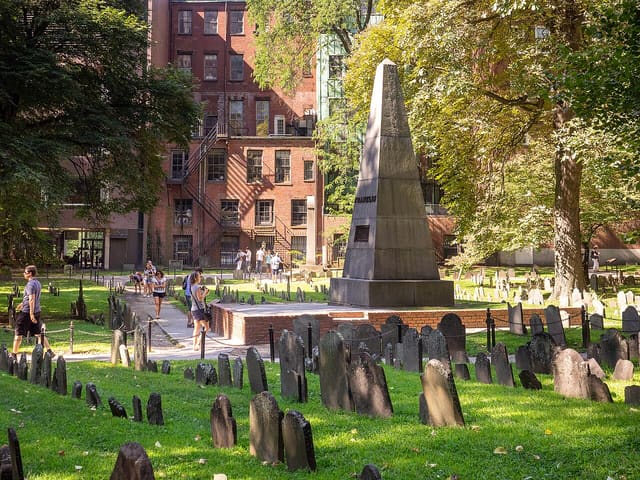
A boy killed eleven days before the Boston Massacre shares a grave with its five victims.
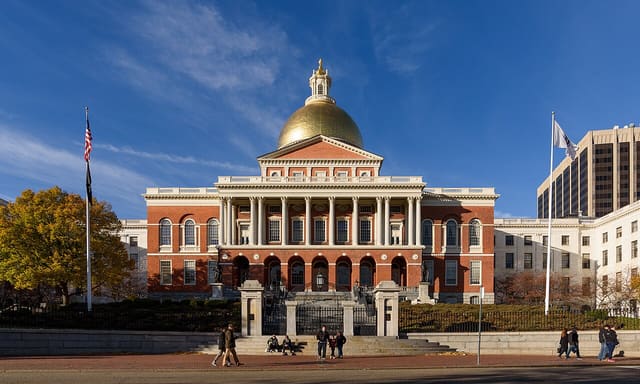
A time capsule beneath the State House cornerstone was rediscovered in 2014.
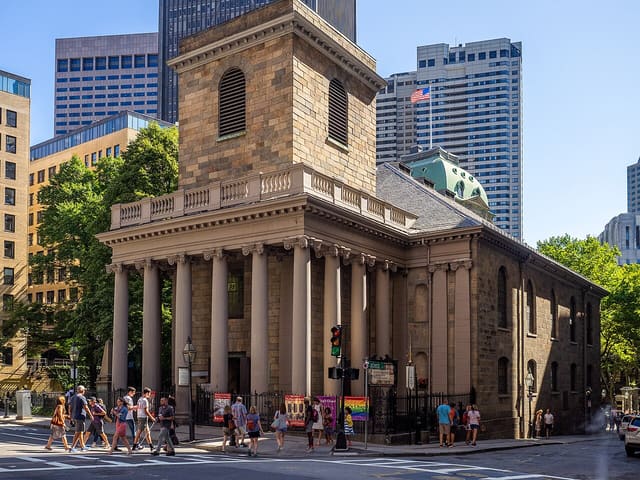
The old wooden church was taken apart through the windows of the new stone chapel.
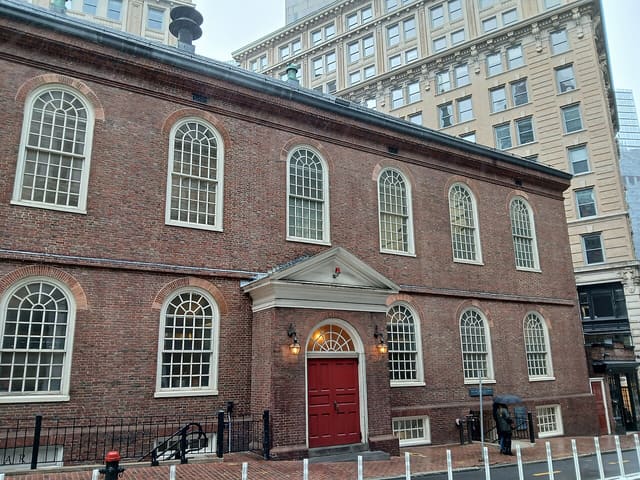
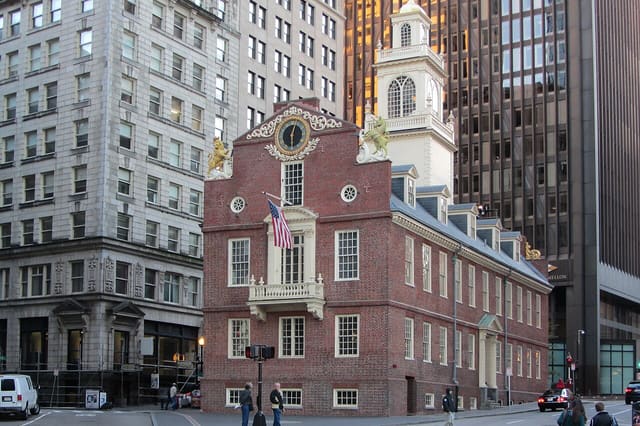
John Adams defended the British soldiers involved in the Boston Massacre.
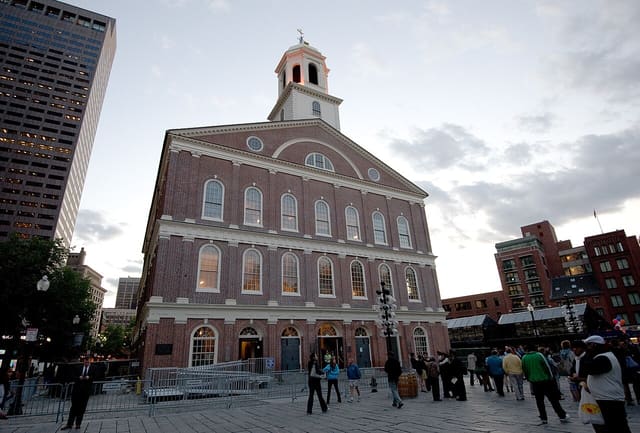
Boston accepted Peter Faneuil’s market gift by a margin of just seven votes.
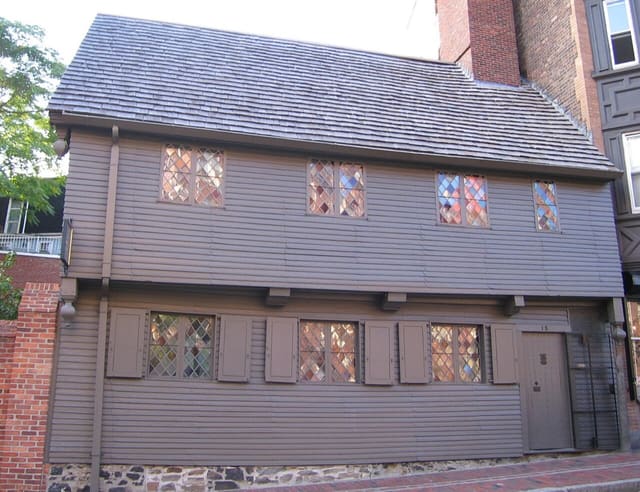
Downtown Boston's oldest surviving building once became a tenement with shops.
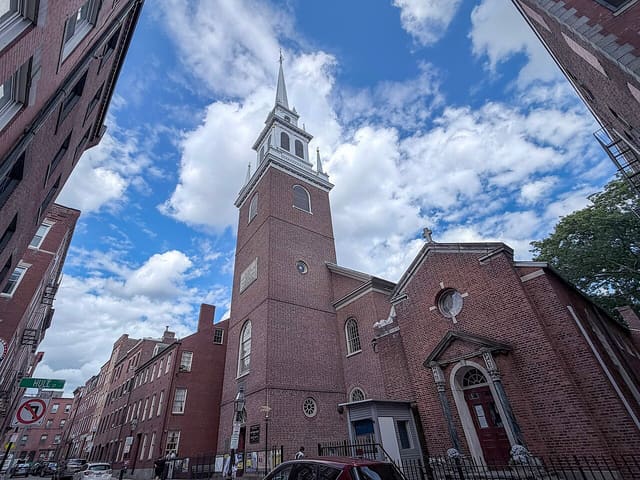
The famous lantern signal came from an Anglican church belonging to the Church of England.