The whole storyStop 7 of Seattle Walking Tour: Pike Place Market to Pioneer Square
The Son Who Wanted It Taller
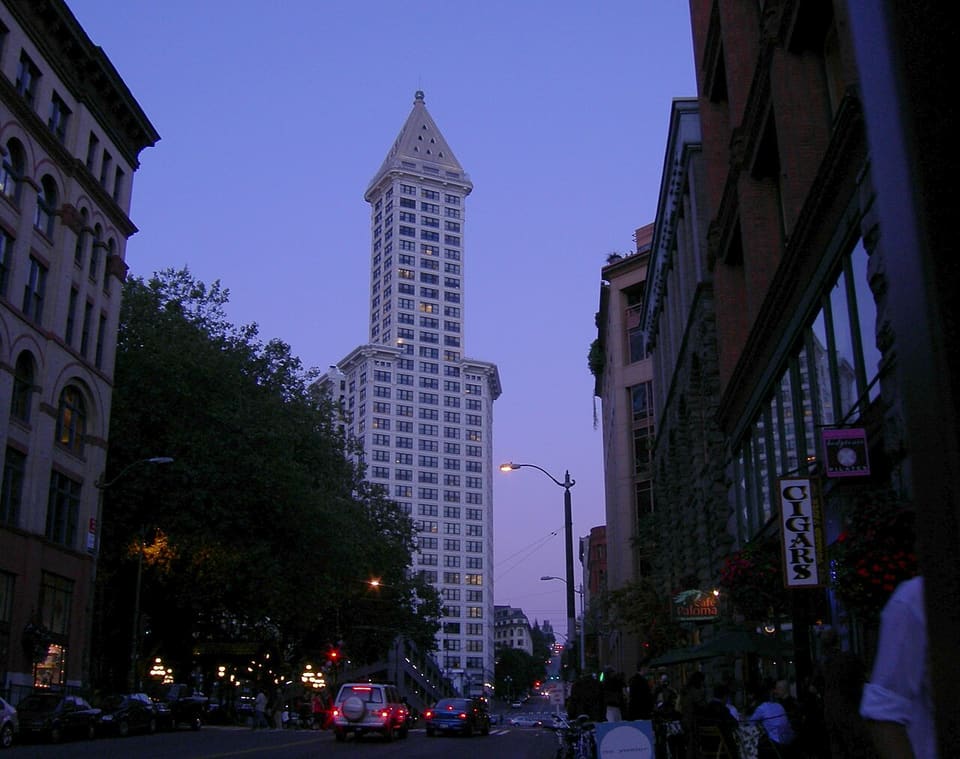
You're at Second Avenue and Yesler Way in Pioneer Square, at the foot of Smith Tower. Tip your head back and follow that white terra cotta skin all the way up to the pyramid on top. That pointed roof is where this story ends. For nearly half a century, nothing on the West Coast stood higher.
The man whose name is on it was Lyman Cornelius Smith, a millionaire from Syracuse, New York, who made his fortune in firearms and typewriters. And no, he had nothing to do with Smith and Wesson. After the Klondike Gold Rush, Eastern money poured into Seattle, and L.C. Smith bought up so much of Pioneer Square that he became the city's biggest taxpayer. In 1899 he picked up this odd-shaped corner lot, then held by a one-story brick building, and for ten years he did nothing with it.
In 1909 he finally drew up plans. A sensible building. Fourteen stories.
That's when his son, Burns Lyman Smith, talked him out of sensible. Thirty miles south, Seattle's rival Tacoma held a title Seattle wanted: the tallest building west of the Mississippi River. Burns convinced his father to build high enough to take it. The plans climbed to 26 stories, then to 40, with one condition attached. Smith would build that tall only if the city promised to keep City Hall on the block next door, instead of moving it uptown. Seattle agreed.
Then, in November 1910, a month after the first building permit was issued, L.C. Smith died. He never saw his tower break ground. The job fell to Burns, who spent the next months untangling his father's estate and convincing a doubtful public the thing would really be built. The design was so far beyond Seattle's building codes that the city demanded round after round of reviews. Workers bored test holes more than 120 feet into the ground and built an 80-ton test box just to see whether the soil would hold.
It held. Nearly 5,000 tons of steel went up, and on July 4, 1914, the tower opened: 38 stories, 462 feet, the tallest building west of the Mississippi.
Here's the part the plaques tend to skip. The crown didn't last as long as people remember. Kansas City took the title in 1931. What Smith Tower kept was the West Coast. It stayed the tallest building on this whole coast until 1962, when the Space Needle rose for the World's Fair.
One last detail about that pyramid on top. When the tower was planned, its builders tucked a 12,000-gallon water tank inside it, to feed drinking water to every tenant below. The highest point in the West, and part of it was a water tank.
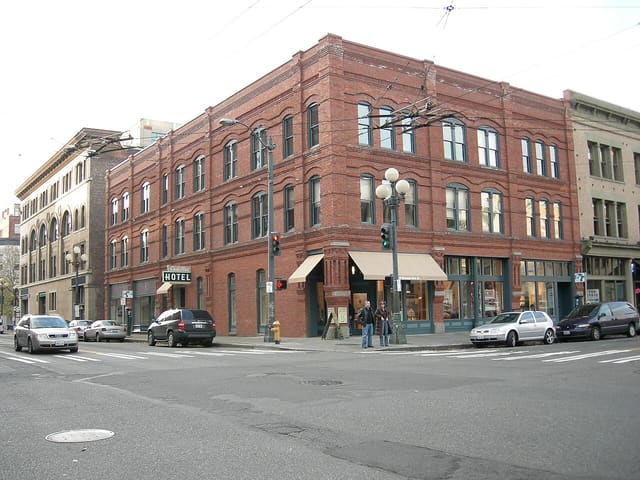
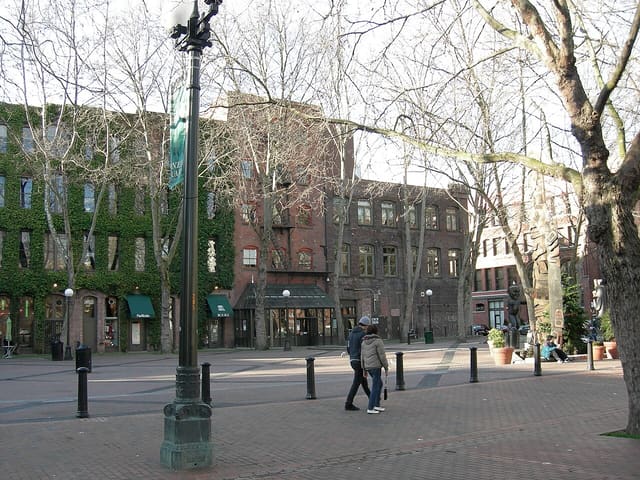
When you're ready, walk southeast, then turn left onto Occidental Avenue South, about four minutes. Occidental Park waits there, an open square among Pioneer Square's old brick buildings.
Hear it where it happened. It plays at stop 7 of Seattle Walking Tour: Pike Place Market to Pioneer Square (3 min), narrated as you walk. Unlock the tour for the audio, or try stop 1 free first.