The whole storyStop 9 of Seattle Walking Tour: Pike Place Market to Pioneer Square
A Ton of Gold, a Ton of Groceries
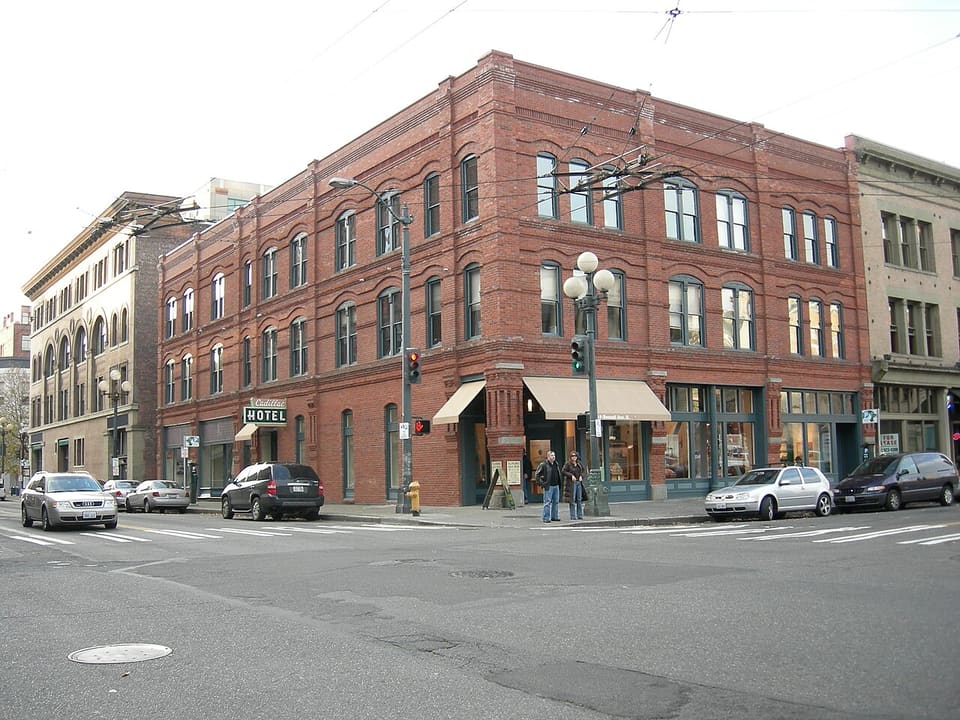
You're on Second Avenue South in Pioneer Square, at the last stop of the walk. The brick building in front of you is the old Cadillac Hotel, where a single room once went for 25 cents a night. Today it holds the Seattle branch of a national park, a small, free museum. The rest of that park sits in Skagway, Alaska, and the gold fields it commemorates lie farther still, in Canada's Yukon.
The rush began in August 1896, when George Carmack and two Tagish men, Skookum Jim and Tagish Charlie, found gold on a creek feeding the Klondike River in the Yukon.
The world didn't hear for almost a year. Then, in July 1897, a steamer called the Portland docked on the Seattle waterfront with prospectors coming home from the Yukon. Seattle's newspaper called its cargo a ton of gold. When the news reached Seattle and San Francisco, it set off a stampede.
Now follow the money. Most of the stampeders weren't heading for a fortune. They were heading for a shopping list. Canadian authorities required each person entering the Yukon to bring a year's supply of food. Add the tools and clothing, and a complete outfit weighed close to a ton.
So do the arithmetic. One ship brought a ton of gold into Seattle. Then a crowd of people each needed a ton of supplies to go back out. An estimated 100,000 prospectors set out for the Klondike between 1896 and 1898. Some became wealthy, but the majority went in vain.
That's why a city on Puget Sound, far from any creek, became a place to start the journey. The park exists because the story has pieces on both sides of the border: staging areas and trails in Alaska, gold fields in Canada, and here, a doorstep in Seattle.
The rush also had a cost that no outfitter's receipt records. Up on the Klondike, the Hän people were forced onto a reserve to make room for miners, and many of them died.
Step inside if it's open. Ask yourself what the people who passed through here believed they were buying, and who actually came out ahead.
That's the end of the walk. From here, the story runs north to Skagway and on to the Yukon. Thanks for walking with us.
Hear it where it happened. It plays at stop 9 of Seattle Walking Tour: Pike Place Market to Pioneer Square (2 min), narrated as you walk. Unlock the tour for the audio, or try stop 1 free first.