The whole storyStop 3 of Gettysburg Battlefield Driving Tour
The Men Who Waited in the Trees
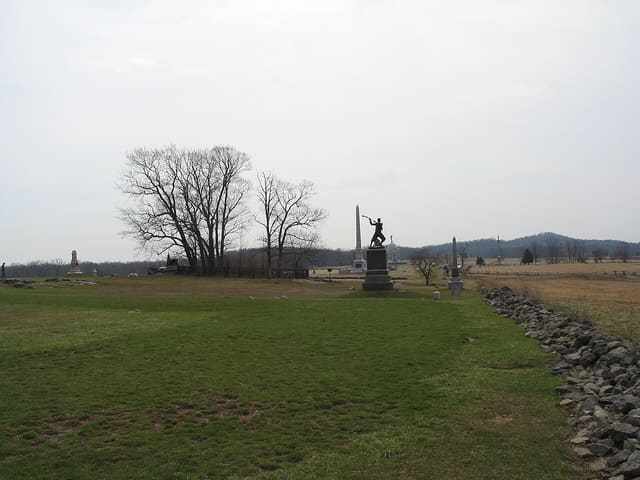
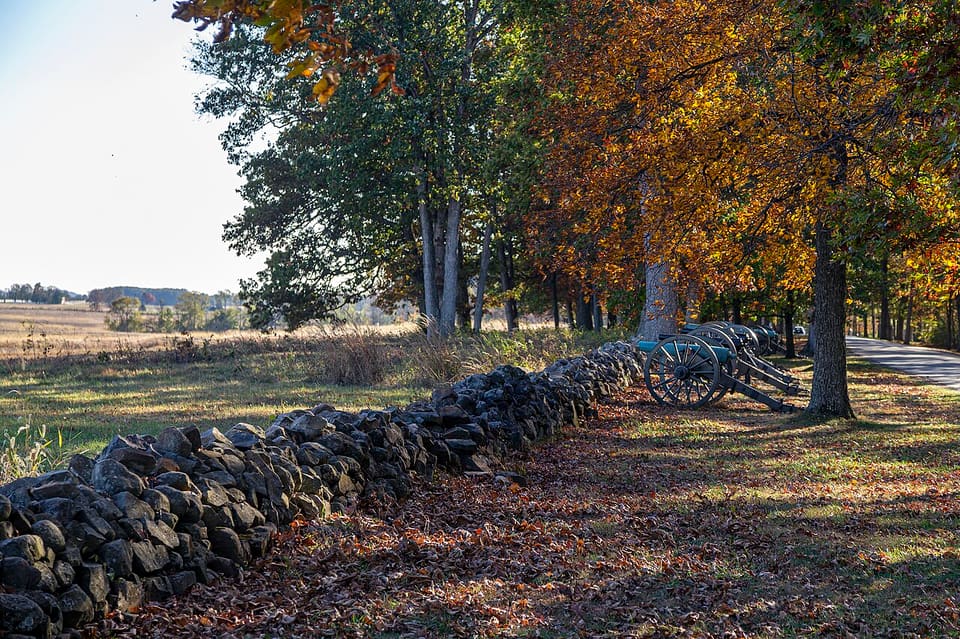
You're on West Confederate Avenue, running along the spine of Seminary Ridge. If it's safe, pull over and look east, away from the trees, across the long open ground to the low ridge on the far side. That far ridge is Cemetery Ridge, where the Union army stood. The open ground between is the field of Pickett's Charge.
This ridge is named for the Lutheran seminary on it, founded in 1826. On the first day of the battle, Union cavalry general John Buford watched the fighting open from the seminary's cupola. Robert E. Lee, the Confederate commander, made his headquarters on the ridge just north of the Chambersburg Pike. And on July 2 and 3, this ridge was the Confederate line of battle for the attacks on Cemetery Ridge.
On July 3, 1863, Lee chose to strike the center of the Union line. First the artillery. Confederate guns along this ridge opened a bombardment meant to smash the Union batteries on Cemetery Ridge before the infantry stepped off. Union guns answered.
Here's the part the famous story usually skips. George Pickett's Virginia division was waiting for its turn along this ridge, much of it in the trees and low ground behind you. The Union counterfire landed here. Before Pickett's men took a single step toward Cemetery Ridge, about 500 of them were killed or wounded right here on Seminary Ridge. One regiment in James Kemper's brigade lost 88 men without ever leaving its position. When the charge finally went forward, those men were already gone from the ranks. You've seen where the survivors reached at the High Water Mark. The losses began here.
The ridge found new uses after the guns stopped. West Confederate Avenue itself was built around the turn of the twentieth century for tourists. In 1918, army camps spread across that same field of Pickett's Charge. In the Second World War, a psychological warfare training camp and a prisoner-of-war camp stood on the ridge. And after Dwight Eisenhower bought a farm just west of here in 1950, the Secret Service used the old Longstreet Tower, built for battlefield visitors, to keep an eye on the battlefield tourists.
Take one more look across that open ground. It's about a mile, and from here it looks easy.
Drive south on West Confederate Avenue, turn sharp left onto Millerstown Road, continue onto Wheatfield Road, then turn right onto Crawford Avenue, about 3.6 miles and 12 minutes, to Little Round Top, the rocky hill the Union army nearly left undefended.
Hear it where it happened. It plays at stop 3 of Gettysburg Battlefield Driving Tour (2 min), narrated as you walk. Unlock the tour for the audio, or try stop 1 free first.