The whole storyStop 8 of Gettysburg Battlefield Driving Tour
A Small Clump of Trees, Made Famous
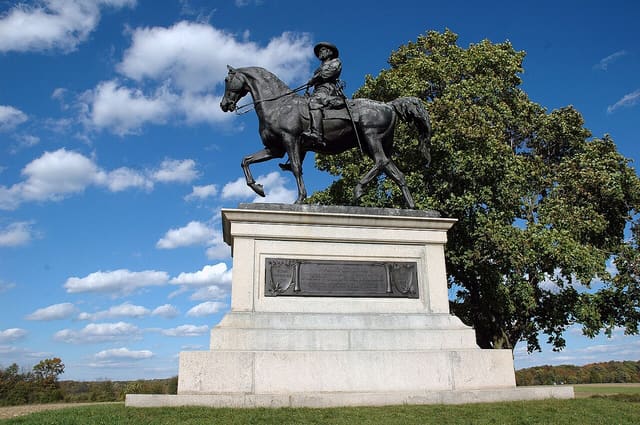
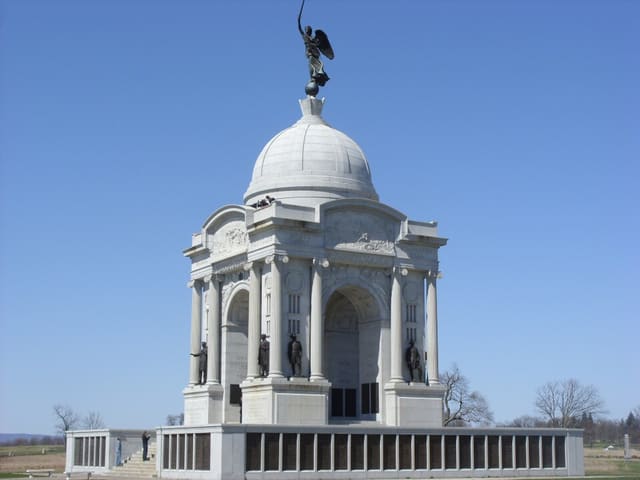
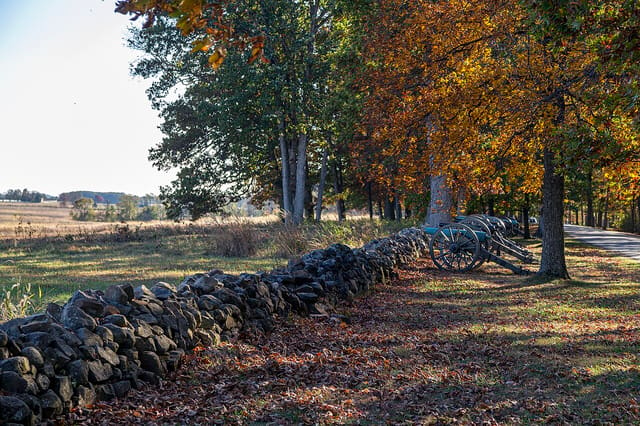
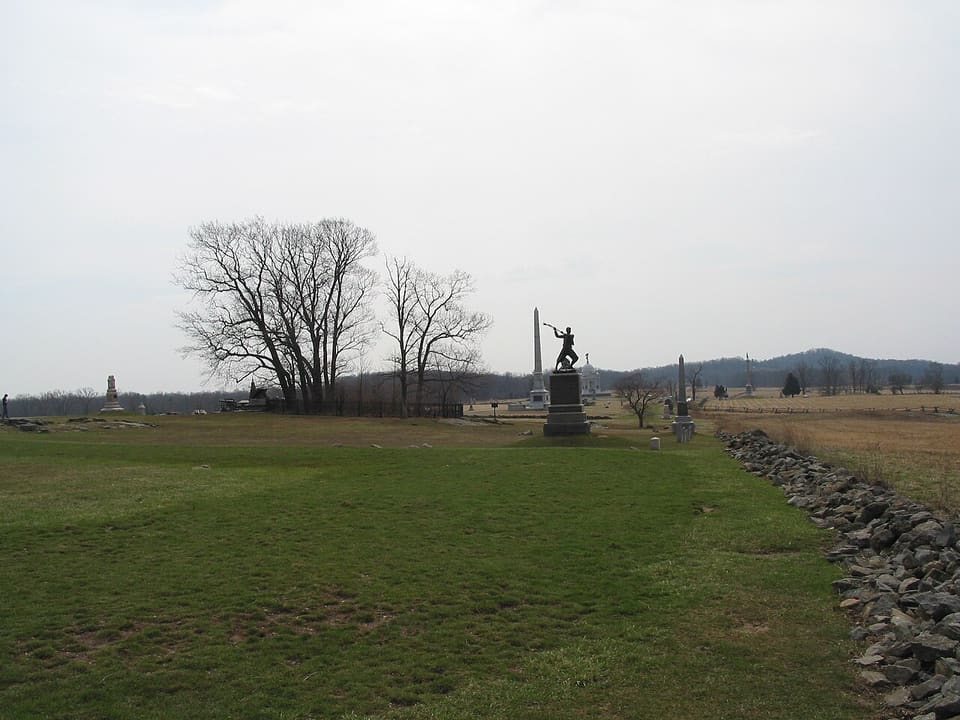
You're on Cemetery Ridge now, at the place everyone here calls the High Water Mark. If you're parked, look for the low stone wall running along the ridge, lined with monuments. Just beyond it is a small grove of trees, the Copse of Trees, which may be the most famous clump of trees in America.
Here's what happened in front of it. On the afternoon of July 3, 1863, after a massive Confederate artillery barrage that was mostly ineffective, Robert E. Lee sent nearly 12,500 men across almost a mile of open fields toward this ridge. The center of the Union line stood right here. Union guns and infantry opened fire as the lines came on, and more than half of the attackers were killed, wounded or captured.
We call it Pickett's Charge. But George Pickett commanded only 3 of the 11 brigades in it, under the overall command of James Longstreet. Pickett's name stuck anyway, and it has been attached to the assault ever since.
Only in one place did the attack break through: a bend in the stone wall known as the Angle. About 1,500 Virginians broke through there, and one of the brigade commanders was Lewis Armistead. A marker near the wall shows where Armistead put his hand on a Union cannon before he collapsed with mortal wounds. Another marks the spot where Lieutenant Alonzo Cushing was mortally wounded defending this line. The gap was hastily closed, and the Confederates who had crossed were quickly captured or killed. Lee's army retreated toward Virginia the next day.
Now the twist. The phrase High Water Mark was invented after the war by a government historian named John Bachelder, while the battlefield's monuments were being built. The name stuck to this spot, and so did the idea that the Copse of Trees was the target of the charge. Some historians now argue that Lee was really aiming at Ziegler's Grove, on Cemetery Hill. So the grove you're looking at may owe its fame less to the battle than to the way the battle was remembered.
And the phrase carries a judgment. It marks arguably the Confederate army's best chance of victory. Even though the war lasted almost two more years, Lee launched few offensive operations afterward, none on the scale of the Gettysburg campaign. Right here, at this wall, that chance ended.
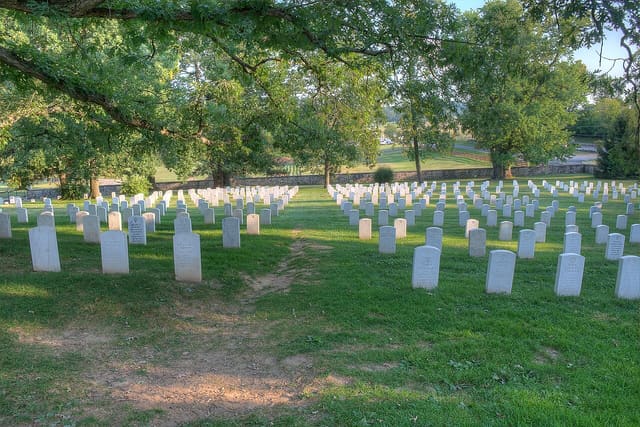
When you're ready, drive north on Hancock Avenue, about half a mile, roughly three minutes. You'll end where Lincoln came that November, to the cemetery this battle made necessary.
Hear it where it happened. It plays at stop 8 of Gettysburg Battlefield Driving Tour (3 min), narrated as you walk. Unlock the tour for the audio, or try stop 1 free first.