The whole storyStop 9 of Gettysburg Battlefield Driving Tour
A Few Appropriate Remarks, and 979 Unknowns
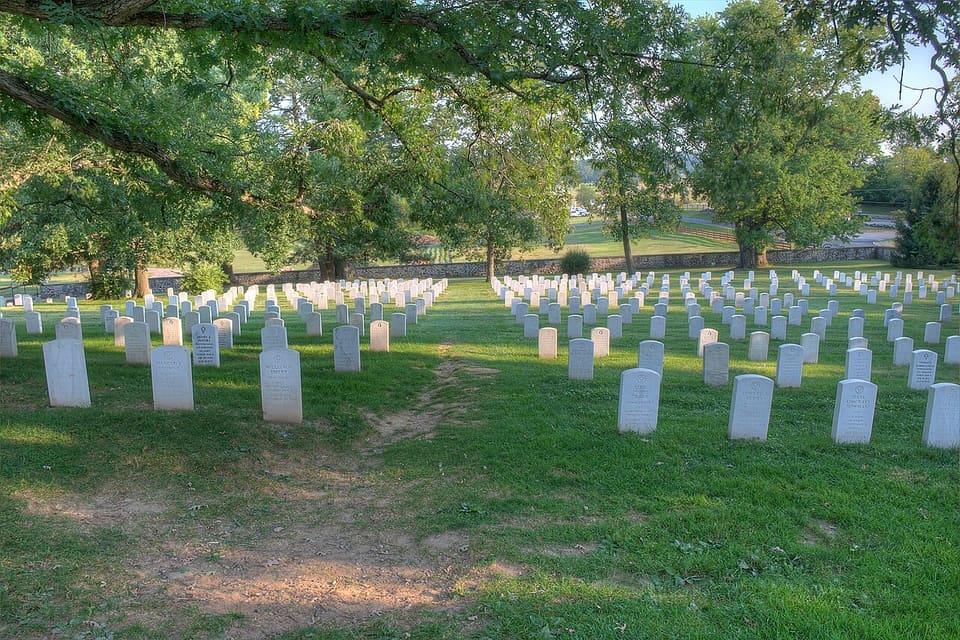
You've come down off Cemetery Ridge to Soldiers' National Cemetery, the ground most people here simply call the National Cemetery. Once you're parked and out of the car, look for the tall granite column at the center, the Soldiers' National Monument, 60 feet high. Now look at the ground around it. Low gray stones curve around that monument in rings, like ripples in a pond.
Those ripples were a choice. In 1863 a committee of Union governors selected a designer named William Saunders to lay out a cemetery for the Union dead. Saunders grouped the graves by state and marked them with simple, unadorned slabs of gray granite. Officers and enlisted men lie side by side, because the Union army was mostly citizen volunteers, and Saunders wanted the ground to say so. The repetition of simple, common things, he wrote, was meant to evoke solemnity.
First, though, the dead had to be found. After the battle, men lay in shallow graves on farms, in churchyards and beside field hospitals. In the Valley of Death below Little Round Top, some were never buried at all; they lay where they had fallen. A man named Samuel Weaver was superintendent of the exhuming. He watched the contractor's workers open grave after grave, place the remains in coffins and bury them here. Today the cemetery holds 3,512 Civil War interments. Of those, 979 are unknowns, men whose names were lost, and they lie in three sections of their own, within the same rings as the rest. No Confederates are mentioned among the Union states' sections; this ground was created for Union casualties.
On November 19, 1863, about 15,000 people came for the dedication. The main speaker was Edward Everett, a former Massachusetts governor and U.S. senator, the great orator of the age. He spoke for two hours.
The president came after. Abraham Lincoln delivered his address that afternoon, and it ran about two minutes. It was only 271 words. Lincoln said the world would little note what was said here, but could never forget what the soldiers did. He had half of that backwards. The words became some of the most famous in American history. And Everett's two hours are almost never read.
He likely did not feel well. After returning from Gettysburg, Lincoln was diagnosed with a mild case of smallpox.
But look again at the rings of gray stone. Lincoln asked the living to finish the work these men began. Saunders gave the ground a plan in which no rank stood above another, and the stones keep saying it.
That's the end of the drive. Walk among the stones and find the unknown sections, then take a moment before you go.
Hear it where it happened. It plays at stop 9 of Gettysburg Battlefield Driving Tour (3 min), narrated as you walk. Unlock the tour for the audio, or try stop 1 free first.