The whole storyStop 2 of Harpers Ferry Walking Tour: John Brown's Fort to Jefferson Rock
The Firehouse That Wouldn't Stay Put
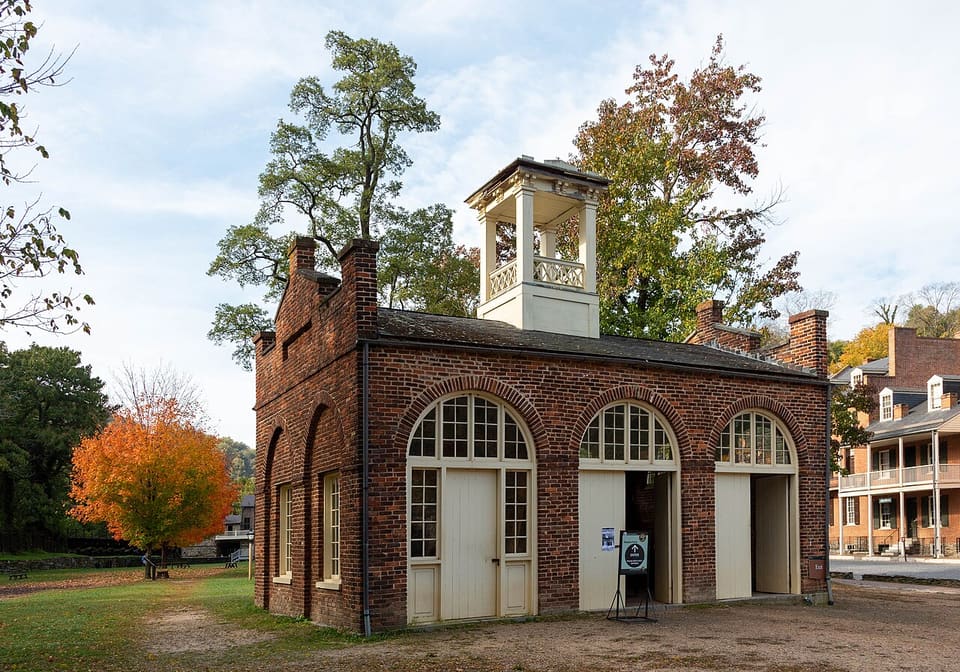
You're standing on Potomac Street in Lower Town, in front of a small, one-story brick building with a slate roof and three doors across its front. It doesn't look like much. It was built in 1848 as the armory's fire engine house and guardhouse. Today it's called John Brown's Fort, and it's the only building of the whole federal armory that survived the Civil War.
In the summer of 1859 John Brown, an abolitionist hoping to launch the overthrow of slavery, rented a farmhouse in Maryland, about 4 miles north of here, under the name Isaac Smith. He ordered 950 pikes from a Connecticut blacksmith. His plan was to seize the armory and its arsenal and use them to supply an army of abolitionists and escaped slaves.
On the night of October 16, Brown and 21 men, 16 white and 5 Black, crossed into town. At first it worked. They took the armory and the arsenal and seized about 60 townspeople as hostages. But local militia and armed townspeople killed several of the raiders, and Brown was forced to take up a position in the sturdiest building around, with some hostages. This one.
On the night of October 17, U.S. Marines arrived, sent at the instruction of President Buchanan and commanded overall by an army colonel named Robert E. Lee, with Lieutenant J.E.B. Stuart as his aide. The next morning, Marines under Lieutenant Israel Greene used a ladder as a battering ram, broke down a door and stormed inside. Greene stabbed Brown, who was captured. In the end, 10 raiders died in the fighting, 7 were tried and hanged, and 5 escaped. Within two years, men who had stood in this small town were fighting the war Brown's raid is often credited with helping bring on.
Here's the part the plaque doesn't quite convey: this building has been a traveler. After the war it became almost a shrine for Black visitors. People carried off bricks as souvenirs, and Frederick Douglass kept one at his home in Washington. In 1891 it was sold to a buyer who wanted to show it at the World's Columbian Exposition in Chicago. The venture failed, and the building was dismantled and left on a vacant lot. Then it came back to the Harpers Ferry area, rebuilt on a farm, where the owner used it to house a wheat crop. In 1909 it moved to the campus of Storer College, and since 1968 it has stood here, near where it began. Look for a white stone obelisk about 150 feet away. That marks the original spot, now covered by a railroad embankment.
So the doors you're looking at have faced Marines, Chicago, and a wheat crop. Four moves, and still they're never quite where they started.
When you're ready, walk east and continue onto the Lower Town Trail, about three minutes.
Hear it where it happened. It plays at stop 2 of Harpers Ferry Walking Tour: John Brown's Fort to Jefferson Rock (3 min), narrated as you walk. Unlock the tour for the audio, or try stop 1 free first.