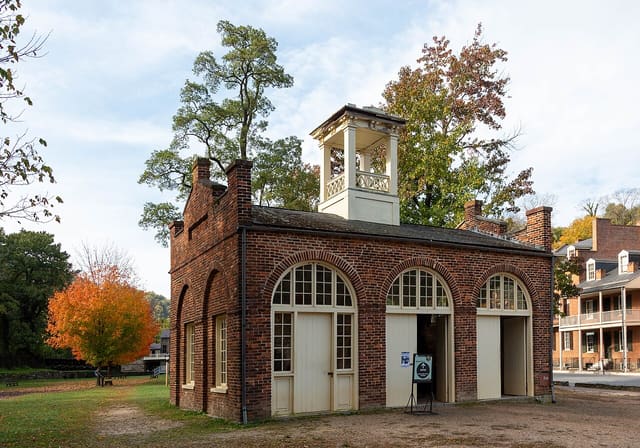
The whole storyStop 5 of Harpers Ferry Walking Tour: John Brown's Fort to Jefferson Rock
The View That Was Worth an Ocean
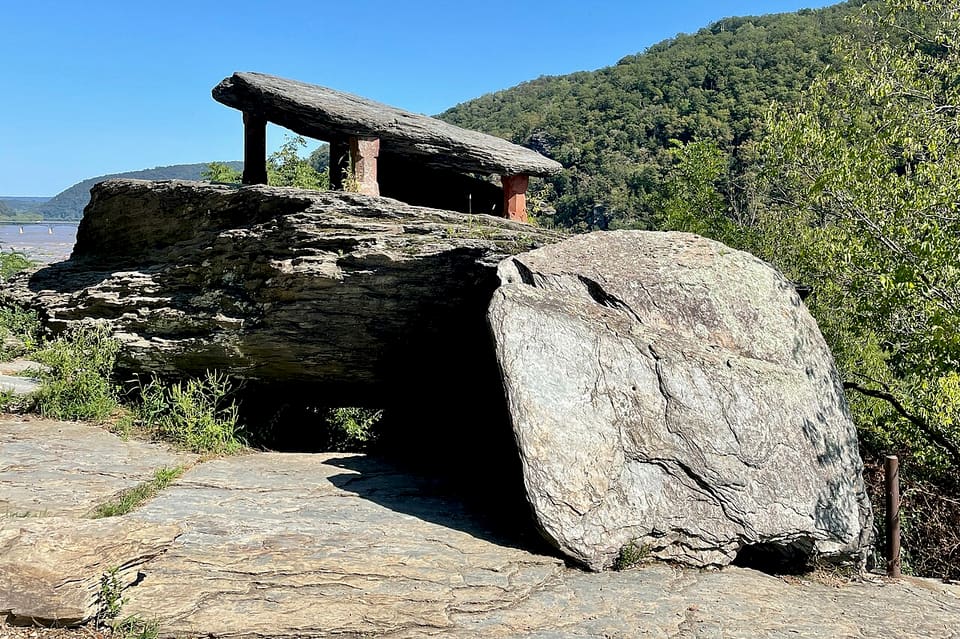
You've climbed up from St. Peter's onto the hillside path, and in front of you is Jefferson Rock: big, flat slabs of shale stacked one on top of another, hanging out over the Shenandoah River. Look at the uppermost slab, then look underneath it. Those four stone pillars, one at each corner, are holding it up. Keep them in mind. We'll come back to them.
On October 25, 1783, Thomas Jefferson stood on this spot. The Revolution was barely over, and he was not yet president. He was a Virginian with a restless, measuring mind, and he was working on a book about his home state called Notes on the State of Virginia. What he saw from this rock went into it, and the passage became one of the most famous pieces of American landscape writing.
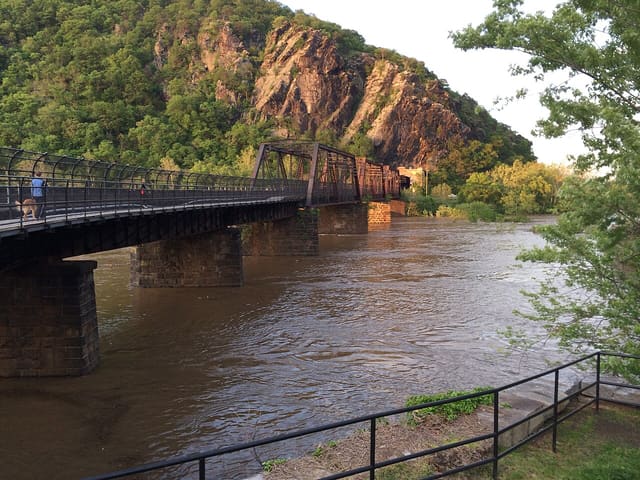
He called the meeting of the rivers "perhaps one of the most stupendous scenes in Nature." The Shenandoah comes up on one side, the Potomac on the other, and in his words, "they rush together against the mountain, rend it asunder and pass off to the sea."
But Jefferson wasn't only admiring. He was theorizing. Looking at the broken rock piled along the Shenandoah, he decided the rivers must once have been dammed up behind the Blue Ridge, forming an ocean that filled the whole valley. Then the water rose until it broke over at this very spot and tore the mountain down, as he put it, "from its summit to its base." It was an eighteenth-century guess at deep time, written from right where you're standing.
Then comes the turn in his writing. After all that violence, he looks through the gap in the mountains and finds "a small catch of smooth blue horizon" in the distance, calm and inviting. That contrast, the riot of water and the quiet beyond it, is what made him write the line this rock is known for: "This scene is worth a voyage across the Atlantic."
That line worked a little too well. People came. And the rock itself was once a kind of toy. The top slab sat on a natural stone base so narrow that a gentle push would sway it back and forth. Weather wore that base down, and so did visitors. One account blamed "the devastations of tourists and curiosity-hunters," people chipping off souvenirs of the famous view until the famous rock was in danger of falling off it. Sometime between 1855 and 1860, someone slid those four pillars underneath.
So the pillars you're looking at are, in a way, a monument to Jefferson's sentence. He praised the view so well that the rock needed propping up. Today climbing on it is against the law, so admire it the way Jefferson did: by looking past it, to the rivers and the gap.
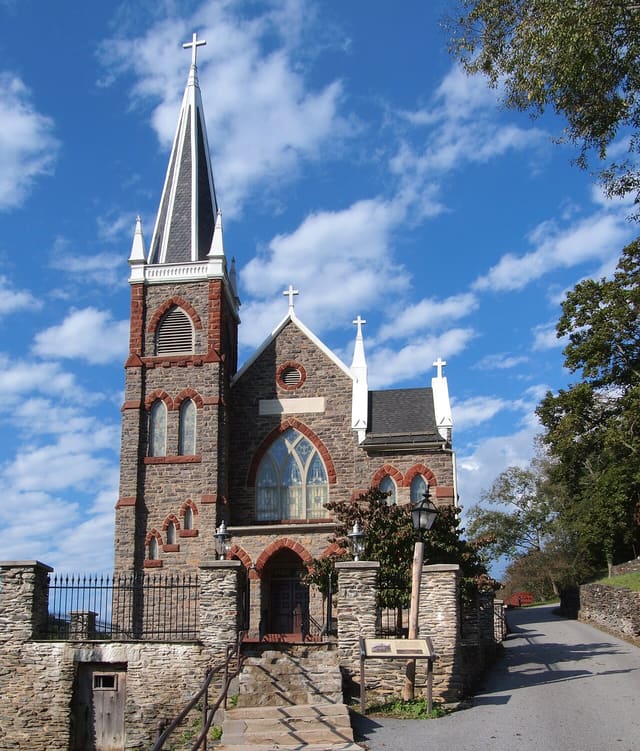
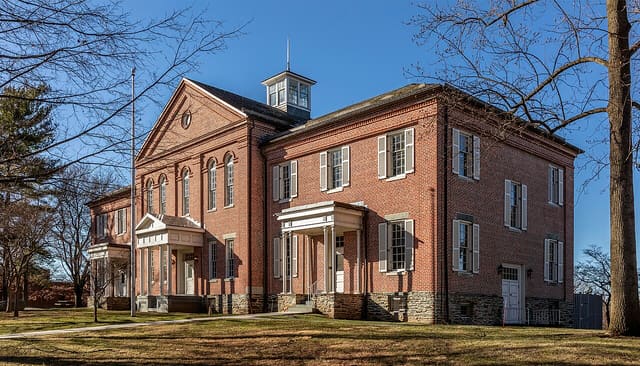
When you're ready, walk northeast, then turn left onto the Appalachian Trail; it's about four minutes to Storer College, where a school born after the Civil War hosted a gathering that shaped the fight for civil rights.
Hear it where it happened. It plays at stop 5 of Harpers Ferry Walking Tour: John Brown's Fort to Jefferson Rock (3 min), narrated as you walk. Unlock the tour for the audio, or try stop 1 free first.