The whole storyStop 9 of Hollywood Walk of Fame Walking Tour: Chinese Theatre to Hollywood and Vine
The Corner That Was Mostly a Voice
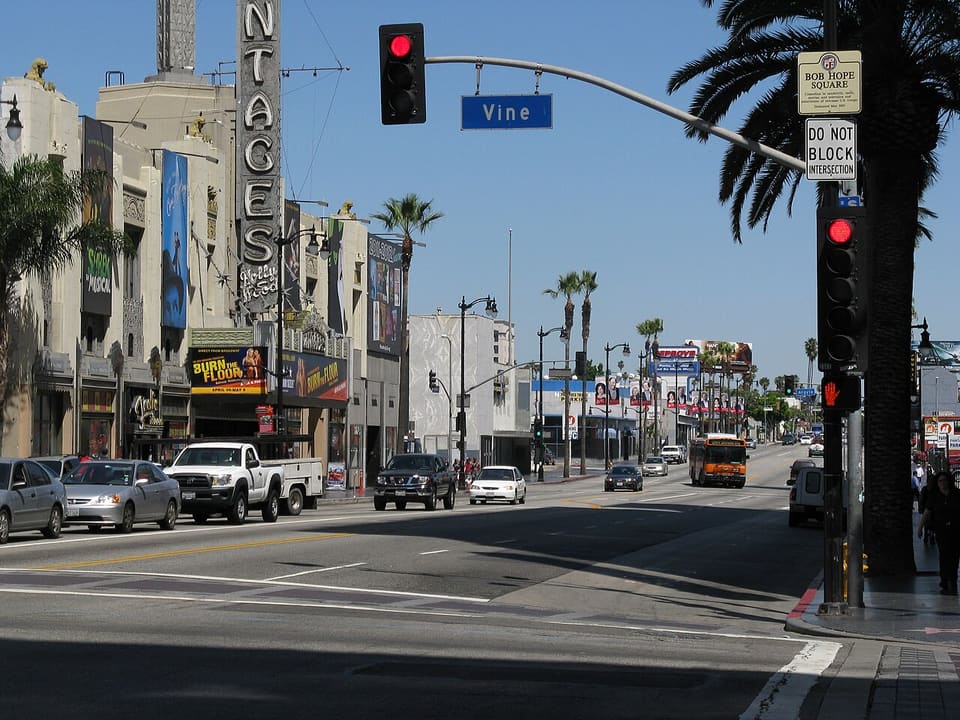
You're standing at Hollywood and Vine, the most famous street corner in a town built on fame. Look at the sidewalk near the curb on any of the four corners and find the round markers shaped like the Moon. Those belong to Neil Armstrong, Buzz Aldrin and Michael Collins, the crew of Apollo 11. The Walk of Fame centers on this crossing, and when the astronauts were added, someone decided only all four corners would do. Three men who flew to the Moon, honored on a sidewalk built for actors.
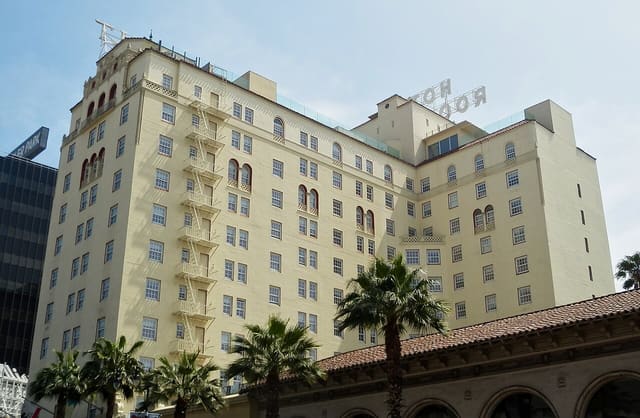
Now turn to the southeast corner and the tall, pale twelve-story building. That's the Taft Building, and it holds the real story of this corner.
A little over a century ago, there was nothing here but lemon trees. The land belonged to Daeida Beveridge, one of the founders of the town of Hollywood. In 1903 she let one corner of this dirt crossing be used for a church, the Hollywood Memorial Church. It didn't last long. In 1923 it came down, and the Taft Building went up in its place, the first high rise at Hollywood and Vine.
What happened inside the Taft explains the legend. In Hollywood's golden age, every studio kept offices there. So did Charlie Chaplin. So did Will Rogers. So did the Academy of Motion Picture Arts and Sciences. Across the street, the Equitable Building on the northeast corner filled up with talent agents and advertising men. Through the 1920s, radio and movie businesses packed in so tightly that this became the second busiest intersection in Los Angeles.
Then radio turned it into a myth. In the 1930s, station KFWB told listeners it was broadcasting live from Hollywood and Vine. Gossip columnists like Hedda Hopper and Jimmie Fidler kept dropping the name. Millions of people who would never see Los Angeles learned to picture this corner as the place where stars simply walked by.
Here's the catch. The movies were mostly made somewhere else, on studio lots spread across the city. Hollywood and Vine was where the business had its offices, its lunches and its microphones. It was famous largely because it was famous.
And when the money moved on in the 1960s, the corner fell hard. Offices and stores sat empty. For decades, tourists arrived expecting glamour and found boarded windows. The comeback started underground, with the subway station that opened here in 1999, and the new towers around you followed.
The stars in the sidewalk came in 1960, right as the decline began. Getting one still works the way it long has: someone nominates an honoree to the Hollywood Chamber of Commerce, and a committee chooses who makes the cut. Fame by application, at the corner that radio made famous by repetition.
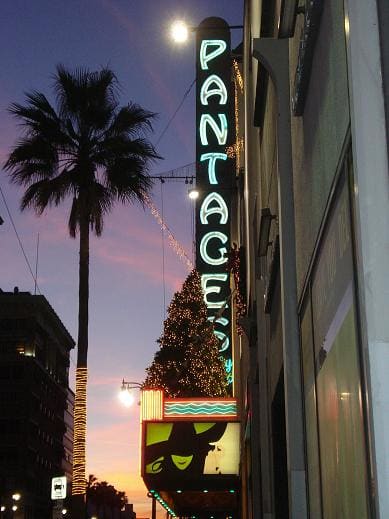
When you're ready, walk north on Vine Street, about a minute, to the Pantages Theatre, a 1930 Art Deco movie palace with a bar tucked inside that's been pouring drinks since 1934.
Hear it where it happened. It plays at stop 9 of Hollywood Walk of Fame Walking Tour: Chinese Theatre to Hollywood and Vine (3 min), narrated as you walk. Unlock the tour for the audio, or try stop 1 free first.