Stories
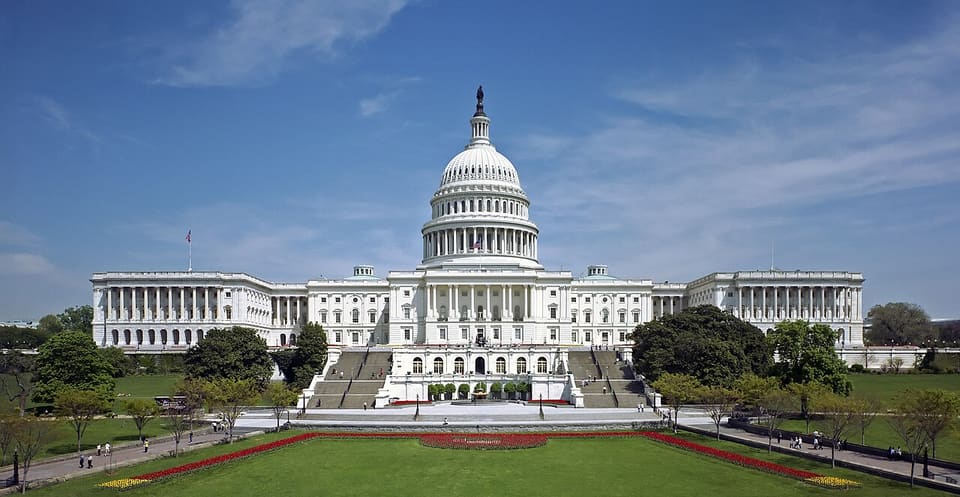
U.S. Capitol, West FrontPhoto: United_States_Capitol_-_west_front.jpg: Architect of the Capitol derivative work: O.J. (Public domain), via Wikimedia Commons
Walking tour · Washington

National Mall Walking Tour

Monuments, memory, and a place to be heard

2 h 4 min8 stops4.2 mi

Start the walk

Stop 1 plays free. All 8 for $4.99, for your whole group on up to 4 phones. 67 facts backed by 25 public sources. Refunded within 7 days if it isn't for you.

The link and where it starts. One email, nothing else.

See the 8 stops

The 8 stops

  1. 1Start hereFree

    U.S. Capitol, West Front

    The Congress That Had to Run

    Free sample · 2:23
    0:002:23

    You're standing on the West Front of the United States Capitol, facing the long green lawn of the National Mall. Look up behind you at the white dome, finished around 1866, just after the Civil War. Then turn and look down the lawn. The building sits at the head of it, high on a hill, and that position has an origin story. It starts with a Congress that had no safe place to sit.

    In June 1783 the Revolutionary War was won, but plenty of the men who won it hadn't been paid. Unpaid soldiers protested at Independence Hall in Philadelphia, where Congress was meeting, and demanded their money. Pennsylvania's governor, John Dickinson, sympathized with the protesters and refused to call up the militia to remove them.

    So the government of the United States left town. On June 21, 1783, Congress fled to Princeton, New Jersey. Afterward it met in Annapolis, then Trenton, and then New York City. The lesson was plain: a legislature that depends on someone else's town depends on someone else's protection.

    The answer was a capital of its own. The 1790 Residence Act chose a site on the Potomac, as part of a compromise brokered by Alexander Hamilton, in which the federal government assumed the states' war debts. The planner, Pierre L'Enfant, placed the Congress House on Jenkins Hill, which he described as a "pedestal awaiting a monument."

    That is why you are standing where you are. A government once chased out of a borrowed room got a hill of its own, with nobody else's permission required.

    The design came from William Thornton, an amateur architect, and George Washington praised it for its "Grandeur, Simplicity, and Beauty." Thomas Jefferson gave the building the name "Capitol," after Rome's Capitoline Hill, a name based on a misconception about what that hill was. So the most famous legislative building in America carries a small misunderstanding in its name, though no one has ever been able to evict it.

    Before you go, take one more look down the lawn, away from the dome. Congress now looks out over open ground from the top of a hill, which is a long way from fleeing to Princeton.

    Turn your back on the dome and leave the West Front lawn, then head north, about 1.9 kilometers, roughly 29 minutes on foot, to the next stop.
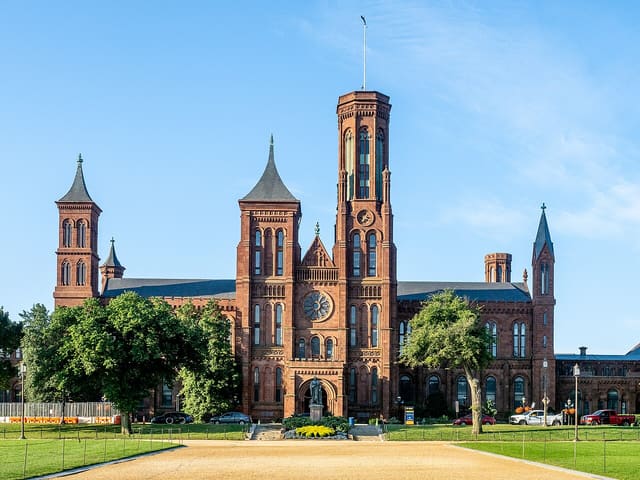
  2. 229 min walk · 3 min story

    Smithsonian Castle

    A Castle for a Man Who Never Came

    Read the story

    You're on Jefferson Drive, on the south side of the Mall, and the building in front of you looks like it wandered in from medieval England. That's the Smithsonian Castle. Look at its color first. Almost everything else on the Mall is white marble or pale granite. This is a deep, rusty red. Now find the towers. There are nine of them, all different heights. The tallest, on the side facing you, rises about 145 feet.

    The man this building exists for never saw it, and never set foot in the United States.

    His name was James Smithson, a British chemist. He was born in secret in Paris around 1765, the illegitimate son of an English duke, and he spent his life drifting around Europe with a blowpipe and a talent for analyzing tiny samples. He studied minerals, snake venom, the chemistry of human tears, and how to make a better cup of coffee. One zinc mineral he worked on is now called smithsonite.

    Smithson never married and had no children. In his will he left everything to his nephew. But he added a strange backup clause. If the nephew died without heirs, the money should go to Washington, to found something called the Smithsonian Institution, "for the increase and diffusion of knowledge among men."

    Smithson died in Italy in 1829. Six years later, in 1835, the nephew died childless. And suddenly the United States had inherited a fortune from a foreigner it had never met, for a purpose nobody had defined.

    It took years of argument to decide what an "establishment for knowledge" even was. The answer started here. In 1846 a young architect, James Renwick Jr., won a national design contest unanimously. He chose this style on purpose, to echo England's old college buildings and suggest learning. The stone came from the Seneca Quarry in Maryland, picked partly because it was cheaper than marble. Historians say it's likely enslaved people quarried that stone. The building was paid for out of the interest on Smithson's money, and it was finished in 1855.

    This wasn't just a museum. Joseph Henry, the Smithsonian's first leader, moved his family into the East Wing, and the building held labs, a library and a lecture hall. Then in 1865 a fire tore through the upper floor. Among the losses were James Smithson's own letters. The papers of the man who started it all went up in smoke inside the building he paid for.

    Smithson did make it here in the end. His tomb sits in a crypt just inside the north entrance. The Castle closed in 2023 for its first major renovation in more than 50 years, so for now you'll have to take that on trust, standing outside the red walls of the only house he ever had in America.

    When you're ready, walk west along the Mall, about thirteen minutes. You can't miss your next stop: it's the tallest thing in the city.

  3. 313 min walk · 3 min story

    Washington Monument

    The Line Where the Money Ran Out

    Read the story

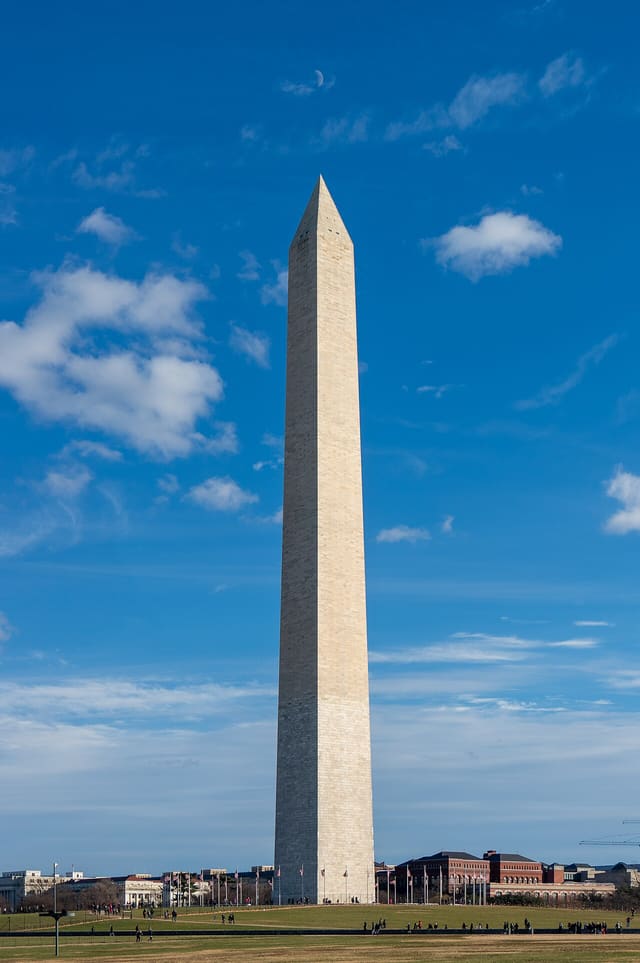
    You're standing at the foot of the Washington Monument, inside the big circle of fifty American flags, one for every state. Tip your head back and follow the white marble up the shaft. Partway up, the stone changes shade. Below that line it's one tone of white; above it, another. That line is a scar, and this is the story of how it got there.

    When George Washington died in 1799, he was the unchallenged public icon of American patriotism. Ten days later, a congressional committee recommended a tomb inside the Capitol. It went nowhere. There was no money, nobody agreed on what kind of memorial to build, and Washington's family was reluctant to move his body from Mount Vernon.

    Politics made it worse. Washington was identified with the Federalist Party, and when the Jeffersonian Republicans took control of Congress in 1801, they were reluctant to celebrate the hero of the opposition. They rescinded the earlier approvals for a memorial.

    So in 1833, ordinary citizens took over. They formed the Washington National Monument Society and started collecting donations. Their architect, Robert Mills of South Carolina, dreamed big. His plan put a 500-foot obelisk on top of a circular colonnaded building, with statues of prominent figures inside. On the roof, Washington himself would stand in a chariot, holding the reins of six horses.

    The money never stretched that far. The Society dropped the colonnade, the statues, and the chariot, and kept only the bare obelisk. The cornerstone was laid on July 4, 1848.

    Then, in 1854, the work stopped. Funding had dried up, factions were struggling for control of the Society, and soon the country was at war. For more than twenty years, the monument to the nation's first president stood here unfinished.

    Construction finally resumed in 1877. The outside facing ended up using three different kinds of white marble, because the building process was repeatedly interrupted. That's the change in color you can see. The stone structure was completed in 1884, and from then until 1889 this was the tallest structure in the world, until the Eiffel Tower went up in Paris.

    So when you look at that line in the stone, you're seeing more than a color mismatch. You're seeing a stretch of 23 years when the work stood still, and a country that decided to finish the job anyway.

    When you're ready, head northwest, about nine minutes, toward the World War II Memorial, where fountains and granite pillars stand on the line between this obelisk and Lincoln.

  4. 49 min walk · 3 min story

    World War II Memorial

    Fifty-Six Pillars, One Veteran's Question

    Read the story

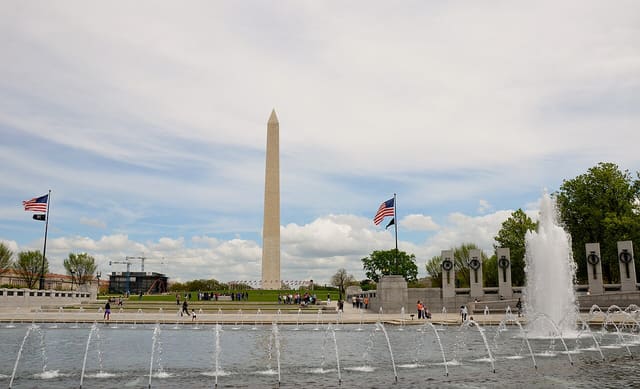
    You've just crossed 17th Street from the Washington Monument, and the ground is sloping down ahead of you into a sunken oval plaza with a fountain at its heart. Arranged in a semicircle around it are granite pillars, each 17 feet tall, each decorated with a bronze wreath. Walk close to one and read the name carved on it. Each pillar is inscribed with the name of a state or territory.

    This memorial began with one man asking a simple question. In 1987, a World War II veteran named Roger Durbin went to his congresswoman, Marcy Kaptur, a Democrat from Ohio, and asked whether a World War II memorial could be built. Kaptur introduced a bill that December, and the session ended without a vote. She tried again in 1989 and in 1991, and both bills suffered the same fate.

    In 1993 she tried a fourth time, one day after Senator Strom Thurmond introduced a companion bill in the Senate. This time it passed, and President Bill Clinton signed it on May 25. Then came the fundraising. A direct mail campaign brought in millions of dollars from individual Americans, veterans' groups gave large donations, and Bob Dole, a decorated World War II veteran, co-led the corporate effort. The federal government provided about 16 million dollars of a 197 million dollar total. The memorial opened in 2004, 17 years after Roger Durbin's question.

    Now look at the pillars again. There are 56. You'd expect 50, but this memorial counts the country as it stood in 1945. So there are the 48 states of that year, plus the District of Columbia, the Alaska Territory and the Territory of Hawaii, the Commonwealth of the Philippines, Puerto Rico, Guam, American Samoa, and the U.S. Virgin Islands. Every one gets a pillar of the same height.

    The memorial honors 16 million members of the armed forces, and also the millions more who supported the war effort on the homefront.

    On the west side, toward the Lincoln Memorial, is the Freedom Wall. It holds 4,048 gold stars, and each star represents 100 Americans who died in the war. In front of it are the words, "Here we mark the price of freedom."

    One more thing to hunt for. Two inconspicuously placed engravings read "Kilroy was here," the symbol American soldiers left wherever they went. Even a granite memorial made room for a bit of that.

    When you're ready, walk south, about 840 meters and thirteen minutes, to the Vietnam Veterans Memorial.

  5. 513 min walk · 3 min story

    Vietnam Veterans Memorial

    A Circle No One Has Carved

    Read the story

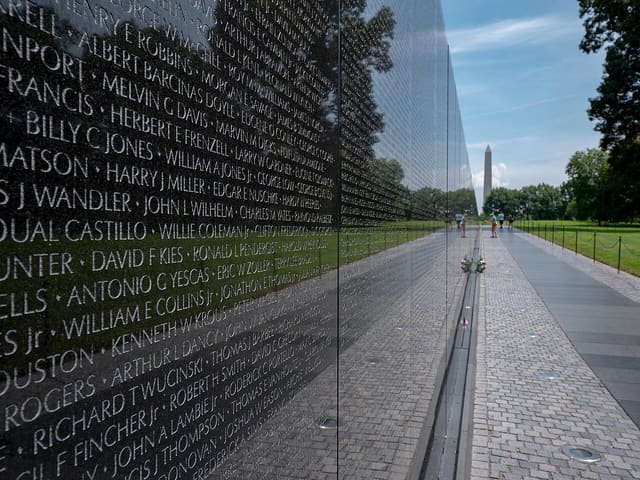
    You're in Constitution Gardens, just off the Mall, and the ground in front of you opens into a long black cut. Walk to the path along its base and look at the polished granite. You'll see names, row on row, and behind them, your own reflection.

    In 1981, a design competition for this memorial was won by Maya Lin, a Yale architecture student who was 21 years old. Her idea was not a statue or an arch. It was two black walls set into the earth, each about 250 feet long. One points at the Washington Monument behind you. The other points at the Lincoln Memorial ahead. As you walk, the wall rises from a few inches to more than 10 feet where the two meet, then sinks back down. You go below the level of the ground and come back up. It's been described as a wound that is closed and healing.

    Plenty of people hated it. It had no heroic figures and no flags in stone. It was a black gash, critics said. Two years after the Wall was finished in 1982, a bronze statue called Three Servicemen, by Frederick Hart, was added nearby in response to veterans who wanted something more traditional. Today the soldiers stand looking toward the names.

    And the names are the point. There were nearly 58,000 when the Wall was dedicated, and more than 58,000 now. They're not alphabetical. They're in the order people died, starting at the apex, where the walls meet, in 1959. They run east to the end, pick up again at the far western tip, and march back to the apex, ending in 1975. So the war begins and ends at the same spot, in the deepest part of the cut. Rank and unit aren't listed. Eight of the names are women, all of them nurses.

    Now look closely beside a name. A small diamond means the death was confirmed. A small cross means the person was missing. If a missing serviceman's remains are identified, a diamond is cut over the cross. And if one ever came home alive, the cross would be surrounded by a circle. That circle has never been carved.

    The record has a stranger twist. The people who compiled the names chose to err toward including too many rather than too few. One man, added as late as 1992, had actually gone AWOL after returning from his second tour. The government only learned he was alive in 1996. His name, like a few dozen others listed in error, is still on the Wall.

    That's the quiet genius of Maya Lin's design. It doesn't tell you what to feel about the war. It just gives back every name, and your own face, in the same dark stone.

    When you're ready, walk southwest, then turn right onto the Lincoln Steps, about five minutes. The western wall you just followed was pointing straight at it.

  6. 65 min walk · 3 min story

    Lincoln Memorial

    Who Got to Sit Up Front

    Read the story

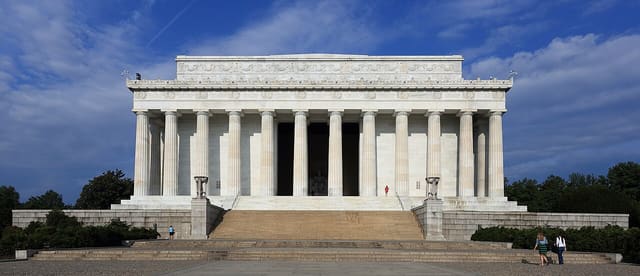
    You've reached the western end of the National Mall, and in front of you is the Lincoln Memorial, a white marble temple standing above the Reflecting Pool. Count the columns running around the outside. There are 36, one for each state in the Union when Abraham Lincoln died. Now look up the steps, through the open front, to the seated figure inside.

    That temple was a fight before it was a landmark. The architect, Henry Bacon, drew a Greek temple, and many people thought it far too ostentatious for a man of Lincoln's humble character. They proposed a simple log cabin shrine instead. Others said the site was too swampy, and they weren't entirely wrong. This was recently reclaimed land by the Potomac. The commission stood firm. Inside, the sculptor Daniel Chester French designed the statue of Lincoln, carved in marble by the Piccirilli brothers. It was first designed at about 10 feet tall. Then the builders measured it against the huge chamber, and Lincoln grew to 19 feet so the room wouldn't overwhelm him.

    On May 30, 1922, the memorial was dedicated. Chief Justice William Howard Taft, who led the memorial commission, handed it to President Warren Harding. Lincoln's only surviving son, Robert Todd Lincoln, was there at 78. And prominent Black Americans, invited to the ceremony, arrived to find they'd been assigned a segregated section, guarded by Marines. The policy came from Lieutenant Colonel Clarence Sherrill, who ran the city's Office of Public Buildings and Grounds. A monument to Lincoln opened with segregation written into the seating.

    Seventeen years later, the steps changed hands. In 1939, the Daughters of the American Revolution refused to let the contralto Marian Anderson perform before an integrated audience at their Constitution Hall. At Eleanor Roosevelt's suggestion, the stage moved here. On Easter Sunday, Marian Anderson sang from these steps to 75,000 people, and to a national radio audience.

    The building had been planned as a shrine to look at. Anderson's concert showed it could also be a place to be heard, with Lincoln at your back. Harry Truman addressed the NAACP here in 1947. In 1963, Martin Luther King Jr. delivered his "I Have a Dream" speech from these steps. On the landing, 18 steps below the statue, you can find the engraved spot where he stood.

    So climb the steps if you like, and turn around before you reach the top. That view down the Mall, all the way to the Capitol, is what the speakers saw. In 1922, the Black guests invited to the dedication were put in a separate, guarded section.

    When you're ready, walk east, about 770 meters or 11 minutes, to the Martin Luther King Jr. Memorial.

  7. 711 min walk · 3 min story

    Martin Luther King Jr. Memorial

    The Stone Pulled From the Mountain

    Read the story

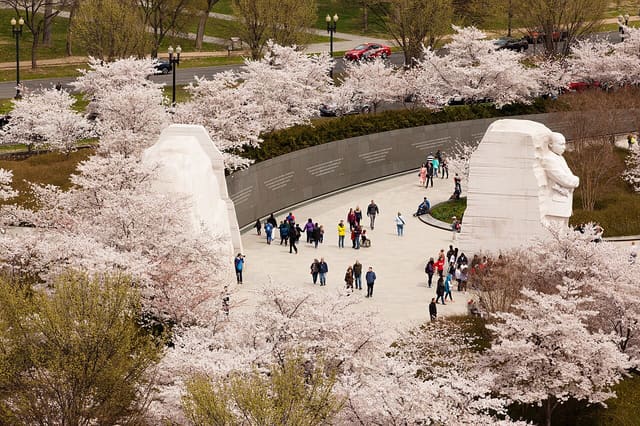
    You're standing in West Potomac Park on the edge of the Tidal Basin, at the Martin Luther King Jr. Memorial. In front of you are two massive slabs of granite with a narrow passage between them. Walk through that gap, and then turn around and look at the single great block that seems to have been pushed out of them. That block is the Stone of Hope, and Dr. King is stepping out of it, arms folded, looking across the water.

    The whole design comes from one line of the speech you just heard about at the Lincoln Memorial. In 1963, Martin Luther King Jr., the Baptist minister who led the civil rights movement, told the crowd at the March on Washington that with faith they could hew "out of the mountain of despair, a stone of hope." So the two slabs behind you are the mountain. You pass through it, the way King passed through the struggle. And the stone, about 30 feet high, is what got carved free.

    Getting it carved took a long time. After King was assassinated in Memphis in 1968, the men of Alpha Phi Alpha, the fraternity King had joined as a graduate student in Boston, proposed a memorial to him in Washington. It took nearly three decades just to get Congress to say yes, in 1996. A design by a San Francisco firm was picked from 900 entries from 52 countries. Then came the money, about 120 million dollars, raised from fraternity brothers, corporations, sports leagues and filmmakers.

    The man who did the carving was Lei Yixin, a sculptor from China. His hands shaped King's face, the folded arms, the rough chisel marks that still show on the sides of the stone. Look at those unfinished edges. They're deliberate: the figure is still emerging, still not quite out of the rock.

    Here's the part the plaques underplay. This was the first memorial to an African American on or near the National Mall, and King is only the fourth person who was never president to be honored this way. He was not always so welcome here. While he lived, the FBI watched him as a suspected subversive. Now the memorial stands on a deliberate sightline, a line of leadership running from the Lincoln Memorial, where he gave that speech, to the Jefferson Memorial across the water.

    Even the address makes an argument. It's 1964 Independence Avenue, for the Civil Rights Act of 1964.

    And one last detail. The memorial opened in August 2011, and the grand dedication was set for August 28, the anniversary of the speech. Then Hurricane Irene came up the coast. After more than 40 years of waiting, the dedication waited a little longer, until October.

    When you're ready, walk east along the Tidal Basin, about 20 minutes, to the domed Jefferson Memorial, the far end of King's line of leadership, where Jefferson's own words ring the walls.

  8. 820 min walk · 3 min story

    Jefferson Memorial

    Chained to the Cherry Trees

    Read the story

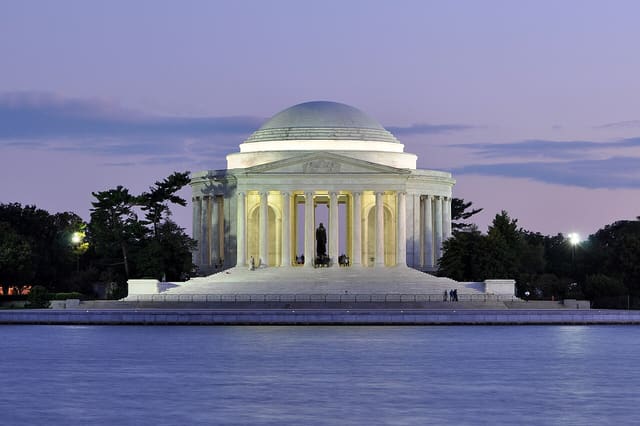
    You're standing at the Jefferson Memorial on the Tidal Basin, directly south of the White House. Look at the shallow white dome and the ring of columns beneath it. Then look between the columns, to the bronze figure standing alone in the center. That's Thomas Jefferson. Now look at the cherry trees along the water's edge, because they are the heart of this story.

    In 1934, Franklin Roosevelt read a book about Jefferson by Claude Bowers and asked about erecting a memorial. The architect was John Russell Pope, who had also designed the National Archives. Pope borrowed from the ancient Pantheon in Rome and from the rotunda Jefferson himself designed for the University of Virginia. So you're looking at a Roman temple filtered through Jefferson's own taste.

    But the site was the problem. In November 1938, as construction got under way, women protesters chained themselves to cherry trees around the site. The trees stood where the building was to go, and the protesters meant to stop the work by making the trees impossible to remove without removing them too. They wanted the shoreline left as it was.

    They did not win. The building went ahead, and the memorial you see is the proof. The chains made their point loudly, but the memorial still rose on this spot. Consider that the next time you look at those trees: the people who defended them lost the argument that day, and the trees are still part of the view anyway.

    The ground has an older argument under it, too. A beach here, opened in 1918, was marked Whites Only. In 1925 the city closed it permanently rather than integrate it. So before there was a memorial to a man famous for liberty, this spot had already been the scene of a fight over who got to share the water's edge.

    Roosevelt dedicated the memorial on April 13, 1943, Jefferson's 200th birthday. But the bronze wasn't ready. A plaster stand-in filled the center until sculptor Rudulph Evans's bronze was installed in 1947.

    That leaves the last complication. Jefferson wrote that all men are created equal, and he enslaved more than 600 people over his lifetime. The memorial's builders, the protesters and the city that closed the beach were all arguing, in their own ways, about who belongs in the picture. Step inside and read the walls with that in mind.

    Walk up the steps and read the quotations on the walls, then turn around at the columns and look north across the water toward the White House, with the cherry trees framing the view.

The whole walk

8 stories across Washington

2 h 4 min · 8 stops · 4.2 mi

Starts at U.S. Capitol, West Front and ends at Jefferson Memorial.

  • Plays right here in your browser, or in the app
  • One purchase for your group, on up to 4 phones
  • Refunded within 7 days if it isn't for you
Not going yet? Email me this walk

The link and where it starts. One email, nothing else.

Plan your walk

    How long

    About 2 h 4 min for 4.2 mi with all 8 stories. Going inside the sites adds time.

    Start and finish

    Starts at U.S. Capitol, West Front and ends at Jefferson Memorial.

    Add it to my calendar

    Planning the walk? National Mall walking map: the route, how far apart the monuments are and how long it takes.

    Faster or slower walker? Work out your own time with the walking time calculator.

    Paying, phones, offline and refunds are answered on the help page.

    Know someone who'd love this walk? or see more gift ideas.

    Questions people ask

    How long does it take to walk the National Mall?

    This walk is 4.2 miles from the Capitol to the Jefferson Memorial and takes about 2 hours 4 minutes with all eight stories. Going inside the museums adds time.

    Where does the tour start and end?

    It starts at the U.S. Capitol's West Front and ends at the Jefferson Memorial on the Tidal Basin.

    Are the National Mall memorials free?

    Yes. The memorials are free and open around the clock. Going up the Washington Monument needs a timed ticket.

    Can I walk the National Mall at night?

    Yes. The memorials are lit after dark, and the walk works at any hour.

    What stops are on the route?

    The eight stops are the U.S. Capitol, West Front; Smithsonian Castle; Washington Monument; World War II Memorial; Vietnam Veterans Memorial; Lincoln Memorial; Martin Luther King Jr. Memorial; and Jefferson Memorial.

    About this tour and its sources

    You're standing on the West Front of the United States Capitol. Turn your back to the building and look west. That long green stretch running toward the Washington Monument and, far beyond it, the Lincoln Memorial is the National Mall.

    It looks finished. Calm, even. It isn't. Almost everything you'll see today was fought over: what to build, who to honor, who paid, who designed it, and who was allowed to stand in front of it and speak. Who gets to be heard on the Mall? The answer has changed, and it changed because people came here and insisted.

    The building behind you carries that story in its walls. Enslaved people helped build the Capitol, quarrying stone and laying its walls, while the nation's lawmakers argued about freedom inside.

    You'll see it again at the Washington Monument, left half-built for decades, and at the Lincoln Memorial, where a singer once turned a barred door into an audience of 75,000.

    Now look up at the dome. Your first story is about the Congress that met beneath it, and the day it had to run.

    Written from public sources and narrated by a synthetic voice. A fact-check compares up to 10 of the most specific claims in each story with those sources. Last checked October 2026.

    Share this walk