The story
A Gold Dome and Four Missing Chariots
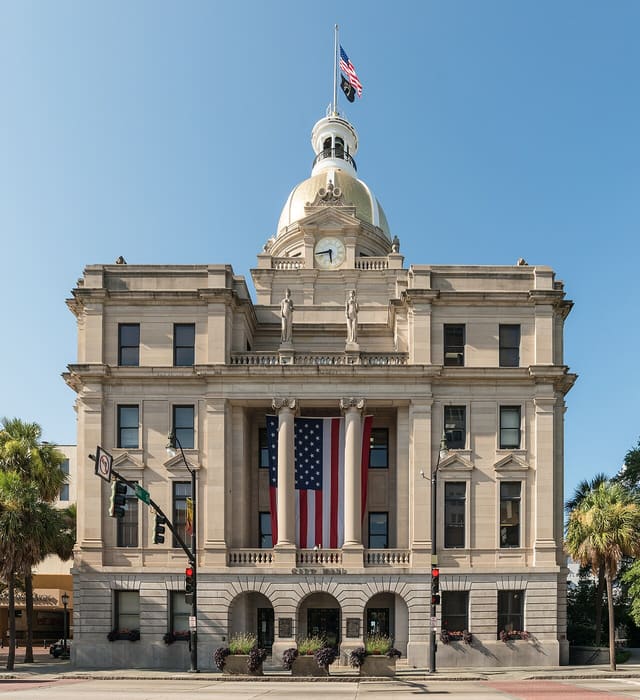
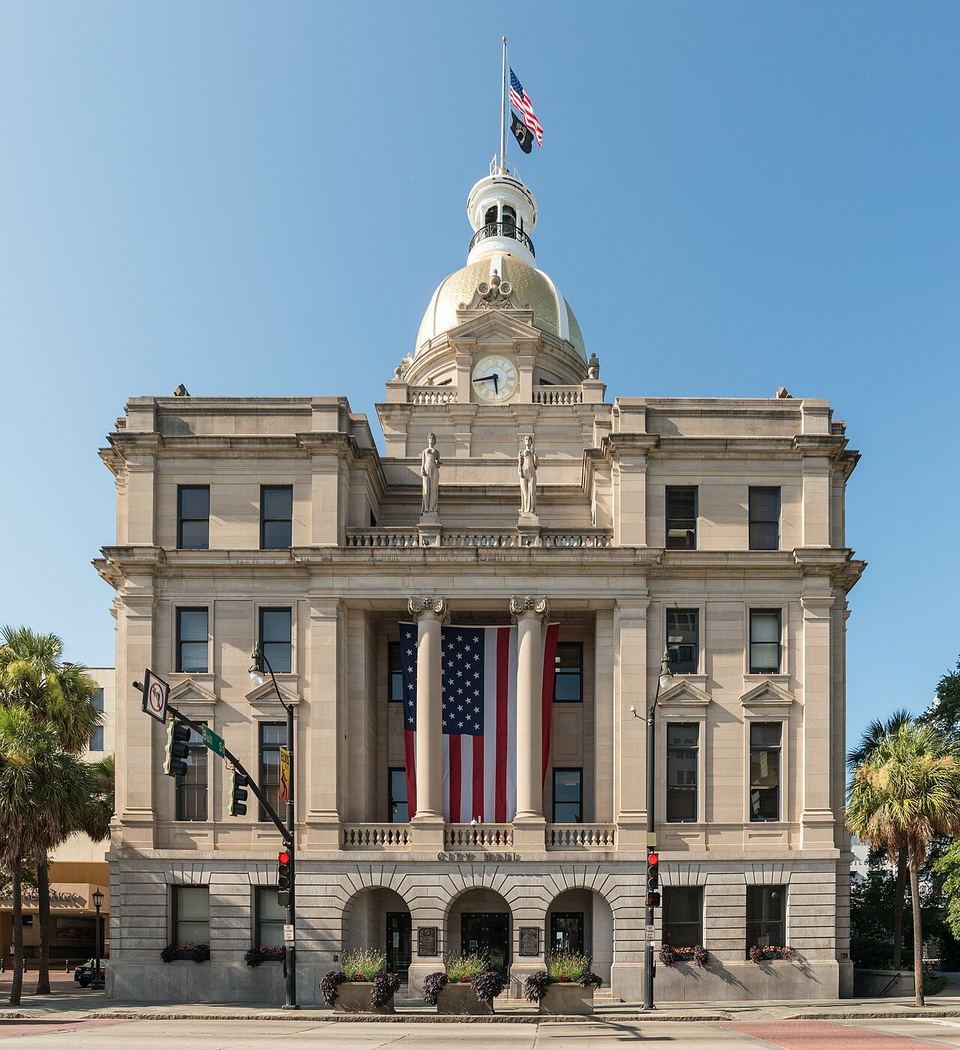
Stop 1 · Savannah City Hall · 2:41You're standing on Bay Street at the top of the bluff, in front of Savannah City Hall. Look up at the dome. That gleam is real gold leaf, laid over the copper in 1987. Now drop your eyes to the four corners of the roofline. Notice how bare they are. Hold that thought.
For more than a century, this spot belonged to a different building, the City Exchange, built in 1799. It was where merchants traded and where the city did much of its business. But it was never built purely to be a city hall. By the early 1900s, Savannah's mayor, Herman Myers, wanted something better. Myers was a mayor who loved public works, and he had big ideas about what this one should say.
So in 1904 the old Exchange came down. On August 11 of that year, the city laid a new cornerstone in a large ceremony. The architect was Hyman Witcover, who designed several other buildings around Savannah. He gave the city a Renaissance Revival hall of limestone and granite, crowned with that dome. It cost more than 250,000 dollars, and it opened on January 2, 1906.
Mayor Myers did not undersell it. He said it would typify, quote, "the twentieth century Savannah, the Savannah of indomitable energy, of punishing progressiveness." Punishing progressiveness. It is a phrase that sounds less like a slogan than a workout plan.
And here's where those empty corners come in. Witcover's plans called for four statues of chariots, one on each corner of the roof. Picture it: bronze horses charging off the top of City Hall toward the river. The money ran out. The chariots never came. So the monument to indomitable energy was finished on a budget, which may be the most honest thing about it.
This was also a first. In all the years since Savannah's founding, this was the first building the city had ever put up solely to serve as its seat of government. Before, the city worked out of shared and borrowed spaces.
It's worth knowing what this bluff was before it was civic. Behind City Hall, the ground drops about 40 feet to River Street and the old warehouses of Factors Row. Factors were traders who sold goods on commission, and here the goods were mostly cotton. That cotton was grown and picked by enslaved people, and the wealth it made built much of the city around you. The government Myers was so proud of rose on a riverfront that slavery had paid for.
So take one more look up. A golden dome, four empty corners, and a mayor's grand promise, half kept.
When you're ready, walk south about two minutes to Johnson Square, the very first square in the plan that shaped this whole city.