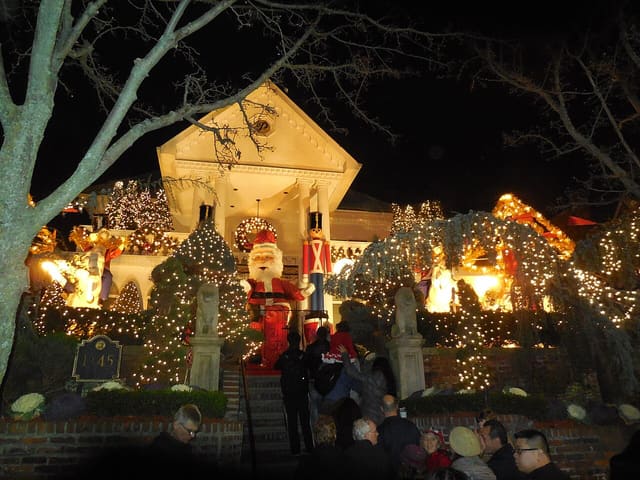
Dyker Heights Christmas Lights Walking Tour
Walk the glowing streets where neighbors turned Christmas decorating into a Brooklyn tradition.
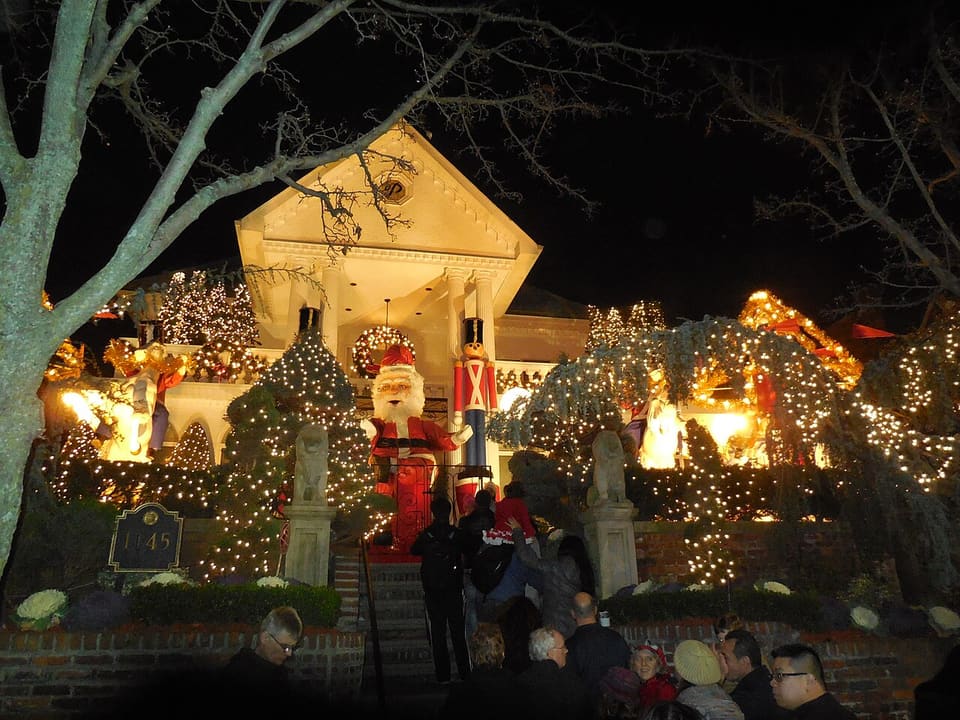 Photo: Photo: HeatherMarieKosur, CC BY-SA 4.0, via Wikimedia Commons
8220 11th Avenue, New York, New York
Dyker Heights is a predominantly residential neighborhood in the southwest corner of the borough of Brooklyn in New York City. It is on a hill between Bay Ridge, Bensonhurst, Borough Park, and Gravesend Bay.
You're standing at 11th Avenue and 82nd Street, near the very top of the hill that gave Dyker Heights its name. It doesn't feel like a mountain, but at about 110 feet this is the highest natural ground in southwest Brooklyn. Look around at what's here: detached houses, driveways, private yards. In most of New York City, that's the unusual part. In December, all of it gets wrapped in light. But the lights are on a suburb that was planned long before anyone strung a single bulb.
This hill sat inside the Dutch town of New Utrecht, settled in 1657. It was too steep to farm, so it stayed common woodland, where townsfolk cut firewood and construction timber.
The first person to build a house up here wanted the hill for its view, and he wasn't admiring the scenery. In the late 1820s, Brigadier General René Edward De Russy, an Army engineer who built forts from the Canadian border to the Pacific, put his homestead on this summit. From here he had a clear view of the harbor and its defenses, especially Fort Hamilton, which he built and which was complete by November 1831.
De Russy died in 1865, and in 1888 his widow, Helen, sold the property to Jane Elisabeth Loveridge and Frederick Henry Johnson. Frederick was in real estate, and when he died in 1893, his second son, Walter Loveridge Johnson, took over the business. By October 1895 he had started Dyker Heights on the family's land, named for the Dyker Meadow and beach that it overlooks.
Try to picture what he started with. In 1890, the only roads here were Kings Highway, 86th Street, Denyse's Lane and a small unnamed road near Tenth Avenue, and none of them were paved. Johnson continued Brooklyn's street grid south with macadam pavement, graded the properties, and installed gas, water, telephone and electricity lines. He planted sugar maples, seven on the avenues and twenty along the streets. That opened more than two hundred building sites. His own house stood on the southwest corner of this very intersection.
His model was Bensonhurst-by-the-Sea, a nearby development once called the most perfectly developed suburb ever laid out around New York. Dyker Heights was meant to be the same kind of place, only on higher ground.
Johnson's house burned down before 1900, but his idea survived: a neighborhood of private family homes on quiet, tree-lined streets. That matters tonight. Every display you'll see is somebody's front yard and somebody's electric bill. So be a good guest: keep to the sidewalk, keep your voice down, and leave the driveways and lawns to the people who live here.
When you're ready, walk southeast about four minutes to the home of Lucy Spata, where one neighbor's decorations helped light the spark for the whole tradition.
Walk the glowing streets where neighbors turned Christmas decorating into a Brooklyn tradition.
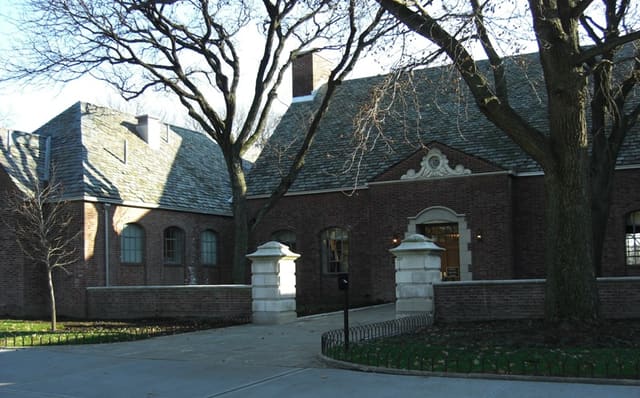
The Dyker Beach Park and Golf Course is a public park and a municipal, 18-hole, championship golf course in the…