The whole storyStop 4 of Salem 1692: The Witch Trials Walk
The Minister's Daughter Under the Towers
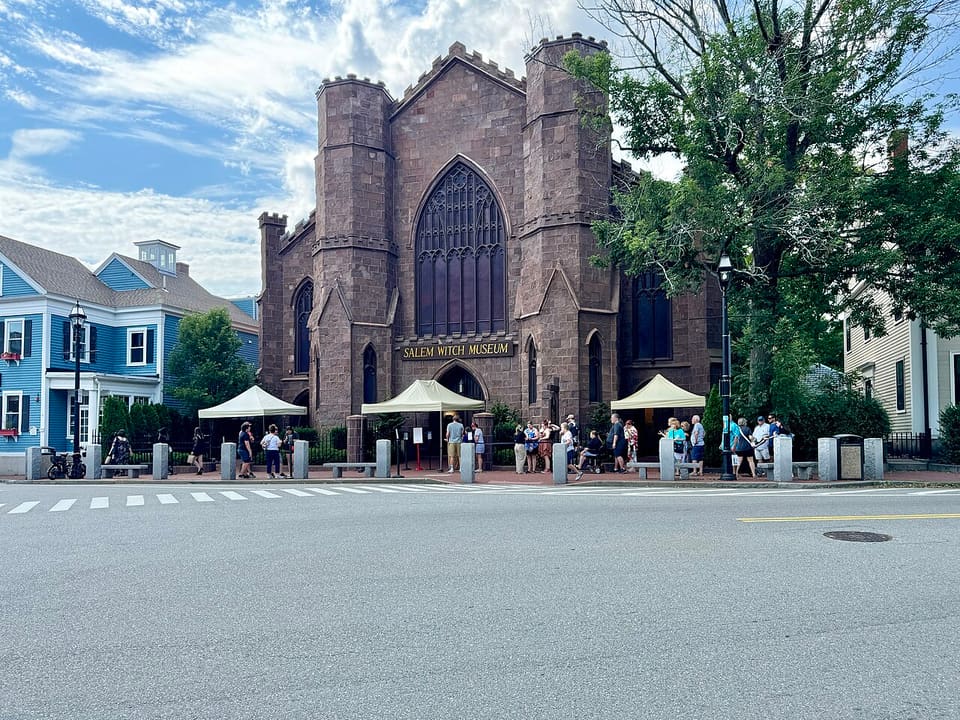
You're on Washington Square North, with Salem Common spread out behind you. The dark stone building in front of you, with its pointed-arch doors and corner towers topped with battlements, looks like a church because it was one. Look at those squat octagonal towers. They used to be taller. Fire cut them down, and nobody ever built them back up.
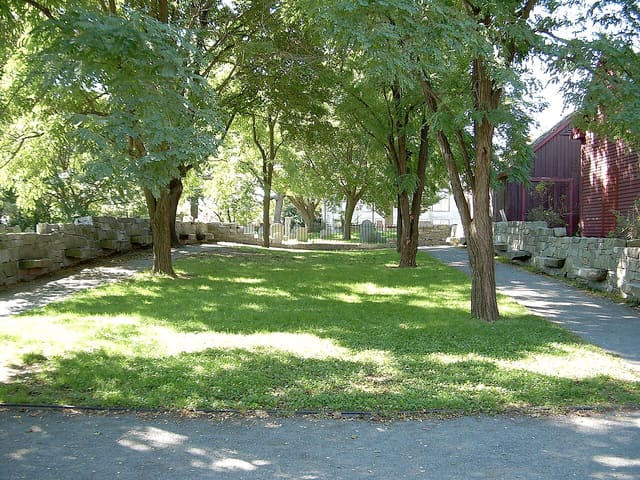
But start with the ground, not the building. In the late 1600s this was the home of Reverend John Higginson, Salem's elder minister. Living with him was his grown daughter, Ann Dolliver. Ten years before the trials, Ann had married a Gloucester fisherman named William Dolliver. He walked out on her and their three children. Ann came back to Salem penniless and moved in with her father and stepmother, right here.
On June 6, 1692, Ann Dolliver was accused of witchcraft. Think about who that makes her. She was the daughter of the town's senior minister, a man who had himself sat in on examinations that year, including the questioning of four-year-old Dorothy Good. Being a minister's daughter didn't protect her. Ann was arrested, jailed and examined. She never came to trial, and she came home to this spot on the Common. But she didn't come home whole. Her father described her as "crazed in her understanding," and she struggled with melancholy for the rest of her life.
After the trials ended, Reverend Higginson wrote an introduction to a book by another minister, John Hale, looking back on 1692. He hoped that whatever errors they had fallen into, in what he called "the dark hour of Temptation," might be acknowledged and disowned, as "Warning & Caution to those that come after us."
Then the site moved on. The Higginson house is gone. In the 1840s the East Church put up this building. By 1957 the church had left, and the place became the Salem Auto Museum, which meant a 1924 Rolls Royce, a replica ice cream parlor and old fire pumpers parked under Gothic arches. A fire in 1969, the building's third serious one, closed that down.
In 1972 it reopened as the Salem Witch Museum, founded by Holly and Tom Mulvihill. Here's where the story of 1692 turns into something else. This museum largely managed the creation of the city's witch trials memorial in 1992. It also helped launch Haunted Happenings in 1982, Salem's month-long Halloween festival. And in 2024, USA Today ranked it the second biggest tourist trap in the world, based on online reviews.
Both things are true. The museum says its mission is to be the voice of the innocent victims. It also helped turn their deaths into an October crowd. So as you look at those cut-down towers, remember Ann Dolliver, who survived 1692 and never recovered from it, and her father's hope that the people who came after would take it as a warning.
Hear it where it happened. It plays at stop 4 of Salem 1692: The Witch Trials Walk (3 min), narrated as you walk. Unlock the tour for the audio, or try stop 1 free first.