The whole storyStop 2 of Gettysburg Battlefield Driving Tour
Twenty-Five Years to Light a Flame
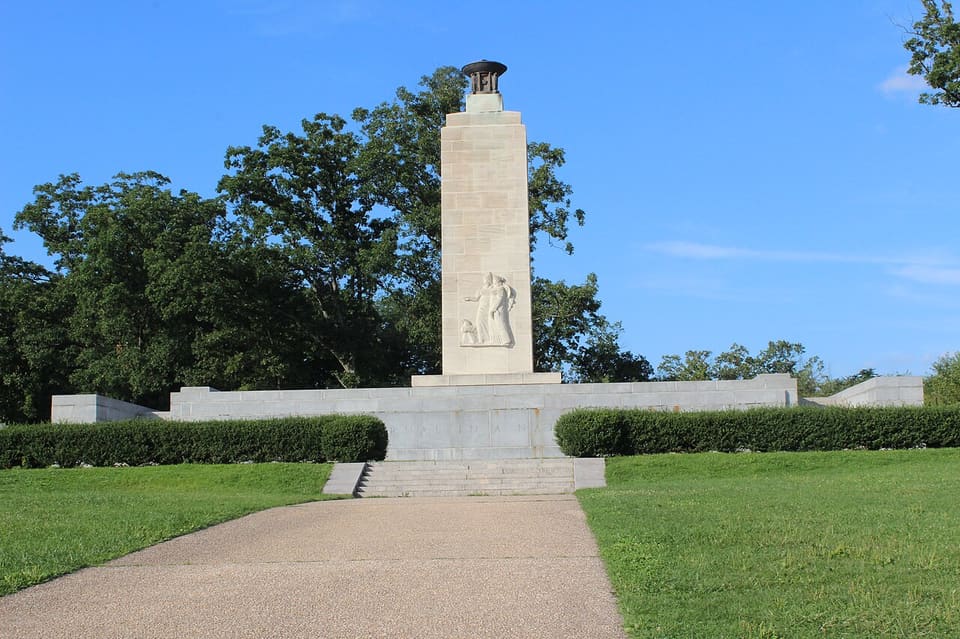
You've pulled up on Oak Hill, on the northwest edge of the Gettysburg battlefield. In front of you a pale stone tower rises from a terrace, and on top of it sits a bronze urn that weighs about a ton. That urn holds a flame. Below it are carved the words Peace Eternal in a Nation United. On a clear day that flame is said to be visible from twenty miles away. The idea behind it took twenty-five years to get here.
It starts in 1913, fifty years after the battle. Thousands of old soldiers came back to Gettysburg for a great reunion. On July 3, the anniversary of Pickett's Charge, a Union artillery veteran named Colonel Andrew Cowan stood up in the reunion's Great Tent. He made a speech calling for a peace memorial on this field. Steps were taken right away, an association was formed, and by December a bill was in front of Congress.
Then the money stalled. The plan was a monument worth a quarter of a million dollars at The Angle, the spot Pickett's men reached. Federal funding stayed postponed, and the idea waited.
The money finally came from the states. Virginia paid first, in 1936. Pennsylvania followed, then New York, Indiana, Tennessee, Illinois and Wisconsin. The planners had eyed Big Round Top, but the monument was finally built here on Oak Hill. The grand monument shrank to sixty thousand dollars.
On July 3, 1938, a quarter of a million people came to see it dedicated. Another hundred thousand tried and never made it, because the roads were jammed. President Franklin Roosevelt spoke for nine minutes. As he finished, at sunset, the memorial, draped in a fifty-foot flag, was unveiled by two men. George Lockwood had fought for the Union. A. G. Harris had fought for the Confederacy. Both were 91. A photocell lit the flame.
The image of Blue and Gray unveiling it together was the picture of the day. It was also only part of the story. Reunions like this were about white veterans making peace, and they often left out what the war had been fought over. But as Roosevelt walked to his car, he stopped to speak with the oldest veteran there. His name was William Barnes, and he had served in the US Colored Troops. He was 112.
The flame hasn't burned without a break. It was reduced to a pilot light during World War II and put out in 1974 during the oil crisis. In 1988 the gas flame was restored. And before a peace conference in 1946, President Truman remarked on that motto and said to change one word, nation to world, and we'll have something.
When you're ready, drive southeast on Confederate Avenue, bear left onto Mummasburg Road, turn right onto North Washington Street, then turn right onto West Middle Street. It's about eight minutes to Seminary Ridge, where Lee's guns lined up.
Hear it where it happened. It plays at stop 2 of Gettysburg Battlefield Driving Tour (3 min), narrated as you walk. Unlock the tour for the audio, or try stop 1 free first.