The story
A Gardener's Shed Grows a Pirate
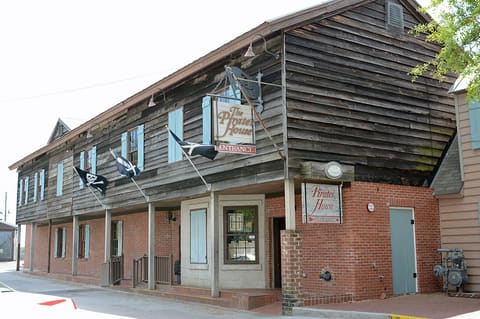
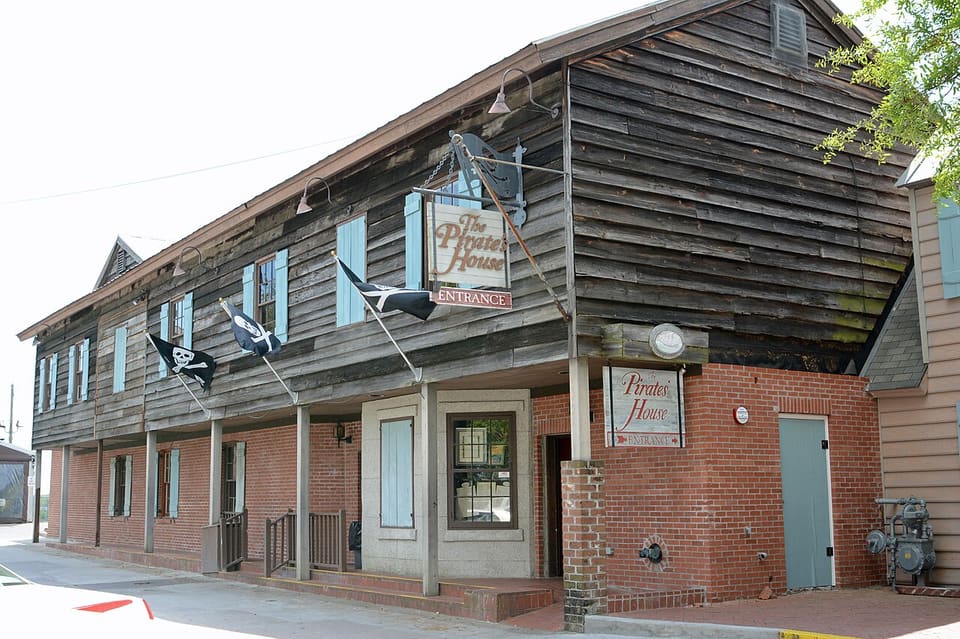
Stop 1 · The Pirates' House · 3:03You're standing on East Broad Street, at the eastern edge of old Savannah, in front of the Pirates' House. It's a cluster of buildings now, a restaurant with fifteen dining rooms. Find the smallest, plainest part of it, the modest building called the Herb House. That's where this story starts. It begins with a gardener, and ends with a ghost who never existed.
James Oglethorpe, the Englishman who led Georgia's first colonists, arrived here in 1733. Just east of his new town he set aside about ten acres for an experiment. It was called the Trustees' Garden, after the men in London who ran the colony, and it was modeled on the Chelsea botanical garden in London. Oglethorpe gathered plants from around the world: indigo, spices, medicinal herbs, cotton, and above all mulberry trees, because Georgia was supposed to make silk.
The silk never came. The soil and the weather defeated the mulberries, and wine failed too. By the late 1730s the garden had fallen out of use. But two of its crops outlived it. The garden handed out peach trees, and Georgia is still known for them. And it grew cotton very well. Cotton became the backbone of Georgia's economy, and it was planted and picked by enslaved people. That is part of what began in this small patch of ground.
Once the garden was gone, the land was built over. Savannah was a busy port, and the river is only a short walk north of you. The restaurant says one of the first things built here was an inn for sailors, opening around 1753. The legend grew from there: pirates drinking in back rooms, and drunk sailors carried off through tunnels to ships waiting on the river. When the building was remodeled, workers did find a secret chamber underneath it. To this day, nobody knows what it was for. That's the documented part. The kidnapped sailors are the story laid on top of it.
Even the age of that little Herb House is disputed. One account says it went up in 1734, to house the garden's gardener, who slept in the hayloft upstairs above his tools. Another dates it to 1853. Both can't be right, and the plaque-friendly date tends to win.
The pirates got a boost from fiction, too. In Robert Louis Stevenson's 1883 novel Treasure Island, Captain Flint dies in Savannah, and local lore put his last days here. Staff tales say his ghost still walks the rooms, which is quite a feat for a man who never lived.
The buildings were nearly torn down in the 1940s. The Savannah Gas Company owned the land, and Mary Hillyer, the wife of the company's president, pushed to save them. In 1953 the place opened as the restaurant you see. A gardener's shed, a sailors' inn, and a secret room nobody can explain.
When you're ready, walk south on East Broad Street, about eleven minutes, to the Marshall House, a hotel whose walls hold a much darker medical past.