The whole storyStop 4 of Gettysburg Battlefield Driving Tour
The Hill Nobody Was Holding
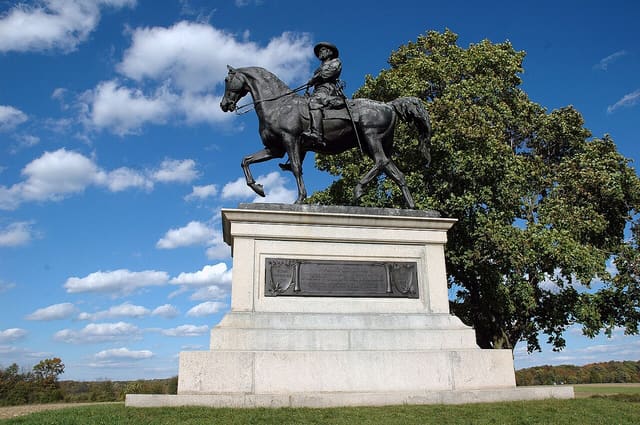
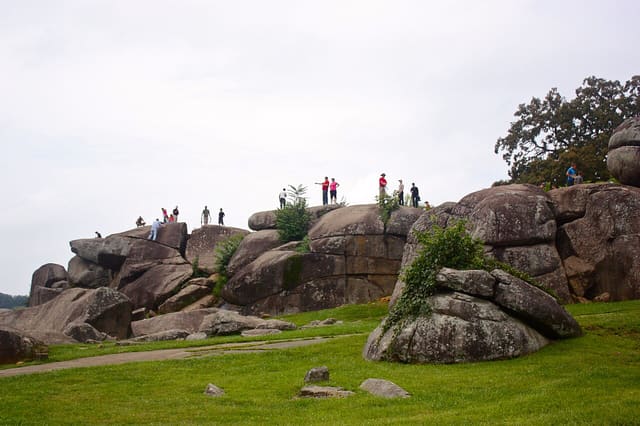
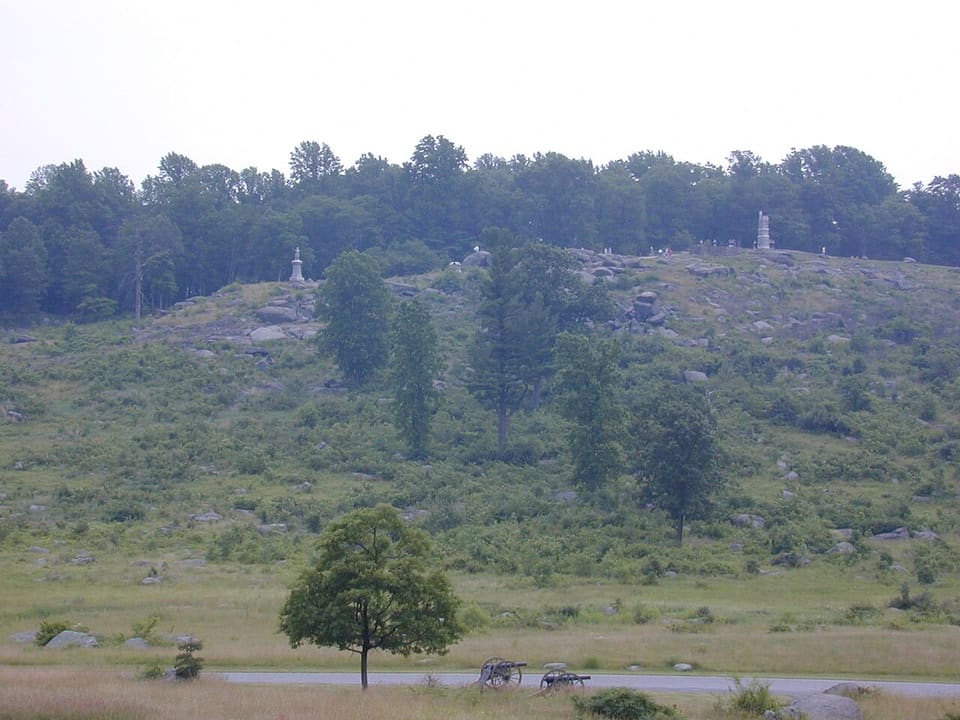
You're on Sykes Avenue, on the rocky hill everyone now calls Little Round Top. If you've pulled over and parked, look at the boulders scattered down the steep western slope, and at the bigger, thickly wooded hill just to the south. That's Big Round Top. On the afternoon of July 2, 1863, the hill under your wheels was the far left end of the entire Union army. And for a while that afternoon, almost nobody was on it.
General George Meade, commander of the Army of the Potomac, had ordered General Daniel Sickles to defend the southern end of Cemetery Ridge, which would have just included this hill. Sickles, defying orders, moved his corps forward to the Emmitsburg Road and the Peach Orchard. That left this hilltop undefended, with only a small Signal Corps station on it.
Meade sent his chief engineer, Gouverneur Warren, to deal with the situation south of Sickles' position. Warren climbed this hill and saw the glint of bayonets in the sun to the southwest. A Confederate assault on the Union flank was imminent. Warren hurried staff officers off to find help from any units nearby.
Help was ordered toward the hill, but the messenger ran into a colonel first. Strong Vincent, a brigade commander, seized the initiative and sent his four regiments to this hill without waiting for permission. He galloped ahead with his bugler to guide them into position.
At the end of his line, on the southern slope, Vincent put the 20th Maine under Colonel Joshua Chamberlain, a college professor from Maine who had volunteered for the war.
The men climbing toward them were Confederates who had marched a long way that day, and the verified record says more than 20 miles, with empty canteens. Chamberlain's 20th Maine held its position for about ninety minutes. Then it ended the fight with a dramatic downhill bayonet charge.
Chamberlain won the Medal of Honor and the fame. Vincent, whose brigade successfully defended the hill, was mortally wounded here and died five days later. General Stephen Weed was mortally wounded on this hill too.
Even the name is a surprise. There is no evidence soldiers or civilians used "Little Round Top" during the battle. Accounts written in 1863 call it Rock Hill, High Knob, even Sugar Loaf Hill. Historian John Bachelder favored Weed's Hill, in honor of the general who fell here, but dropped it by 1873. One of the first public uses of "Little Round Top" came from Edward Everett, in his oration at the dedication of the Soldiers' National Cemetery on November 19, 1863.
When you're ready, drive north on Sykes Avenue, turn left onto Wheatfield Road, then left onto Crawford Avenue, about four minutes. You'll be down among those boulders at Devil's Den.
Hear it where it happened. It plays at stop 4 of Gettysburg Battlefield Driving Tour (3 min), narrated as you walk. Unlock the tour for the audio, or try stop 1 free first.