The whole storyStop 2 of Route 66 in Arizona: Painted Desert to Oatman
A Motel Paid For in Dimes
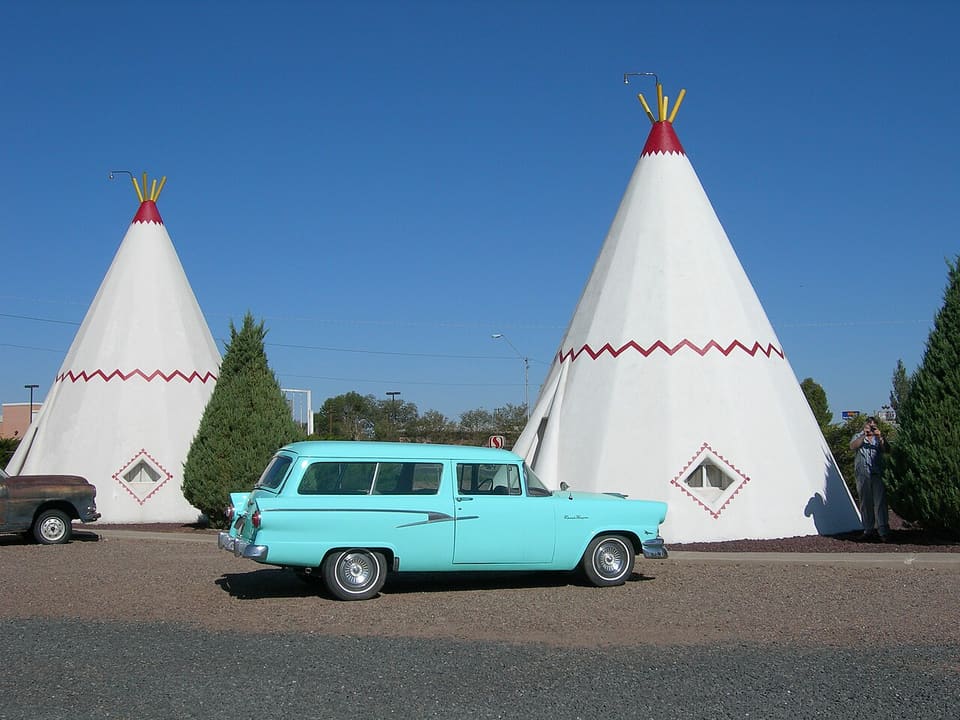
You're on West Hopi Drive in Holbrook, the old Route 66 through the middle of town. Look straight ahead: white concrete cones, each about 32 feet tall, standing around a square. Now look at the old cars parked beside them, as if their owners just checked in.
The man behind this place was Chester Lewis, an Arizona motel owner with a long memory.
In 1938, Lewis was passing through Cave City, Kentucky, and saw something he couldn't forget: a motel built as a ring of giant tipis. It was the work of Frank Redford, who had started out adding tipi-shaped units around a museum-shop built to house his collection of Native American artifacts. Redford owned the design patent, so if you wanted his buildings, you had to deal with him. The places were called Wigwam Villages, though the shape is a tipi, and the name is a mistake that stuck.
Lewis wanted one on Route 66, and he had a clever way to pay for it. He struck a royalty deal with Redford for the design and the name. Coin-operated radios would go into the rooms, and every dime a guest dropped in for 30 minutes of music would be sent to Redford. A motel, in effect, paid for in dimes by motorists who wanted the radio on.
Lewis opened his Wigwam Village here in 1950. It is Village Number 6, one of seven the chain once had, and today one of only three left.
Then the road moved. In 1974, Interstate 40 bypassed downtown Holbrook, and the motel closed. Lewis died in 1986. Two years later, his children Clifton, Paul and Elinor reopened it, and the cones have been taking guests since.
Say this plainly, too: the whole idea borrows the look of Native American life as a roadside gimmick, and a tipi has little to do with this part of Arizona. Native people are not a chapter that ended before the motel arrived. They are here now. Holbrook has a Navajo name, Tʼiisyaakin, and Navajo, Hopi and other Native communities remain part of this region today. Treat the cones as a piece of Route 66 showmanship, not as a picture of the people who live around them.
Still, the house style is part of the fun. You call the units wigwams, not rooms or tepees or cabins. They're numbered 1 to 16, but there is no Number 13. Even a motel built as a gimmick knew better than to push its luck.
When you're ready, drive west, mostly on I-40, about 32 miles to Winslow, and a street corner that one song made famous.
Hear it where it happened. It plays at stop 2 of Route 66 in Arizona: Painted Desert to Oatman (3 min), narrated as you walk. Unlock the tour for the audio, or try stop 1 free first.